
 Worksheets
Geological Evidence Quizizz Review
Total questions: 30
Worksheet time: 2hrs 30mins

Scientists have discovered hundreds of fossils of tropical plants in harsh, cold environments such as Antarctica. What could be the BEST conclusion made by the discovery of these fossils in this environment?
People who have traveled to Antarctica brought tropical plants with them
Tropical plants can survive in harsh, cold environments
The climate in this area was once warm and tropical and has changed over the years
The movement of glaciers carried these fossils to their current location

A scientists discovered the fossils in a sedimentary rock layer of a hill. How has this environment likely changed?
It was first covered by water and then became land
It was first covered by land and then became an ocean
It was first covered by a lake and then became an ocean
It was first covered by land and then became a hill
Several students were studying 2 different fossils that came from different rock layers. What could these students determine based on their observations of these fossils?
How the organisms died
The type of environment the organisms may have lived
The time in which these fossils were discovered
The absolute age of the fossils
Many Scientist believe that dinosaurs evolved and replaced their non-dinosaur ancestors. Recently, Scientist concluded that dinosaurs lived at the same time as some non-relative organisms. What evidence could help support this recent conclusion?
Very little amphibians were discovered before the dinosaurs
Most amphibians and reptiles were discovered after the dinosaurs
Several different types of fossils were found in the same rock layer as the dinosaurs
Many fossils found before the dinosaurs were much larger than the dinosaur fossils discovered

Fossils of the reptile Mesasouras have been found on continents separated by the Atlantic Ocean. What is the most likely explanation?
This animal lived when all the continents were joined
This animal swam across the Atlantic ocean
This animal migrated from Africa to South America when a predator began attacking this animal
Ocean currents carried this animal across the ocean
Fossil types and distribution of fossils can tell scientist what?
Ancient region's climate and environment
Ancient region's land to water ratio
Current plate and animal life
A chemical composition of a rock layer
Marine fossils were found in a mountainside. What conclusion could be supported by this evidence?
The climate was dry and the organisms had to evolve to live on land
These organisms migrated to land when sea levels dropped
The current climate is tropical and warm
Earth's environment has changed over millions of year
All of these things make the best index fossils except for ---.
Fossils that lived for a short period of time
Fossils that lived in many time periods
Fossils that are widespread
Fossils that are unique
Fossil evidence has mainly been used to do what?
Explain how the Earth's environment is currently
Subdivide geologic time into units or periods
Identify unconformities in rock layers
Explain catastrophic events that have happened in the past and today
Many fossils that probably lived in the ocean were found in a mountain range. What can be concluded regarding the place in which these fossils are found?
The mountains were once covered by the sea at some point in the past
The mountains were once covered by glaciers at some point in the past
The mountains were once covered by desert land at some point in the past
The mountains were dry and cold in the past
Pieces of rock and a huge crater were discovered in the Yucatan peninsula. It is believed this discovery was from the giant asteroid that struct Earth almost 65 million years ago. What did this catastrophic event cause?
The ocean levels to rise covering the entire Earth with water
Caused the start of a series of volcanic explosions
Caused a mass extinction of many life-forms at the time
Caused all of the continents to collide to form one large landmass called Pangea

A student studies the geologic time scale and concluded that the dinosaurs became extinct due to humans. Why is the student's claims wrong?
Dinosaurs suddenly evolved into aquatic animals leaving the land for the sea
Dinosaurs died due to the loss of food sources during the Jurassic Period
Dinosaurs evolved into humans after the Cenozoic Era began
Dinosaurs did not exist at the same time as humans according to the time scale

A researcher examines fossils found in some rock layers. The fossils shown were found in undisturbed layers of rock. Which fossil is the youngest?
Trilobites
Armored fish
Dinosaurs
Early horses
Much of the evidence that is used to support evolution of life on Earth is obtained by -------.
Studying fossils preserved in rock
Radioactive dating of rock
Relative dating of rock
Absolute dating of rock


Which makes a good index fossil?
a fossil not commonly found in rocks
a fossil that lived throughout geologic time
a fossil that lived during three geologic time periods
a fossil that lived during only one geologic time period and commonly found on many continents

A
B
C
D

What is a likely event that occurred between fossil layers B and D?
explosion of new species
mass extinction
can not tell from the image
small changes to the environment
Which of the following can be learned by using the fossil record?
When organisms changed or evolved
when organisms appeared on Earth
when organisms became extinct
All the above

What type of fossil is formed when water and minerals soak into buried remains in sediment, replacing the remains and crystalizing them changing them into rock?
Carbon Film
Preserved Fossils
Petrified Remains
Trace Fossils

A geologist uncovered several fossils while digging in a mountain side. He observed these fossils and determined that they could have been formed at the end of the Paleozoic Era or the beginning of the Mesozoic Era. How old would these fossils have to be in order to support this observation?
240 million years old
500 million years old
1.6 million years old
330 million years old

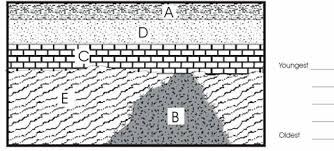
What is the relative age of the igneous intrusion?
The igneous intrusion is younger than layer E
The igneous intrusion is older than layer E
The igneous intrusion is the same age as layer C
The igneous intrusion is older than layer F

