
 Worksheets
CP Quiz: Forces Intro Notes
Total questions: 67
Worksheet time: 42mins
A support force directed straight out of a surface at a 90 degree angle is called what force?
normal
friction
tension
gravitational
An attractive force between you and the Earth
normal
friction
tension
gravitational
A force that either prevents sliding or slows something down that's already sliding because it is RUBBING against each other for two or more objects.
normal
friction
tension
gravitational
A pulling force that is transferred through a solid object like a rope or a chain
normal
friction
tension
gravitational
A force is defined as
a beast of an individual
a push or pull
a magic power from the science fiction world
What is the SI unit for Forces
Newton
Grams
Frix
Mass
what the name of the force that acts between two objects rubbing together
Tension
Compression
Friction
Gravity
The GENERAL name for Forces that act between two objects that are physically TOUCHING each are called?
gravity
contact forces
tension forces
non-contact forces

the picture shows an example of which force?
Tension force
Contact force
compression force
friction force
FORCES THAT DO NOT REQUIRE DIRECT TOUCHING ARE CALLED "FIELD FORCES" OR NON-CONTACT FORCES. AN EXAMPLE OF ONE WOULD BE....
Gravitational force
Applied force
Normal force
Tension force
What scientist is famous for laws of motion and had a unit of FORCE named after him?
Einstein
Hawking
Rodd
Newton
Which has the MOST inertia?


Objects with greater _________ also have greater inertia.
speed
mass
force
friction
Which one has the LEAST inertia?


Things keep doing what they are already doing is Newton's first law, It is also called the law of ______
thirds
seconds
gravity
Inertia
Newton's 2nd law, says that Force is the produnt of mass times _________
mass
Force
Acceleration
weight
According to Newton’s Third Law, for every action there is an equal and opposite
force
energy
reaction
time
If an object is at rest, what must be applied to get it moving?
force
acceleration
mass
speed
A squirrel has a weight of 4.9 N. What is his Mass if he is running on the Ground?
4.9 kg
9.8 N/kg
0.5 kg
5.0 kg
______ is explained as a push or pull motion
Force
Friction
Gravity
Weight
______ is the attractive force between any two objects that depends on the objects mass and distance to each other.
Weight
Gravity
Net Force
Rolling Friction
You fly to Venus and research if life can exist there. Your mass is 100 kg and have a weight of 90 N what is the Gravitational strength of Venus?
900 N/kg
9 N/kg
0.9 N/kg
9000 N/ kg
______ is the gravitational force exerted on an object
Mass
Gravity
Force
Weight
What are the units for Weight?
Kg
N
N/kg
Joules
What is the weight of a 0.456 kg object?
456g
0.456kg
4.56N
456N
Find the weight of a 20g object
200N
20g
0.2N
0.02kg
What statement is true?
Mass never changes. Weight does.
Weight never changes. Mass does.
Both mass and weight change because they are affected by gravity.
Neither mass nor weight change. They are always the same.
Find the weight of a 5kg rock on Mercury with a gravitational pull of 3.59m/s/s.
5kg
17.95N
1.39N
0.718N
Find the mass of a 5kg rock on Mercury with a gravitational pull of 3.59m/s/s.
5kg
17.95N
1.39N
0.718N
Which formula would you use to calculate weight (Fg)?
mass/gravity
gravity/mass
weight-mass
mass x gravity
If you have an empty box and then fill it with books, which statement is true about the box?
The mass and weight are directly proportional and both increase.
The mass increases and the weight decreases because they are indirectly proportional.
The weight increases but since mass doesn't change it stays the same.
Gravity pulls less on the box when it is full so it weighs less.
the tendency of an object to resist a change in its motion
acceleration
inertia
mass
frame of reference
Inertia is the tendency of an object to resist a change in its ___________.
temperature
shape
size
motion
Inertia is a force
True
False
Inertia is Newton's _______ Law of Motion.
First
Second
Third
What is the relationship between heavy objects and inertia?
Only heavy objects have inertia.
Heavy objects have more inertia.
Heavy objects have less inertia.
Heavy objects have no inertia.
Inertia tells us that we need ____________ to get an object moving or to make it stop.
a force
gravity
friction
strength

Diagram 3 shows a cat chasing a rat. The inertia of the cat is bigger than the rat because.
The size of the cat is bigger than the rat
The length of the cat is more than the rat
The mass of the cat is bigger than the rat
Which phenomenon shows the effect of Inertia?


Which of the objects listed below have the greatest inertia?
A 500 kg object that is not moving.
A 300 kg object that is not moving on the Moon.
A 250 kg object moving at 25 m/s.
A 700 kg object moving at 3 m/s.

While you’re ice-skating with your friends, you push off from one end of the rink and slide forward. Based on Newton’s first law of motion, what is true?
You will lose your balance and fall over before you reach the middle of the ice rink.
You will continue to slide across the ice until a force makes you stop or change direction.
The force of gravity will make you keep your velocity until your friend makes you stop.
The size of your ice skates will determine how quickly or slowly you travel across the ice.

Diagram shows the two tins of the same size oscillating after they are released from the same height. After a while the tin filled with sand is still oscillating while the empty tin has stopped. What is the inference can be made for this experiment?
The tin filled with sand has the biggest inertia
The tin filled with sand has the smallest inertia
The tin filled with the sand experience bigger air resistance
The tin filled with the sand experience smaller air resistance
Seat belt is needed for safety purpose in a vehicle. What is the use of the seat belt?
To increase the effect of inertia
To reduce the effect of inertia
To increase the effect of momentum
To decrease the effect of momentum
Which phenomenon shows the effect of inertia on a moving object?
A racing car can go faster than an ordinary car
An aeroplane can fly higher than a helicopter
A smaller car takes shorter time to stop the car completely compare to a lorry
Bigger effect on the small vehicle in an accident
Which of the following can reduce the effect of inertia in an accident?
Install a long car bumper
Install air bag
Drive a vehicle with a long crumple zones
Drive a higher car
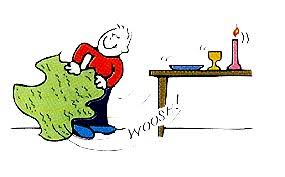
Which explains why the tablecloth trick works?
The dishes are stuck in place due to air resistance.
The tablecloth is an ilusion.
The dishes have inertia, and therefore stay on the table.
magic

Which action increases the inertia?
Use a rougher card /
Use a smooth card /
Pull the card with greater force /
Change the coin to a heavier coin /

While riding in my car, I notice the dice hanging from the mirror swing to the left. What force is pushing the dice to the left?
tension
gravity
velocity
there isn't a force pushing it left

What direction is the car (the frame of reference) accelerating?
Forward
Backward
Right
Left

How is it possible for this car to be accelerating to the right?
It can't.
It's sliding.
It's turning.
It's tipped over on its right side.
What is inertia?
Objects changing their motion on their own.
Objects moving in a straight line.
Objects staying still when they are acted on by a force.
Objects not changing motion unless acted on by an unbalanced force.
A car moves at a constant speed without changing direction. What HAS to be true about the forces on the car?
A force is pushing the car in the direction it's moving.
The forces on the car are not balanced.
The forces on the car are balanced.
Forces push on the car in all directions.

Sara swings a bucket full of water around her head. The water doesn't spill out of the bucket. Why not?
A force is pushing out on the water.
Inertia causes the water to move in a straight line.
A force is pushing out on the bucket.
The water would spill out of the bucket.
T
A ball is sitting still on a plate. How could the ball start moving?
The ball's inertia disppears.
All the forces on the ball stop.
A new, balanced force acts on the ball.
A new, unbalanced force acts on the ball.
A

A driver stops suddenly at a red light. He is thrown forward against the seatbelt. Why?
A force pushes him forward when he stops.
The force of the seatbelt pushes him backwards.
A force pushes the whole car forward, including the driver.
The force of the brakes stops the car, but not the driver.
A car runs into a wall. What will happen to the people in the car?
They will be pushed backwards by the force of the wall.
They will be thrown forward because of the force of the car.
They will keep moving forward until they hit their seatbelt or the dashboard.
They will be pushed in all directions equally.
A car turns left suddenly. The drink in the drink holder falls over onto the person sitting in the right-hand seat. Why?
The car turns left, but the drink continues going straight, tipping it to the right.
The car turns left, and the drink is pushed in the opposite direction.
The car turns left, and the force causes the drink to move. It could have fallen either way.
The force of the turn pushes both the car and drink to the left, but the drink isn't pushed as much.

What is inertia?
the force that opposes motion
the force of attraction between 2 objects
an object's tendency to stay in its state of motion
a change in an object's speed and/or direction

