
 Worksheets
Newton's Laws
Total questions: 68
Worksheet time: 1hrs 7mins

Sir Isaac Newton lived from ____ to ____.
1642 - 1726
1824-1876
1902 - 1979
1066 - 1107
1202-1267
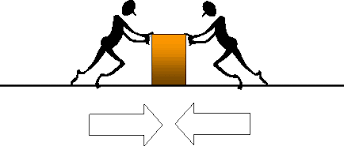
All objects have inertia
True
False
Inertia depends on ______
Velocity
Speed
Distance
Mass
More mass = More inertia
True
False
Inertia is the tendency of an object to resist a change in its ___________.
temperature
shape
size
motion
the tendency of an object to resist a change in its motion
acceleration
inertia
mass
frame of reference
According to Newton’s first law of motion, a moving object that is not acted on by an unbalanced force will
remain in motion, in a straight line @ a constant speed.
eventually come to a stop.
change its momentum in a straight line @ a constant rate.
accelerate.
Which of these best describes why your weight (on Earth) would change on another planet?
weight doesn’t change, no matter where you are
different planets have different gravitational pulls based on their mass
In general, the smaller the planet, the greater weight
dehydration effects on different planets change weight
1st
Law of Motion
2nd
Law of Motion
3rd
Law of Motion

Which law helps explain why we must wear a seatbelt (because an object in motion wants to stay in motion)?
Newton's First Law
Newton's Second Law
Newton's Third Law
Newton's Fourth Law
Cam Newton's Law of Panthers
According to the Newton’s Universal Law of Gravitation, the force of gravity between two objects is directly proportional to
The distance between the objects.
The product of the masses of the objects.
The gravitational constant.
The square of the distance between the objects.
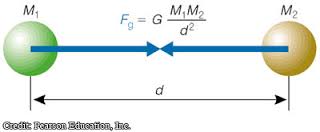
Which configuration will result in the greatest gravitational force?
small masses far apart
large masses far apart
small masses close together
large masses close together

Newton's Third Law of Motion states that forces
always act in equal or opposite pairs
equal mass times velocity
act on an object to move it or to stop it.

Two factors effecting the strength of gravity between 2 objects are...
weight and mass
distance and weight
mass and matter
mass and distance
What prevents planets from drifting off into space and keeps it in the planets in our Solar System?
Gravity
Weight
Friction
Forward Motion

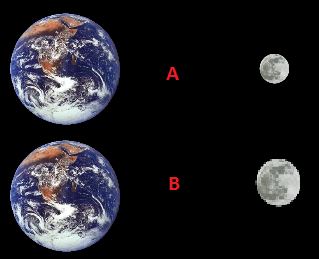
Which system has the greater gravitational attraction between the two objects (if any)?
System A
System B
Same gravitational attraction for System A and System B
Is gravity a push, a pull, or both?
push
pull
both
Mass is...
A force
The amount of matter in an object
Measured in Newtons
Measured in grams or kilograms
Weight is...
A force
The amount of matter in an object
Measured in Newtons
Measured in grams or kilograms
Caused by gravity pulling masses together
On a planet, an object's weight force always acts...
Downwards
Towards the centre of the planet
Upwards

What would happen to Earth if there were no inertia?
Earth would crash into the sun
Earth would fly out to space
Earth would collapse
Earth would orbit the moon


An archer pulls the bowstring back, then releases the string and the arrow flies forward. Pulling the string back is the...
action force
reaction force
net force
inertia

A cannonball with a mass of 1 kg is flying at an acceleration of 10 m/sec/sec. What is its force?
(F=ma)
100 Newtons
10 Newtons
20 Newtons
9.5 Newtons
More mass = Less inertia
True
False
Which of the following statements best describe Newton's 3rd law?
For every action, there is a reaction
When forces balance out, it is due to a reaction force
For every force acting on an object, there is an equal and opposite force acting on the object that caused the force.
Forces on a singular object balance out

As the hammer hits the nail downwards, the hammer experiences an upward force exerted by the nail.
True
False
Which diagrams show action-reaction pairs. Choose more than 1 answers.


Determine the reaction force involved when a ball is hit with a racket with a force of 100 N west.
a force on the ball of 100 N east.
a force on the ball of 100 N west.
a force on the racket of 100 N east.
a force on the racket of 100 N west.

Calculate momentum.
mass = 2 kg
velocity = 6 m/s
4 kg m/s
8 kg/m/s
12 kg m/s
26 kg m/s
8 momentum units
Calculate momentum.
mass = 2 kg
velocity = 4 m/s
4 kg m/s
8 kg/m/s
12 kg m/s
26 kg m/s
8 momentum units
Calculate momentum.
mass = 3 kg
velocity = 4 m/s
4 kg m/s
7 kg/m/s
12 kg m/s
26 kg m/s
8 momentum, tum, tum, tums
Calculate momentum.
mass = 1 kg
velocity = 4 m/s
4 kg m/s
7 kg/m/s
12 kg m/s
26 kg m/s
8 TumTums



If a force of 50 Newton's was applied to an object with a mass of 500 grams (0.500 kg), what will the object's acceleration be?
Force = mass x acceleration
Acceleration = Force / mass
10 m/s2
.1 m/s2
100 m/s2
1 m/s2


