
 Worksheets
Reflection and Refraction
Total questions: 65
Worksheet time: 1hrs 5mins
What is the phenomenon of sending light back in the same medium called?
Refraction
Dispersion
Reflection
Diffraction
What type of image is formed by the actual intersection of light rays?
Diminished Image
Reflected Image
Virtual Image
Real Image
What type of lens is thicker at the center and thinner at the edges?
Concave Lens
Biconvex Lens
Biconcave Lens
Convex Lens
What does the refractive index represent?
Speed of light in a vacuum
Distance of the object from the lens
Ratio of speeds of light in two media
Angle of incidence
What is the principal focus of a lens?
Point where light rays converge
Center of the lens
Edge of the lens
Point of maximum divergence


Which of the following in the diagram is the refracted ray?
The speed of light in vacuum is _______ m/s
3x10⁸
3x10¹²
3x10⁶
3x10¹⁰

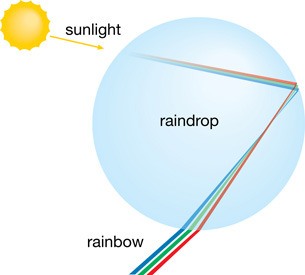
What type of reflection is shown in the image?
Regular reflection
Diffuse reflection
Total internal reflection
Which of the following statements is true about refraction?
Light does not bend as it passes from one medium to another.
Refraction is due to changes in temperature.
Light travels faster in glass than air.
Refraction is due to changes in the speed of light.

What do we call a material that light can travel through?
air
water
medium
pathway
What is the name of a line drawn at 900 to the surface of a material?
Boundary
Incident
Normal
Reflected
A light ray meets a plane mirror at 600 . What is the angle of reflection?
60 degrees
30 degrees
120 degrees
180 degress
A light ray passes from air into water at an angle of 300 . Which of these angles is likely to be the angle of refraction?
30 degrees
22 degrees
38 degrees
What happens to the speed of light when it passes from air into glass?
it increases
it does not change
it decreases
When a ray of light from air enters a block of glass at an angle, what change in direction will the ray take?
The ray will move towards the normal
The ray won't move at all
The ray will move away from the normal
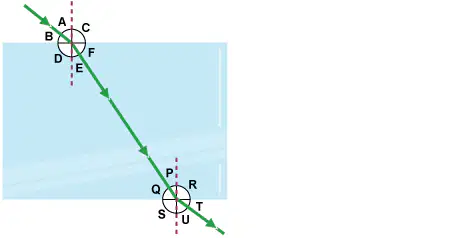
What letters indicate angles of incidence?
B and F
A and E
A and P
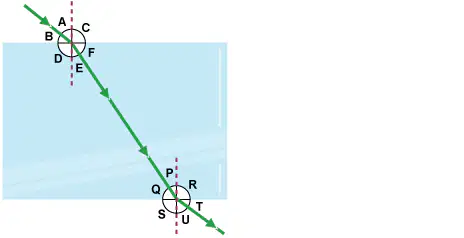
What letters indicates angles of refraction?
E and U
P and T
B and Q
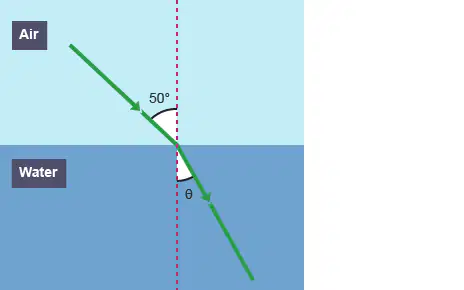
A ray of light is incident on the surface of water as shown in the diagram. Given that refractive index is 1.33, what would be the angle of refraction.
20 degrees
30 degrees
35 degrees
60 degrees
A light ray is directed at the vertical face of a glass cube. The angle of incidence at the vertical face is 390 and the angle of refraction is 250. What is the refractive index of glass?
1.0
1.3
1.5
2.0
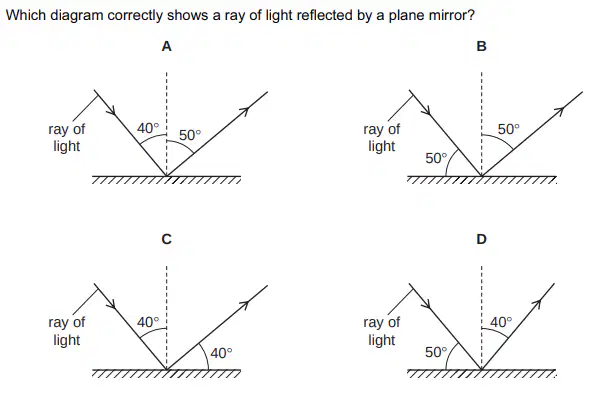
Which diagram correctly shows a ray of light reflected by a plane mirror?
A
B
C
D
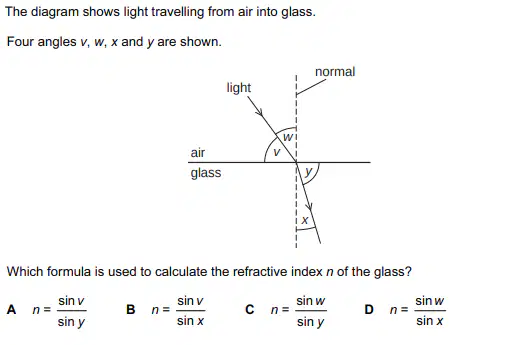
Which formula is used to calculate the refractive index,n of the glass?
A
B
C
D
Fiber optic cables work because of the principle of _____.
total internal refraction
incomplete internal refraction
total internal reflection
partial internal reflection

_____ cables transmit beams of light without allowing any of the light to escape until it gets to the end of the cable.
Ethernet
Fiber optic
Armored
Coaxial
When angle of incident (i) equals to critical angle (c) if light is traveled from a denser medium to a less dense medium,
total internal reflection occurs.
angle of refraction is equal to 90 degree.
light is refracted out
light travel in straight line

What happens to light during total internal reflection?
The angle of incidence is greater than the critical angle.
The angle of reflection is the same as the critical angle.
The angle of refraction is less than the critical angle.
The angle of incidence is zero.
An image behind the mirror is...
virtual
real
inverted
upright
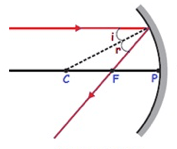
This ray diagram is for which mirror?
concave
convex
plane
window
Real images are :
Always inverted
can be larger or smaller than the object
can be obtained on screen
all the above
The side view mirrors on your car help shrink the image on both sides of the car, allowing you to see a larger field of view. What type of mirror is this?
a convex mirror
a concave mirror
a convex lens
a concave lens
An image that forms when light rays actually meet
virtual image
real image
diffuse reflection
regular reflection
Virtual images are
always upright
can be obtained on screen
always smaller
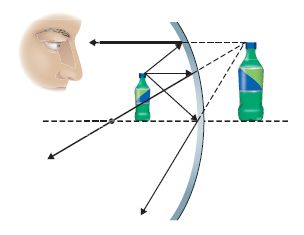
A diverging lens is also known as a ____lens.
refracted
diffracted
convex
concave
Which lens represents the path light takes through a diverging lens?


What type of image is formed?
virtual and inverted
virtual and upright
real and upright
real and inverted
Which ray diagram is correct for convex lens?


What are the three primary colors of light?
Red,Yellow,Blue
Red,Green,Yellow
Red,Green,Blue
Yellow,Blue,Green

Two polarizing filters are set up so the transmitted light is at a maximum intensity.
Through which angle should polariser 2 be rotated so that no light is transmitted?
45º
60º
90º
180º
Properties of waves are
I. polarization
II. diffraction
III. refraction
Which of these properties apply to sound waves?
I and II
II and III
I and III
All of them
Polarized glasses block __________ light.
horizontal
vertical
Polarized glasses allow __________ light to pass through.
horizontal
vertical
How do polarizing filters allow each eye to see separate images in the projection of 3-d movies?
No one really knows...
Each glasses lens is polarized the same and two polarized images are projected onto the screen
Each glasses lens is polarized 45 degrees from the other and two polarized images are projected onto the screen
Each glasses lens is polarized 90 degrees from the other and two polarized images are projected onto the screen

