wayground logo

Free Printable Worksheets

NEW

Font size

S
M
L
XL
Worksheets

Wave Review

Total questions: 60

Worksheet time: 54mins

Name
Class
Date
1.
The highest point on a wave is:
a)
the crest
b)
the trough
c)
the top
d)
the coast 
2.
The lowest point on a wave is the:
a)
Amplitude
b)
Crest
c)
Trough
d)
Wavelength
3.
The number of wavelengths that pass a point each per second is:
a)
frequency
b)
period
c)
longitudinal 
d)
transverse wave 
4.
The type of waves that require medium to pass:
a)
Mechanical Waves
b)
Electromagnetic Waves
5.
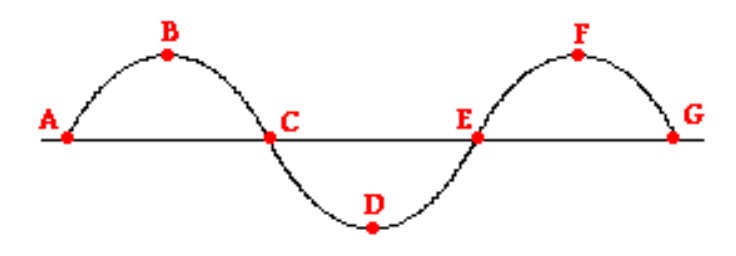
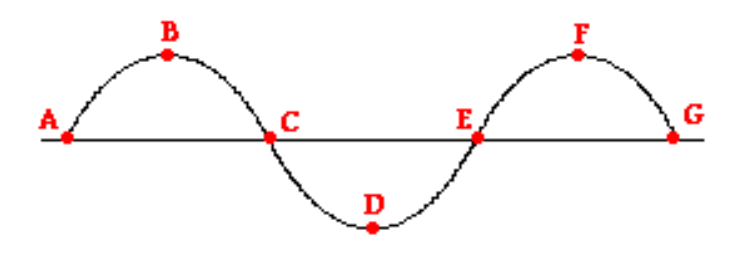
Which vocabulary term is used to identify the distance between points C & G?
a)
Amplitude
b)
Crest
c)
Frequency
d)
Wavelength
6.
When the frequency of a wave increases, what happens to the wavelength?
a)
The wavelength is not directly affected by the frequency of a wave.
b)
The wavelength increases.
c)
The wavelength decreases.
d)
More specific information is needed to form a conclusion about the wavelength.
7.
When the frequency of a wave increases, what happens to the wavelength?
a)
The wavelength is not directly affected by the frequency of a wave.
b)
The wavelength increases.
c)
The wavelength decreases.
d)
More specific information is needed to form a conclusion about the wavelength.
8.
A mechanical wave cannot travel through...
a)
a vacuum(empty space).
b)
water.
c)
air. 
d)
glass.
9.
Which letter(s) represent the trough of the wave?
a)
A
b)
B & D
c)
D
d)
C & G
10.
Which letter(s) represent the crest of the wave?
a)
A
b)
B & D
c)
B & F
d)
F
11.
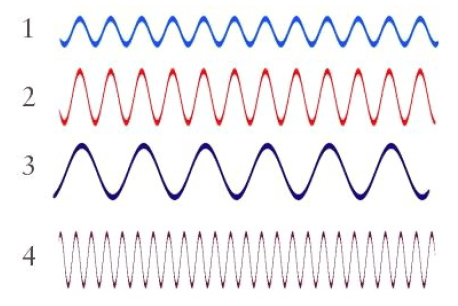
Which wave in the diagram has the greatest frequency?
a)
1
b)
2
c)
3
d)
4
12.
Which wave in the diagram has the greatest wavelength?
a)
1
b)
2
c)
3
d)
4
13.
Which of the following can sound travel through?
a)
solid
b)
liquid
c)
gas
d)
all of the above
14.
crest to crest or trough to trough
a)
crest
b)
trough
c)
amplitude
d)
wavelength
15.
regular disturbances that carry energy through matter or space
a)
crest
b)
energy
c)
wave
d)
trough
16.
which material does sound travel the fastest?
a)
solid 
b)
liquid 
c)
gases
17.
When a wave strikes and object and bounces off. (example echo)
a)
medium
b)
refraction
c)
reflection
d)
interference
18.
When a wave bends as it passes through at an angle from one medium to another.(example: pencil in a glass of water-)
a)
medium
b)
refraction
c)
reflection
d)
interference
19.
When a wave bends as it passes through at an angle from one medium to another.(example: pencil in a glass of water-)
a)
medium
b)
refraction
c)
reflection
d)
interference
20.
What is the amplitude of a wave related to?
a)
velocity
b)
speed
c)
mass
d)
height
21.
In the wave equation (λ) represents what?
a)
amplitude
b)
wavelength
c)
frequency
d)
wave speed
22.
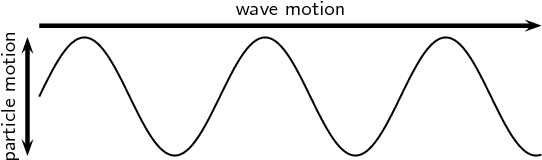
What kind of wave is pictured below?
a)
compressional wave
b)
transverse wave
c)
sound wave
d)
mechanical wave
23.
Waves are a transfer of what?
a)
Heat
b)
Light
c)
Energy
d)
Food
24.
Amplitude reflects the amount of ____________________ in a wave.
a)
energy
b)
compression
c)
rarefaction
d)
speed
25.
The units for frequency are measured in _____________.
a)
hertz
b)
seconds
c)
m/s
d)
m
26.
What is the speed of a sound wave that has a frequency of 250 hertz and a wavelength of 8 meters? 
a)
31 m/s
b)
250 m/s
c)
2000 m/s
d)
5280 m/s
27.
A wave in which the particles of the medium move perpendicularly to the direction the wave is traveling
a)
A. surface wave
b)
B. transverse wave
c)
C. electromagnetic  wave
d)
D. longitudinal wave
28.
A wave in which the particles of the medium vibrate parallel to the direction of the wave motion
a)
A. mechanical wave
b)
B. surface wave
c)
C. longitudinal wave
d)
D. wave
29.
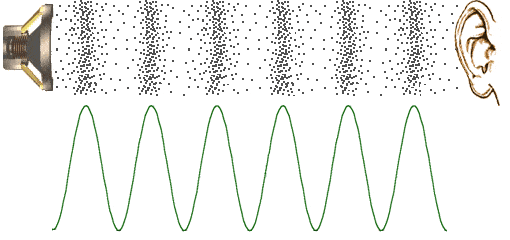
How many waves are in this wave chain?
a)
6
b)
3
c)
4
d)
5
30.
A wave has wavelength of 10 m and a speed of 340 m/s. What is the frequency of the wave?
a)
34 m/s
b)
3400 Hz
c)
3400 m/s
d)
34 Hz
31.
A wave has wavelength of 10 m and a speed of 340 m/s. What is the frequency of the wave?
a)
34 m/s
b)
3400 Hz
c)
3400 m/s
d)
34 Hz
32.
When two waves combine to form a new wave with a smaller amplitude, it is called 
a)
Refraction
b)
Constructive Interference
c)
Resonance
d)
Destructive Interference
33.
When the crest of one wave passes through the trough of another wave, ______ takes place.
a)
resonance
b)
diffraction
c)
destructive interference
d)
constructive interference
34.
When the crest of one wave passes through the trough of another wave, ______ takes place.
a)
resonance
b)
diffraction
c)
destructive interference
d)
constructive interference
35.
A tuning fork starts to vibrate when a certain note is played on the piano, This is an example of _______.
a)
resonance
b)
refraction
c)
diffraction
d)
reflection
36.
In ________ interference, the energy of the combined wave is greater than the energy of each of the two waves.
a)
destructive
b)
rarefaction
c)
resonance
d)
constructive
37.
What occurs when vibrations traveling through an object match the object's natural frequency?
a)
reflection
b)
diffraction
c)
resonance
d)
refraction
38.
When two waves combine to form a new wave with a larger amplitude, it is called 
a)
Diffraction
b)
Destructive Interference
c)
Resonance
d)
Constructive Interference
39.
This image is representing what wave interaction?
a)
Refraction
b)
Diffraction
c)
Reflection
d)
Interference
40.
Interference that causes a wave that appears to be standing still is known as what?
a)
Standing wave
b)
Resonance
c)
Destructive Interference
d)
Constructive Interference
41.
True or False: Every object has at least one natural frequency.
a)
True
b)
False
42.
When a wave moves around a barrier or though an opening it is known as what?
a)
Diffraction
b)
Refraction
c)
Rarefaction
d)
Destruction
43.

A beam of light bends when it passes from air into water, and more when it passes from water into glass. What can you conclude from this fact?

a)

Air is denser than glass

b)

Water is denser than glass

c)

Glass is denser than water

d)

Air is denser than water

44.
Light refracts when:
a)
it Changes speed
b)
it changes from a particle to a wave
c)
its density changes
d)
it encounters a solid object
45.
Light refracts when:
a)
it Changes speed
b)
it changes from a particle to a wave
c)
its density changes
d)
it encounters a solid object
46.
Which of the following is the best example of diffraction?
a)
Your voice echoing back when you shout into a canyon
b)
A straw appearing to bend when you place it in a glass of water
47.
What is the main difference between refraction and diffraction?
a)
refraction is a phenomenon that affects light; diffraction is a phenomenon that affects sound
b)
refraction involves the bending of light; diffraction involves the bending and spreading of light, usually around an obstacle
48.

A rainbow forms when white light separates into different colors during?

a)

Absorption

b)

Scattering

c)

Refraction

d)

Diffraction

49.
A student placed a pencil in a cup of water.  The pencil appears broken because light-
a)
always travels in a straight line
b)
bends when it passes through water
c)
makes the water in the glass evaporate
d)
reflects the pencil on the water's surface
50.
Refraction is the bending of a wave disturbance as it passes from one _________ into another.
a)
glass
b)
medium
c)
area
d)
boundary
51.
According to the Law of reflection, a light ray striking a mirror
a)
continues moving through the mirror in the same direction
b)
moves into the mirror at a slightly different angle
c)
bounces off the mirror toward the direction it came from
d)
bounces off the mirror at the same angle it hits.
52.
A material or substance that a matter wave travels through is  ________
a)
a block
b)
a wall
c)
a medium
d)
an electromagnetic spectrum
53.

What type of wave spreads out and goes through an opening or around corner?

a)

Reflection

b)

Refraction

c)

Interference

d)

Diffraction

54.

What does this image describe ?

a)

Reflection

b)

Diffraction

c)

Interference

d)

Refraction

55.

How are electromagnetic waves different from other waves?

a)

They have very short wavelengths

b)

They transmit energy instead of matter

c)

They can travel through a vacuum

56.

A wave of constant wavelength diffracts as it passes through an opening in a barrier. As the size of the opening is increased, the diffraction effects

a)

decrease

b)

increase

c)

remain the same

57.

The orca uses this behavior of waves to locate food.

a)

Refraction

b)

Reflection

c)

Absorption

d)

Diffraction

e)

Interference

58.
A ray of light is incident on a plane mirror and the angle of incidence is 25 degrees. What is the angle of reflection?
a)
A. 0 degrees
b)
B. 50 degrees
c)
C. 90 degrees
d)
D. 25 degrees
59.
What does it mean to refract?
a)
bounce off
b)
to bend
c)
curve outward
d)
reflect
60.
Sound waves are what kind of wave?
a)
Longitudinal
b)
Transverse
c)
Surface
d)
Electromagnetic