
 Worksheets
Midterm Review: Heat and Forces
Total questions: 63
Worksheet time: 1hrs 8mins
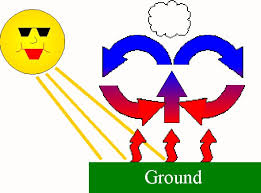


The weather patterns for a given region over time
weather
climate
waves
global warming
The total sum of the kinetic energy in a given sample
heat
temperature
salinity
density
What is the Coriolis effect?
heat transfer caused by the rising of hotter, less dense fluids and the falling of cooler, more dense fluids.
A punk rock band.
the apparent deflection of moving air as a result of Earth's rotation.
The amount of matter in a given volume.
Surface Ocean currents are primarily caused by
temperature and salinity
wind
convection
continental drift
Deep Ocean currents are primarily caused by
temperature and salinity
wind
gravity
precipitation
Differences in water temperature create movement in the Ocean because
bodies of water at different temperature have different densities.
warm water is pulled more by the force of gravity then cold water is.
warm and cold water mix until they reach the same temperature.
The ocean just likes to "move-it move-it".
which of these characteristics will produce the most dense water?
high salinity, high temperature
high salinity, low temperature
low salinity, high temperature
low salinity, low temperature
Which one cools down slower?
water
air
land
long-term change in the prevailing weather patterns
climate change
global warming
fossil fuels
greenhouse gases
natural resources
a natural, non-renewable fuel such as coal, oil, or natural gas formed over a very long time in the geological past from the remains of living organisms
climate change
global warming
fossil fuels
greenhouse gases
natural resources
continual rise in the average temperature of Earth's climate system
climate change
global warming
fossil fuels
greenhouse gases
natural resources
Due to _______________ global temperature, ice sheets are melting, which adds water globally and increases the sea level.
increased
decreased
stable
unusual
Human activity has added gases that have increased the _______________ in the atmosphere and have caused Earth's surface temperature to rise.
carbon dioxide
greenhouse effect
carbon monoxide
climate change
Greenhouse gases can
Clean your greenhouse
Trap the heat escaping from earth.
Inflate your greenhouse
Cool the Earth
An example of a greenhouse gas is
Carbon dioxide
Helium
Oxygen
Hydrogen
Carbon dioxide is NOT made by
Humans breathing out
Dogs breathing out
Volcanoes
Plants during photosynthesis
How long ago was the Industrial Revolution?
400 years
200 years
500 years
1000 years
a high-speed wind current, generally moving from west to east over the US
wind
jet stream
Gulf Stream
polar easterlies
A warm swift current in the Atlantic Ocean that flows from the Gulf of Mexico along the eastern coast of the United States. Responsible for warming the east coast in the winter. Hurricanes follow this path because of the warm water
jet stream
Gulf Stream
prevailing westerlies
Tradewinds

Everyone should try to reduce their ...
carbon footprint
solar footprint
pylon footprint
global footprint

List the 4 fundamental forces in order from strongest to weakest.
gravity, strong nuclear, weak nuclear, electromagnetic
electromagnetic, weak nuclear, strong, nuclear, gravity
strong nuclear, weak nuclear, electromagnetic, gravity
strong nuclear, weak nuclear, gravity, electromagnetic
Which force holds the nucleus together even though the protons are pushing each other apart?
weak nuclear
gravity
electromagnetic
strong nuclear
Which force allows electrons in the outer order to escape and cause that element to give off radiation?
strong nuclear
gravity
weak nuclear
electromagnetic

What is the resultant of these two vectors?
+17 m
+3 m
-17 m
-3 m

What is the magnitude of the resultant vector, r?
3
4
5
7

What is the resultant of the two vectors shown above?
+5
-5
+15
-15
A vector includes ______ and ________.
direction, magnitude
magnitude, units
direction, units
scalars, scalars


1st
Law of Motion
2nd
Law of Motion
3rd
Law of Motion
What is the acceleration of a 50 kg object pushed with a force of 500 newtons?
100 m/s2
25,000 m/s2
10 m/s2
25 m/s2

A cannonball with a mass of 0.5 kg is flying at an acceleration of 10 m/sec/sec. What is its force?
50 Newtons
5 Newtons
20 Newtons
9.5 Newtons

