wayground logo

Free Printable Worksheets

Font size

S
M
L
XL
Worksheets

Bonding Types

Total questions: 51

Worksheet time: 40mins

Name
Class
Date
1.
What is a cation
a)
a metal with a negative (-) charge
b)
a non-metal with a negative (-) charge 
c)
a metal with a positive (+) charge 
d)
a non-metal with a positive (+) charge
2.
What is a anion
a)
a metal with a negative (-) charge
b)
a non-metal with a negative (-) charge 
c)
a metal with a positive (+) charge 
d)
a non-metal with a positive (+) charge
3.
What is the charge on a chloride ion?
a)
-1
b)
1
c)
+2
d)
+1
4.
How many valence electrons does calcium have?
a)
2
b)
4
c)
6
d)
7
5.
Ionic bonds form between metals and ____.
a)
metalloids
b)
metals
c)
nonmetals
6.
How do covalent bonds form?
a)
Donating & receiving valence e- between atoms.
b)
Opposite slight charges attract each other between compounds.
c)
Scientists are still not sure how they form.
d)
Sharing valence e- between atoms.
7.
What two types of atoms make a covalent bond?
a)
2 Nonmetals
b)
1 Nonmetal and 1 Metal
c)
2 Metals
d)
2 Noble Gases
8.
In a covalent bond, one or more electrons are? 
a)
shared 
b)
lost 
c)
gained 
d)
transferred 
9.

If an atom has no charge, which of the following must be true?

a)

It has more neutrons than protons or electrons.

b)

There are only neutrons inside the atom.

c)

Its number of protons is equal to its number of electrons.

d)

The neutrons in the atom outnumber the electrons and protons.

10.
Ionic compounds are formed when one or more valence electrons are transferred from _____
a)
a nonmetal atom to a metal atom
b)
a nonmetal atom to a nonmetal atom
c)
a metal atom to a nonmetal atom
d)
a metal atom to a metal atom
11.
The correct name for NaCl is...
a)
Sodium Chlorine
b)
Sodium Chloride
c)
Nickel Chloride
d)
Sodium Choroxide 
12.
Why does K become positive when it bonds to Cl to form KCl?
a)
Because it loses an electron to have a full valence shell 
b)
Because it gains an electron to have 2 valence electrons
c)
Because it loses an electron to become negatively charged
d)
Because Cl gives away its 7 electrons to Na to form an equal charge 
13.
CO2
a)
Ionic
b)
Covalent
c)
Polyatomic Ion 
d)
Metallic 
14.
NaCl
a)
Ionic
b)
Covalent
c)
Metallic
d)
Polyatomic Ion 
15.
MgCl2
a)
Ionic
b)
Covalent
c)
Polyatomic Ion
d)
Metallic 
16.
SO4
a)
Covalent
b)
Ionic
c)
Metallic
d)
Polyatomic Ion
17.
Ionic compounds tend to be _________ whereas covalent compounds tend to be ______ or _____
a)
solids // liquids or gases
b)
liquids // solids or gases
c)
gases // solids or liquids
d)
solids // solids or liquids 
18.
The octet rule means that all valence shells want to have the number...... 
a)
1
b)
9
c)
8
d)
16
19.
All atoms/elements bond in order to ....
a)
Have a full valence shell
b)
Give away electrons or take electrons
c)
Only share electrons
d)
To create electrical currents for human use 
20.
All solids at room temperature
a)
ionic compounds
b)
covalent compounds
21.
Some are solids, some are liquids, and some are gases at room temperature.
a)
ionic compounds
b)
covalent compounds
22.
Molten compound conducts electricity.
a)
ionic compound
b)
covalent compound
23.
Molten compound does NOT conduct electricity.
a)
ionic compound
b)
covalent compound
24.
Have a high m.p. (1000°C-3000°C)
a)
ionic compounds
b)
covalent compounds
25.
Have a low m.p. (< 200°C)
a)
ionic compounds
b)
covalent compounds
26.
When dissolved in water, the solution is a good conductor of electricity.
a)
ionic compounds
b)
covalent compounds
27.
When dissolved in water, the solution does NOT conduct electricity.
a)
ionic compounds
b)
covalent compounds
28.
usually hard but brittle
a)
ionic compounds
b)
covalent compounds
29.
usually soft
a)
ionic compounds
b)
covalent compounds
30.
forms ions in solution
a)
ionic compounds
b)
covalent compounds
31.
electrolytes
a)
ionic compounds
b)
covalent compounds
32.
nonelectrolytes
a)
ionic compounds
b)
covalent compounds
33.

The chemical bond between a non-metal and another non-metal will be a ________ bond.

a)

metal

b)

ionic

c)

covalent

d)

polar

34.

In an ionic bond the metal wants to ______ electrons.

a)

lose

b)

gain

c)

share

35.

When a metal loses an electron(s) it becomes a ...

a)

positive ion

b)

negative ion

c)

metalloid

d)

nonmetal

36.

In an ionic bond the non-metal wants to ______ electron(s).

a)

lose

b)

gain

c)

share

37.

In a covalent bond both non-metals _____ electrons.

a)

transfer

b)

share

38.

Carbon and Oxygen will make a ___________ bond.

a)

ionic

b)

covalent

c)

metallic

39.
How do covalent bonds form?
a)
Donating & receiving valence e- between atoms.
b)
Opposite slight charges attract each other between compounds.
c)
Scientists are still not sure how they form.
d)
Sharing valence e- between atoms.
40.
Which of the following is NOT formed by a covalent bond?
a)
K2S
b)
H2O
c)
I2
d)
CO2
41.
What do we call a covalent bond where electrons are shared UNEVENLY or UNEQUALLY?
a)
Ionic
b)
Polar Covalent
c)
Nonpolar Covalent
d)
Van der Waals Force
42.
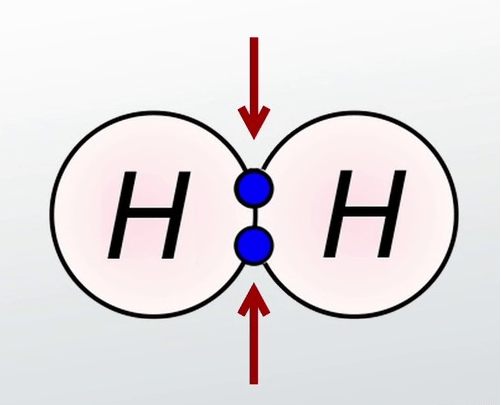
What type of bond is shown in this image?
a)
Ionic
b)
Polar Covalent
c)
Nonpolar Covalent
d)
Van der Waals Force
43.
Diatomic elements are defined as IDENTICAL elements that bond with each other (i.e. Oxygen with Oxygen).  What type of bond should they form?
a)
Ionic
b)
Polar Covalent
c)
Nonpolar Covalent
d)
Van der Waals force
44.
A polar bond is one that
a)
Has an electronegativity difference greater than 0.7
b)
Has an electronegativity difference greater than 0.5
c)
Has an electronegativity difference less that 0.5
d)
Has an electronegativity difference less than 0.7
45.
What is the basis of a metallic bond?
a)
the attraction of neutral metal atoms.
b)
the attraction between protons and neutrons.
c)
the attraction between positive metal ions and interlocking electrons.
d)
the attraction between positive metal ions and free floating electrons.
46.
There are more metals than non metals in the periodic table.
a)
True
b)
False
47.
At room temperature, most metals are
a)
liquid
b)
solid
c)
gas
d)
an alloy
48.
What does malleable mean?
a)
able to be shaped
b)
will break easily
c)
can be used for wire
d)
is shiny
49.
Electrons that are free to move in metals
a)
delocalized electrons
b)
oxidation number
c)
chemical bond
d)
salts
50.
Why do metals conduct
a)
They are shiny
b)
The electrons are held tightly within the lattice
c)
The electrons are delocalised and able to move
d)
The electrons are shared between two metal ions
51.

Which of these are considered properties of metals? (choose ALL that apply)

a)

brittleness

b)

low melting point

c)

luster (shininess)

d)

malleability

e)

ductility