wayground logo

Free Printable Worksheets

Font size

S
M
L
XL
Worksheets

Algebra 2 - Unit 1 and 2 Review

Total questions: 160

Worksheet time: 13hrs 20mins

Name
Class
Date
1.

Say 'TRUE' or 'FALSE' If a quadratic equation ax2 + bx + c = 0 has equal roots, then b2 - 4ac = 0 

a)
TRUE
b)
FALSE
2.

How many solutions can a quadratic have?

a)

1 solution

b)

3 solutions

c)

0 solutions

d)

2 solutions

3.

What can the roots to a quadratic equation be called?

a)

zeros

b)

solutions

c)

x-intercepts

d)

none of the choices

4.

What is the quadratic formula?

a)
b)
c)
d)
5.

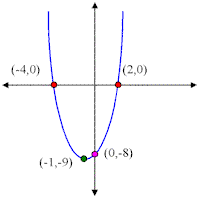
Which value is the vertex?

a)

(-4, 0)

b)

(-1, -9)

c)

(0, -8)

d)

(2, 0)

6.

Which value is the y-intercept?

a)

(-4, 0)

b)

(-1, -9)

c)

(0, -8)

d)

(2, 0)

7.

What are the zeros of this graph?

a)

x = {-4, 2}

b)

(-4, 0 ) and (2, 0)

c)

x = {-1, 0}

d)

(-1, 9 ) and (0, -8)

8.

Does this graph have a maximum or a minimum?

a)

maximum

b)

minimum

c)

I am not sure.

d)

neither

9.

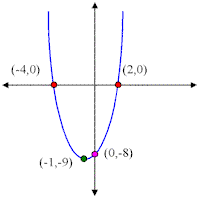
Does this graph have a maximum or a minimum?

a)

maximum

b)

minimum

c)

I am not sure.

d)

neither

10.

Does this graph have any roots?

a)

yes

b)

no

c)

I am not sure.

11.

What is the equation for standard form of a quadratic?

a)

y = x2 + bx + c

b)

y = ax2 + bx + c

c)

y = mx + b

d)

Ax + By = C

12.

a)

less than

b)

less than or equal to

c)

greater than or equal to

d)

greater than

e)

equal

13.

a)

less than

b)

less than or equal to

c)

greater than or equal to

d)

greater than

e)

equal

14.

a)

less than

b)

less than or equal to

c)

greater than or equal to

d)

greater than

e)

equal

15.

a)

less than

b)

less than or equal to

c)

greater than or equal to

d)

greater than

e)

equal

16.

a)

less than

b)

less than or equal to

c)

greater than or equal to

d)

greater than

e)

equal

17.

a)

less than

b)

less than or equal to

c)

greater than or equal to

d)

greater than

e)

not equal

18.

Which symbols will have a closed circle?

a)
b)
c)
d)
e)
19.

Which symbols will have an open circle?

a)
b)
c)
d)
e)
20.

Less than

a)
b)
c)
d)
e)
21.
Is 2 a possible solution for b<-3 ?
a)
Yes
b)
No
22.
Is -2.5 a possible solution for y ≤ -3 ?
a)
Yes
b)
No
23.
Is -4.8 a possible solution for p ≥ -3 ?
a)
Yes
b)
No
24.
Is  ½ a possible solution for k > -6 ?
a)
Yes
b)
No
25.
Is 0 a possible solution for p<-4 ?
a)
Yes
b)
No
26.
Match the graph with its inequality.
a)
11 < a
b)
11 > a
c)
 11 ≤ a
d)
 11 ≥ a
27.
Pick the correct inequality.
a)
A
b)
B
c)
C
d)
D
28.
Will my dot be colored in?
5 ≥ x
a)
Yes
b)
No
29.
Which graph matches the inequality
2 > p?
a)
A
b)
B
c)
C
d)
D
30.
Which graph matches the inequality 
x < -1.1?
a)
A
b)
B
c)
C
d)
D
31.

The imaginary number i is equal to...

a)

i

b)

1

c)

-i

d)

-1

32.

The imaginary number i2i^2  is equal to...

a)

i

b)

1

c)

-i

d)

-1

33.

The imaginary number i3i^3  is equal to...

a)

i

b)

1

c)

-i

d)

-1

34.

The imaginary number i4i^4  is equal to...

a)

i

b)

1

c)

-i

d)

-1

35.

The discriminant is which choice?

a)

b24acb^2-4ac

b)

a2+b2=c2a^2+b^2=c^2

c)

y=mx+by=mx+b

d)

y=ax2+bx2+cy=ax^2+bx^2+c

36.

Which term is associated with the AC Method?

a)

factor by grouping

b)

the quadratic formula

c)

the pythagorean theorem

d)

the squeeze theorem

37.

The factors (x+2)\left(x+2\right) and  (x2)\left(x-2\right)  are _______? 


a)

conjugate pairs

b)

circles

c)

squares

d)

invisible

38.

The roots of the given equation, (x+2)(2x9)=0\left(x+2\right)\left(2x-9\right)=0 , are...? 


a)

x=2, x=92x=-2,\ x=\frac{9}{2}  

b)

x=2, x=29x=-2,\ x=\frac{2}{9}  

c)

x=2, x=92x=2,\ x=\frac{9}{2}  

d)

x=2, x=29x=2,\ x=\frac{2}{9}  

39.

State the maximum number of unique zeros any given quadratic equation can have.

a)

zero

b)

one

c)

two

d)

three

40.

The form, y=ax2+bx+cy=ax^2+bx+c , is the ______ form of a quadratic equation. 

a)

standard

b)

pythagorean theorem

c)

linear

d)

slope

41.

TRUE OR FALSE: The signs of the coefficients in a quadratic equation / expression helps us determine the signs of its factors.

a)

TRUE

b)

FALSE

42.

The expression x210x+24x^2-10x+24 is equivalent to...? 

a)

(x+12)(x2)\left(x+12\right)\left(x-2\right)  

b)

(x12)(x+2)\left(x-12\right)\left(x+2\right)  

c)

(x+6)(x+4)\left(x+6\right)\left(x+4\right)  

d)

(x6)(x4)\left(x-6\right)\left(x-4\right)  

43.

Daniel correctly factored the expression m212m64m^2-12m-64 . Which expression did he write? 

a)

(m8)(m8)\left(m-8\right)\left(m-8\right)  

b)

(m8)(m+8)\left(m-8\right)\left(m+8\right)  

c)

(m16)(m+4)\left(m-16\right)\left(m+4\right)  

d)

(m+16)(m4)\left(m+16\right)\left(m-4\right)  

44.

When the discriminant is greater than 0, it has ____ x-intercepts.

a)

0

b)

1

c)

2

d)

3

45.

When the discriminant is equal to 0, it has ____ x-intercepts.

a)

0

b)

1

c)

2

d)

3

46.

When the discriminant is less than 0, it has ____ x-intercepts.

a)

0

b)

1

c)

2

d)

3

47.

If b24ac<0b^2-4ac<0 , then its roots are...? 

a)

imaginary

b)

real, rational, equal

c)

real, rational, unequal

d)

real, irrational, unequal

48.

If b24ac=0b^2-4ac=0 , then its roots are...? 

a)

imaginary

b)

real, rational, equal

c)

real, rational, unequal

d)

real, irrational, unequal

49.

If b24ac>0b^2-4ac>0 and is a nonperfect square, then its roots are...? 

a)

imaginary

b)

real, rational, equal

c)

real, rational, unequal

d)

real, irrational, unequal

50.

If b24ac>0b^2-4ac>0 and is a perfect square, then its roots are...? 

a)

imaginary

b)

real, rational, equal

c)

real, rational, unequal

d)

real, irrational, unequal

51.

The roots of the equation 9x2+3x4=09x^2+3x-4=0 are...? 

a)

imaginary

b)

real, rational, and equal

c)

real, rational, and unequal

d)

real, irrational, and unequal

52.

The roots of the equation x210x+25=0x^2-10x+25=0 are...? 

a)

imaginary

b)

real, rational, and equal

c)

real, rational, and unequal

d)

real, irrational, and unequal

53.

Which graph represents a quadratic function with a negative discriminant?

a)
b)
c)
d)
54.

Which if the following is an equation for a quadratic function that opens downward (concave down) and has the vertex of (-4, 7)?

a)

f(x)=(x4)2+7f\left(x\right)=-\left(x-4\right)^2+7  

b)

f(x)=(x+4)2+7f\left(x\right)=\left(x+4\right)^2+7  

c)

f(x)=(x+4)2+7f\left(x\right)=-\left(x+4\right)^2+7  

d)

f(x)=(x4)2+7f\left(x\right)=\left(x-4\right)^2+7  

55.

How does the graph of g(x)=3x2g\left(x\right)=3x^2 compare to the quadratic parent function f(x)=x2f\left(x\right)=x^2  ?

a)

The graph of g(x) is wider than the graph of f(x).

b)

The graph of g(x) is narrower than the graph of f(x).

c)

The graph of g(x) is translated up 3 units above f(x).

d)

The graph of g(x) is translated down 3 units below f(x).

56.

How would you describe the translation from f(x) = x2 to g(x) = (x - 3)2 ?

a)

Horizontal translation: three units to the left

b)

Horizontal translation: three units to the right

c)

Vertical translation: three units up

d)

Vertical translation: three units down

57.

Which describes the transformation of the graph of f(x) = x2 to the graph of g(x) = -4x2

a)

Reflected, narrower

b)

reflected, wider

c)

shifted down 4 units

d)

shifted up 4 units

58.
Which quadratic is the narrowest graph?
a)
y = 3x2
b)
y = 4x2
c)
y = 2x2
59.
Which quadratic graph is the widest?
a)
y = 5x2
b)
y = -¼x2
c)
y = -½x2
d)
y = 5x2
60.
If the blue graph is
f(x) = x2 
then the red must be...
a)
g(x) = x- 5
b)
g(x) = x+ 5
c)
g(x) = (x - 5)2
d)
g(x) = (x + 5)2
61.
What are the zeros for the quadratic function? 
a)
(-6, 0) and (14, 0)
b)
(-50, 0) and (14, 0)
c)
(-6, 0) and (-50, 0)
d)
(-50, 0) and (-60, 0)
62.
Identify the vertex and whether the graph opens up or down.
a)
(5, 2); opens up
b)
(5, 2); opens down
c)
(-5, 2); opens up
d)
(-5, 2); opens down
63.

Determine the values of a, b, and c for the quadratic equation:

4x2 – 8x = 3

a)

a = 4, b = -8, c = 3

b)

a = 4, b =-8, c =-3

c)

a = 4, b = 8, c = 3

d)

a = 4, b = 8, c = -3

64.
If the graph of a quadratic does not intercept the x-axis at any point, then it has:
a)
1 Real Solution
b)
2 Real Solutions
c)
Half a Solution
d)
No Real Solution
65.

What does the discriminant tell us?

a)

The maximum or minimum

b)

The y-intercept

c)

The number and type of solutions

d)

The axis of symmetry

66.
____________
For the function above, is the discriminant positive, negative, or zero?
a)
Positive
b)
Negative
c)
Zero
d)
Not Sure
67.

Simplify the given expression: (2x3)(x+4)\left(2x-3\right)\left(x+4\right)  

a)

2x2+8x3x122x^2+8x-3x-12  

b)

2x2122x^2-12  

c)

2x2+5x122x^2+5x-12  

d)

2x25x122x^2-5x-12  

68.

Simplify the given expression: (y6)(y4)\left(y-6\right)\left(y-4\right)  

a)

y210y+24y^2-10y+24  

b)

y24y6y+24y^2-4y-6y+24  

c)

y2+24y^2+24  

d)

y224y^2-24  

69.

Find the GCF of 3r and 18

(a)  

70.

The GCF of 7r2 and 49r is.....

a)

7

b)

7r

c)

49r

d)

49

71.

Identify the a, b, and c values for this quadratic:

6x+3x276x+3x^2-7  

a)

a= 3 b=6 c=7

b)

a=6 b=3 c=7

c)

a=3 b=6 c=-7

d)

a=6 b=3 c=-7

72.

Simplify the given expression: (2+ 5i) + (3 - 8i)

a)

1 - 3i

b)

1 - 13i

c)

5 - 3i

d)

5 + 13i

73.

Simplify the given expression: ( 5 + i ) - ( 2i - 3 )

a)

3i - 2

b)

8 - i

c)

8 + i

d)

3i + 2

74.

Simplify the given expression: ( 3 + 2i ) - ( 7 + 7i )

a)

-4 + 5i

b)

4 + 5i

c)

4 - 5i

d)

-4 - 5i

75.

Write the equation in vertex form.  y = x2+ 2x + 5 y\ =\ x^2+\ 2x\ +\ 5\  

a)

y=(x+1)2  4 y=\left(x+1\right)^2\ -\ 4\  

b)

y=(x+1)2 +4y=\left(x+1\right)^2\ +4  

c)

y=(x4)21y=\left(x-4\right)^2-1  

d)

y=(x+4)2+1y=\left(x+4\right)^2+1  

76.

What is the vertex of the given equation? y=(x+1)2+4y=\left(x+1\right)^2+4  

a)

(1,4)

b)

(-1,-4)

c)

(-1,4)

d)

(1,-4)

77.

Does this equation have a maximum or a minimum?

y=(x+1)2+4y=-\left(x+1\right)^2+4  

a)

Max  is -1

b)

Min is -1 

c)

Max is 4 

d)

Min is 4 

78.

Does this equation have a maximum or a minimum? y=(x5)2y=\left(x-5\right)^2  

a)

Max is -5 

b)

Min is  -5

c)

Max is 0

d)

Min is 0 

79.

Solve the following quadratic linear system

y=x2+2x + 6y=x^2+2x\ +\ 6  ,  y=x +4y=-x\ +4  

a)

(1,5) and (2,6)

b)

(-1,5) and (2,6)

c)

(-1,5) and (-2,6)

d)

(-1,5) and (2,6)

80.

50x3y\sqrt{50x^3y}  Simplify

a)

52xy5\sqrt{2xy}  

b)

5x2xy5x\sqrt{2xy}  

c)

5ix2xy5ix\sqrt{2xy}  

d)

5x22xy5x^2\sqrt{2xy}  

81.

48x10y5\sqrt{-48x^{10}y^5}  Simplify

a)

4ix10y23y4ix^{10}y^2\sqrt{3y}  

b)

16ix5y43y16ix^5y^4\sqrt{3y}  

c)

4ix5y23y4ix^5y^2\sqrt{3y}  

d)

16x5y23y16x^5y^2\sqrt{3y}  

82.

Which of the following symbols read as greater than?

a)

>>

b)

<<

c)

\ge

d)

\le

83.

Which of the following symbolizes less than?

a)

>>

b)

<<

c)

\le

d)

\ge

84.

Solutions are in the ___________ area.

a)

non-shaded

b)

shaded

c)

vertex

d)

axis of symmetry

85.

Simplify the given expression.

a)

10

b)

-10

c)

10i

d)

-10i

86.

Simplify the given expression.

a)

5i

b)

-5i

c)

5+i

d)

-5

87.

What is the complex conjugate of 4 - 3i?

a)

143i\frac{1}{4-3i}

b)

14+3i\frac{1}{4+3i}

c)

-4 + 3i

d)

4 + 3i

88.

Simplify the given expression: 25\sqrt{-25}  

a)

-5i

b)

5

c)

5i

d)

-5

89.

Factor completely: x21x^2-1  

a)

(x+1)(x +1)

b)

(x - 1)(x - 1)

c)

prime

d)

(x + 1)(x - 1)

90.

Factor completely: x2 - 25

a)

( x + 5 ) ( x - 5 )

b)

( x - 5 ) ( x - 5 )

c)

( x + 5 ) ( x + 5 )

d)

Prime

91.

Factor completely: 4x2 - 25

a)

(2x + 5) (2x - 5)

b)

(2x - 5)2

c)

(2x + 5)2

d)

2x + 5(2x - 5)

92.

Factor completely: x2 - 16

a)

(x + 4) (x - 4)

b)

(x + 8) (x - 2)

c)

(x + 4)2

d)

x + 4(x - 4)

93.
Determine the number of solutions to the given linear-quadratic system.
a)
0 solutions
b)
1 solution
c)
2 solutions
d)
3 solutions
94.

What is the solution to the linear-quadratic system graphed in the picture.

a)

(0, 0)

b)

(3, 0)

c)

(2, -3)

d)

(-3, 2)

95.
Which of the following represents "a number greater than 3"?
a)
x < 3
b)
x > 3
c)
x ≥ 3
d)
x ≤ 3
96.
Which of the following represents "a number less than 0"?
a)
x < 0
b)
x ≥ 0
c)
x ≥ 0
d)
x > 0
97.
Which inequality matches this situation:
You must be at least 18 years old to vote
a)
x > 18
b)
x < 18
c)
x ≤ 18
d)
x ≥ 18
98.
Which of the following represents  "a number less than or equal to -5" 
a)
x < -5
b)
x ≥ -5
c)
x > -5
d)
x ≤ -5
99.
When graphing b< 6 would you use an open or closed circle?
a)
Open
b)
closed
100.
Will my circle be colored in?
5 ≥ x
a)
Yes
b)
No
101.
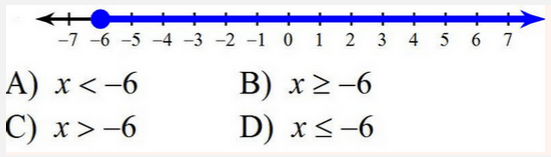
What inequality does the number line graph represent?
a)
x ≤ 4
b)
x ≥ -4
c)
x < -4
d)
x < 4
102.
Pick the correct inequality.
a)
A
b)
B
c)
C
d)
D
103.
What type of circle will be used?
5 ≥ x
a)
Open
b)
Closed
104.
What inequality does the number line graph represent?
a)
-5 ≥ x
b)
x < −5
c)
x > -5
d)
x ≥ −5
105.
Which graph matches the inequality
r ≥ -6?
a)
A
b)
B
c)
C
d)
D
106.
Does this parabola have a maximum or minimum?
REMEMBER MAXIMUM IS THE HIGHEST AND MINIMUM IS THE LOWEST. 
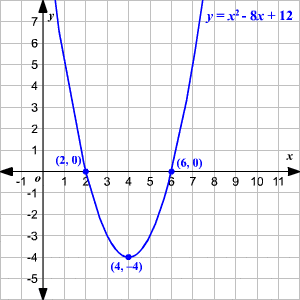
a)
Maximum
b)
Minimum
107.
If the a value is positive, which direction does the graph open?
a)
up
b)
down
c)
left
d)
right
108.
If the a value is negative, which direction does the parabola open?
a)
up
b)
down
c)
left
d)
right
109.
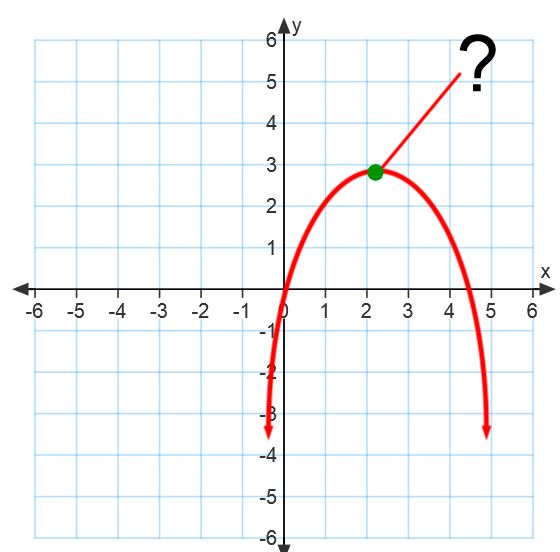
Does this graph have a maximum or minimum?
a)
Minimum
b)
Maximum
110.
What is the green dot on the parabola called?
a)
maximum
b)
minumum
c)
roots
d)
zeros
111.
Is this a max or min?
a)
max
b)
min
c)
cannot be determined
112.
The highest or lowest point on a quadratic is called the...
a)
Max
b)
Vertex
c)
Axis of Symmetry
d)
Intercept
113.
The line that goes through the vertex of a parabola is called the...
a)
Vertex
b)
Axis of Symmetry
c)
x-intercept
d)
y-intercept
114.
This graph is...
a)
Concave up
b)
Concave down
115.
If a quadratic has a vertex that is a maximum, then the quadratic is...
a)
Concave up
b)
Concave down
116.
How many x-intercepts does this quadratic have?
a)
0
b)
1
c)
2
d)
infinitely many
117.
If a quadratic is concave up, then the vertex is the...
a)
Minimum point
b)
Maximum point
118.

What is the green dashed line called?

a)

roots or x-intercepts

b)

parabola

c)

axis of symmetry

d)

y intercept

119.
Which transformation maps the graph of
f(x) = x2 to the graph of g(x) = (x + 4)2?
a)
a reflection across the line x = -4
b)
a reflection across the line y = -4
c)
a translation shifting f(x) 4 units to the left
d)
a translation shifting f(x) 4 units to the right
120.
Which transformation will occur if f(x) = x2 is replaced with f(x) + 2?
a)
Nothing happens, it stays the same.
b)
Vertical stretch by a factor of 2.
c)
Vertical translation up by 2 units.
d)
Reflection across the x-axis.
121.
Which transformation will occur if f(x) = x2 is replaced with -f(x)?
a)
Nothing happens, it stays the same.
b)
Vertical stretch by a factor of 2.
c)
Vertical translation up by 2 units.
d)
Reflection across the x-axis.
122.

What steps transform the graph y = x2 to y = 2(x+2)2 - 5?

a)

Compress by 2, shifted 2 units left and 5 down

b)

Stretch by 5, shifted 5 units left and 2 down

c)

Stretch by 2, shifted 2 units left and 5 down

d)

Compress by 5, shifted 2 units left and 2 down

123.

What steps transform the graph y = x2 to y = x2 + 8

a)

shifted up 8 units

b)

shifted down 8 units

c)

shifted left 8 units

d)

shifted right 8 units

124.

If the graph of a function crosses the x-axis, what does that mean about the multiplicity of that zero?

a)

Even

b)

Odd

c)

None

125.

If the there is a turning point on the x-axis, what does that mean about the multiplicity of that zero?

a)

Even

b)

Odd

c)

None

126.

The degree of a polynomial determines...

a)

the maximum number of x-intercepts

b)

the number of turning points

c)

if the end behavior is up or down

d)

the y-intercept

127.
What are the
zeros of the polynomial
y = 3(x + 4)(x + 1)(x - 3)?
a)
-4, -1, 3
b)
3, -3, 4, 1
c)
4, 1, -3
d)
3, -4, -1, 3
128.
Classify the function:
a)
quadratic
b)
cubic 
c)
quartic
d)
linear
129.
What is the name of a polynomial with two terms?
a)
monomial
b)
binomial
c)
trinomial
d)
quadratic
130.
What is the name of a polynomial with three terms?
a)
monomial
b)
binomial
c)
trinomial
d)
cubic
131.
What are the zeros of the polynomial function?
y = x(x - 6)(x + 5)
a)
0, 6, -5
b)
6, -5
c)
0, -6, 5
d)
1, -6, 5
132.
What are the roots of the polynomial function?
y = (x + 2)(x - 7)3
a)
-2, 7 multiplicity 3
b)
-2, 7, 3
c)
2, -7 multiplicity 3
d)
2, -7, 3
133.
Odd Multiplicities have which of the following effects on the x-axis?
a)
Cross the x-axis
b)
Turn on the x-axis
134.
What are the zeros of the function?
a)
4,1
b)
3,1,-2,-5
c)
-3, -1, 2, 5
d)
-2,4
135.
What are the roots of the polynomial function?
y = (x + 2)(x - 7)3
a)
-2, 7 multiplicity 3
b)
-2, 7, 3
c)
2, -7 multiplicity 3
d)
2, -7, 3
136.

If P( -4) = 0, which of the following statements is true about P(x)?

a)

x+4 is a factor of P(x)

b)

P(x) = 0, has four negative roots

c)

4 is a root of P(x) = 0

d)

P(0) = - 4

137.

What can we say if  P(3)=0P\left(-3\right)=0  ?

a)

(x3) \left(x-3\right)\  is a factor of  P(x)P\left(x\right)  

b)

(x+3)\left(x+3\right)  is a factor of  P(x)P\left(x\right)  

c)

(x3)\left(x-3\right)  is NOT a factor of  P(x)P\left(x\right)  

138.

What can we say if  P(2)=3P\left(2\right)=3  ?

a)

(x2)\left(x-2\right)  is a factor of  P(x)P\left(x\right)  

b)

(x2)\left(x-2\right)  is NOT a factor of  P(x)P\left(x\right)  

c)

(x+2)\left(x+2\right)  is NOT a factor of  P(x)P\left(x\right)  

139.
What is the degree of the function graphed here?
a)
2
b)
3
c)
4
d)
5
140.
What is the degree of the above polynomial graph?
a)
3
b)
4
c)
5
d)
6
141.
Which function is graphed?
a)
(x - 4)(x + 2)(x - 8)=0
b)
(x - 4)(x - 2)(x + 8)=0
c)
(x - 4)(x + 2)(x + 8)=0
d)
(x + 4)(x + 2)(x + 8)=0
142.

How many zeros does this polynomial have?

a)

0

b)

2

c)

3

d)

5

143.

What are the "zeros" of this polynomial?

a)

-2, -1

b)

-2, -1, 0, 1, 2

c)

-2, -1, 1, 2

d)

-2, -1, 4, 1, 2

144.

What are the "zeros" of this polynomial? List your answer(s) as single numbers, separated by commas if more than one answer.

(a)  

145.
A parabola is the set of all points equidistant from the focus and the directrix.
a)
true
b)
false
146.
If given the equation y = 3(x + 5)2 - 4, what is the vertex of the parabola?
a)
(5, -4)
b)
(-5, -4)
c)
(-15, -4)
d)
(15, -4)
147.
The focus is always inside the parabola.
a)
true
b)
false
148.
The 'p' value represents the distance between the vertex and the focus AND the vertex and the directrix.
a)
True
b)
False
149.
The sign of the 'p' value determines if the graph opens upward or downward.
a)
True
b)
False
150.
The vertex, (h, k), is halfway between the focus and the directrix.
a)
true
b)
false
151.
If the directrix is y = 4 and the focus is at 
(3, 0), the value of p is:
a)
8
b)
-8
c)
2
d)
-2
152.
Does y = -4x2 have a maximum or minimum value?
a)
maximum
b)
minimum
153.
What is the vertex of the equation
y= (x-12)2+7 ?
a)
(1,7)
b)
(-12, 7)
c)
(7,12)
d)
(12, 7)
154.
Determine the vertex of the parabola y=5(x-2)2–7
a)
(5, -7)
b)
(-2, -7)
c)
(2, -7)
d)
(-7, -2)
155.
Does the equation open up or down? 
Y = -3x2 +7x - 2
a)
up
b)
down
c)
both 
d)
neither
156.

Addition


7+1=

(a)  

157.
12 - 4 x 2 = 
a)
16
b)
4
c)
8
d)
18
158.

What would be my first step? 3 + 4 x 6 - 4 =

a)

Addition

b)

Multiplication

c)

Subtraction

d)

Division

159.
6 + (4)3
a)
18
b)
30
c)
13
d)
42
160.

Solve:

30 - 7 x 4 =

a)

2

b)

92

c)

7

d)

84