
 Worksheets
Periodic Trends
Total questions: 25
Worksheet time: 1hrs 9mins
ELECTRONEGATIVITY __________ from left to right across a period and __________ from top to bottom down a group.
decreases, increases
increases, increases
increases, decreases
decreases, decreases
The element with the largest electronegativity is -
At
F
Cl
Br

As you move down a GROUP on the periodic table the atomic radius get bigger. This is because ____________.
The atoms have more neutrons in the nucleus.
The atoms have more protons in the nucleus.
The atoms have more energy levels for the electrons
The atoms have greater repulsion forces between the protons and electrons
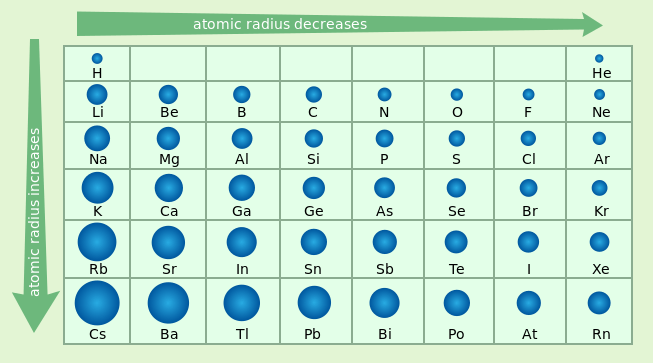
As you move across a period on the periodic table the atomic radius tend to get smaller because, ______________.
the atoms have more mass making them heavier.
more neutrons, making the nucleus bigger.
the atoms have more protons, pulling the electrons closer.
the atoms have less energy levels for the electrons to occupy.

Which element has a greater atomic radius, nitrogen (N) or fluorine (F)?
Fluorine
Nitrogen

Which element has a greater ionization energy, nitrogen (N) or fluorine (F)?
Fluorine
Nitrogen

Which element has a greater atomic radius, sulfur (S) or tellurium (Te)?
sulfur
tellurium
Which element has a greater ELECTRONEGATIVITY, sulfur (S) or tellurium (Te)?
sulfur
tellurium

Which element has a greater IONIC RADIUS, copper (Cu) or gold (Au)?
copper
gold

Which element has a greater IONIZATION ENERGY, helium (He) or xenon (Xe)?
helium
xenon

Which element has a greater ELECTRONEGATIVITY, aluminum (Al) or sulfur (S)?
aluminum
sulfur

Which element has a greater IONIC RADIUS, sulfur (S) or chlorine (Cl)?
sulfur
chlorine

Which element has a greater IONIC RADIUS, potassium (K) or manganese (Mn)?
potassium
manganese

Which element has a greater ELECTRONEGATIVITY, sulfur (S) or argon (Ar)?
sulfur
argon
IONIZATION ENERGY __________ from left to right across a period and __________ from top to bottom down a group.
decreases, increases
increases, increases
increases, decreases
decreases, decreases
ATOMIC RADIUS __________ from left to right across a period and __________ from top to bottom down a group.
decreases, increases
increases, increases
increases, decreases
decreases, decreases
IONIC RADIUS __________ from left to right across a period and __________ from top to bottom down a group.
decreases, increases
increases, increases
increases, decreases
decreases, decreases

As you move across a period on the periodic table the ionization energy tend to increase because, ______________.
the atoms have more mass making them heavier so it is harder to remove the electrons because of this increased mass.
the atoms have more protons in the nucleus making a stronger attraction to the electrons.
the atoms have more neutrons, making the nucleus bigger so they want their electrons more.
the atoms have more energy levels for the electrons to occupy so they don't want to leave the atom.
As you move DOWN a group on the periodic table the ionization energy tend to decrease because, ______________.
the atoms have more mass making them heavier so it is harder to remove the electrons because of this increased mass.
the atoms have more protons in the nucleus making a stronger attraction to the electrons making it harder to remove them.
the atoms have more neutrons, making the nucleus bigger so they attract their electrons more making it easier to remove them.
the atoms have more energy levels and the electrons that are being removed are further away so there is less attraction making it easier to remove them.
Which element has a greater ATOMIC RADIUS, helium (He) or xenon (Xe)?
helium
xenon
Which element has a greater IONIZATION ENERGY, sulfur (S) or chlorine (Cl)?
sulfur
chlorine

Which element has a greater IONIC RADIUS, oxygen (O) or selenium (Se)?
oxygen
selenium
Which element has a greater IONIZATION ENERGY, oxygen (O) or selenium (Se)?
oxygen
selenium

