wayground logo

Free Printable Worksheets

Font size

S
M
L
XL
Worksheets

Dimensional Analysis and Measurement

Total questions: 73

Worksheet time: 2hrs 27mins

Name
Class
Date
1.
How many significant figures: 153.0 mL
a)
1
b)
2
c)
3
d)
4
2.
How many significant figures: 1000 mL
a)
1
b)
2
c)
3
d)
4
3.
How many significant figures: 0.012 km
a)
1
b)
2
c)
3
d)
4
4.

How do you know where to round your answer when completing dimensional analysis problems?

a)

You can round anywhere.

b)

Round to the same number of significant figures as your original measurement.

c)

Always round to the nearest whole number.

d)

Round to the number of significant figures in your conversion factor.

5.

Sally is using dimensional analysis to determine how many milliliters are in 2.45 L. Her answer is 2,500 mL.

Is this answer correct? If not, explain why.

a)

Yes

b)

No, the units are missing

c)

No, it is not rounded to the correct number of significant figures

d)

No, the units are missing and it is not rounded to the correct number of significant figures

6.

Mark walks 1.3 miles to get home each day from school. He is asked to use dimensional analysis to determine this distance in kilometers (1 km = 0.621 mi). After he solves the problem, he answers 2.1


Is this answer correct? If not, why?

a)

Yes

b)

No, the units are missing

c)

No, it is not rounded to the correct number of significant figures

d)

No, the units are missing and it is not rounded to the correct number of significant figures

7.

Which of the following conversion factors could you use to convert between g and kg?

a)

 1 kg1000 g\frac{1\ kg}{1000\ g} 

b)

 1000 kg1 g\frac{1000\ kg}{1\ g} 

c)

 100 g1 kg\frac{100\ g}{1\ kg} 

d)

 10 kg1 g\frac{10\ kg}{1\ g} 

8.

Which of the following conversion factors could you use to convert between L and mL?

a)

1 mL1000 L\frac{1\ mL}{1000\ L}

b)

1000 mL1 L\frac{1000\ mL}{1\ L}

c)

100 mL1 L\frac{100\ mL}{1\ L}

d)

10 L1 mL\frac{10\ L}{1\ mL}

9.

How many liters are in 34.72 mL?

a)

0.03472 L

b)

34,720 L

c)

3,472 L

d)

0.34720 L

10.

How many gallons are in a pool that holds 830,000 Liters?

(1 gallon = 3.79 Liters)

a)

200,000 gal

b)

3,100,000 gal

c)

220,000 gal

d)

3,000,000 gal

11.

The Olympic record for the high jump is just over 2.6 yards. What is that distance in feet? (1 yd = 3 ft)

a)

0.867 ft

b)

7.8 ft

c)

2.6 ft

d)

93.6 ft

12.

You know that 12 inches = 1 foot. Convert 60 inches to feet.

a)

720 feet

b)

5 feet

c)

5 inches

d)

72 feet

13.

Americans drink 5,604,000 gallons of sweet tea each day. How many liters is that? (1 gal = 3.79 L)

a)

21,200,000 L

b)

21,240,000 L

c)

21,207,190.2 L

d)

21,000,000 L

14.

How many miles will a person run during a 10.0 km race? (0.621 mi = 1.00 km)

a)

16.1 mi

b)

6.21 mi

c)

0.0621 mi

d)

6 mi

15.

(a)   is a measure of how close measurements come to each other when they are made in the same way.

16.

How close a measurement is to the accepted value is called (a)   .
17.
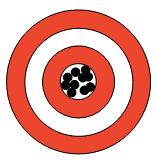
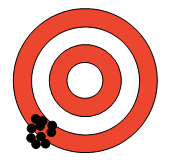
This bullseye demonstrates...
a)
High Accuracy & High Precision
b)
High Accuracy & Low Precision
c)
Low Accuracy & High Precision
d)
Low Accuracy & Low Precision
18.

This bullseye demonstrates...

a)

High Accuracy & High Precision

b)

High Accuracy & Low Precision

c)

Low Accuracy & High Precision

d)

Low Accuracy & Low Precision

19.

A student's measured length during a science experiment was 12.00 cm. The actual size was 14.25 cm.


What was the percent error?


*Hint: You now know how to calculate error, and you should know how to calculate a percent, so put the two together to find this answer.

a)

15.79%

b)

18.75%

c)

2.25%

20.

Jessie estimates the weight of her cat to be 8 pounds. The actual weight of the cat was 10 pounds.


What was the percent error?


*Hint: You now know how to calculate error, and you should know how to calculate a percent, so put the two together to find this answer.

a)

15%

b)

20%

c)

25%

d)

30%

21.

Which is the more precise measurement?

a)

4 mL

b)

4.3 mL

c)

4.30 mL

d)

4.300 mL

22.

Describe the accuracy and precision of the image

a)

Very accurate and somewhat precise

b)

Very accurate but not precise at all

c)

Not accurate at all but very precise

d)

not accurate and not very precise

23.

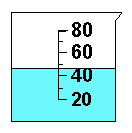
Based on the markings of this beaker, what is the estimated volume?

a)

48 mL

b)

48.2 mL

c)

48.25 mL

d)

0.04 L

24.

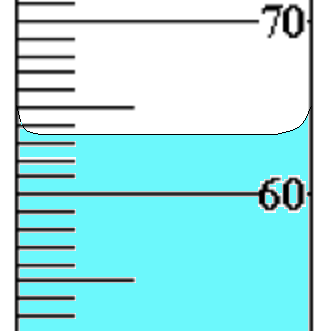
Based on the markings of this graduated cylinder, what is the estimated volume?

a)

63.5 mL

b)

63 mL

c)

63.55 mL

d)

0.063 L

25.

This image is a great example of...

a)

precision

b)

accuracy

26.

A set of data are all close in value to each other, but they are not close to the actual value. This set of data can be described as _________________.

a)

precise

b)

accurate

27.

A set of data are all close to each other, and they are close to the actual value. This set of data can be described as...

a)

accurate

b)

precise

28.

In this problem 2(9.8 in. +12.53 in.) =2\left(9.8\ in.\ +12.53\ in.\right)\ = the answer should be.

a)

44.0

b)

44.7

c)

44.6

d)

44.66

e)

45.00

29.
Zed went to the store and bought a bag of chips.  He estimated there would be 350 chips in the package, but realized there were only 210 chips in that package.  What was his percent error?
a)
35%
b)
67%
c)
85%
d)
92%
30.
The deer population is estimated to be 17,600 in northern Illinois, but an actual count was 21,300. What is the percent error?
a)
21%
b)
17.37%
c)
17.4%
d)
21.02%
31.
The students measured length during a science experiement, they got 12 cm. But the actual measurement was 14.25 cm. What was the percent error?
a)
15.79%
b)
18.75%
c)
2.25%
d)
18%
32.
The attendance for the basketball game was estimated to be 15,000 people but 12,500 people attended. What was the percent error?
a)
16.67%
b)
20%
c)
2500%
d)
80%
33.
Jessie estimates the weight of her cat to be 8 pounds.  The actual weight of the cat was 10 pounds.  Find the percent error.  
a)
15%
b)
20%
c)
25%
d)
30%
34.
Bob estimates that there will be 230 people who attend the concert.  There was an actual total of 300 people who attended.  Find the approximate percent error.  
a)
23%
b)
33%
c)
27%
d)
37%
35.
An archaeologist estimated that a fossil was 520 years old. It was actually 500 years old. What was the percent error?
a)
4%
b)
20%
c)
3.8%
d)
none of these
36.
Ms. Brown estimated 70 students would try out for the Cross Country team. This year, only 63 students tried out. What was her percent error?
a)
11%
b)
50%
c)
12%
d)
1%
37.
Convert from meters to cm:  9 meters
a)
900 cm
b)
90 cm
c)
0.9 cm
d)
0.09 cm
38.
Convert 17 m to cm:
a)
0.17 cm
b)
0.017 cm
c)
1,700 cm
d)
170 cm
39.
Convert 300 meters to centimeters:
a)
3000 cm
b)
0.3 cm
c)
30,000 cm
d)
3 cn
40.
Convert 8 kilometers to meters
a)
800 m
b)
80,000 m
c)
8,000 m
d)
.008 m
41.
Convert 5 cm to mm:
a)
5,000mm
b)
0.5 mm
c)
0.05 mm
d)
50 mm
42.
1000 grams = _____ kilograms
a)
0.0001
b)
1,000,000
c)
10
d)
1
43.
7,000 g = ____ kg
a)
70
b)
700
c)
7
d)
0.07
44.
490,000 g =____ kg
a)
490
b)
49
c)
4,900
d)
0.49
45.
5,000 mg = ____ g
a)
50
b)
5
c)
500
d)
5,000
46.
Is 20 g greater than, less than, or equal to 2 kg?
a)
greater than
b)
less than
c)
equal to
47.
648 g = ____ mg
a)
6,480
b)
64,800
c)
648,000
d)
64.8
48.
285 kg = ____ g
a)
285,000
b)
285
c)
2,850
d)
28,500
49.
285 kg = ____ g
a)
285,000
b)
285
c)
2,850
d)
28,500
50.
42 L = ___mL
a)
4,200
b)
.0042
c)
4.20
d)
42,000
51.
1 L = _______ mL
a)
1
b)
10
c)
100
d)
1000
52.

7,000 g = ____ kg

a)

70

b)

700

c)

7

d)

0.07

53.
Is 55,000 mg greater than, less than, or equal to 5 kg?
a)
greater than
b)
equal to
c)
less than
54.
285 kg = ____ g
a)
285,000
b)
285
c)
2,850
d)
28,500
55.
When writing a number in scientific notation, the first number must be greater than 1, but less than 10.
a)
False
b)
True
56.
What is it called when you go from this form to this next form?
0.0088 to 8.8 x 10³
a)
Standard form to scientific notation
b)
Scientific notation to regular form
c)
Scientific notation to standard form
d)
Standard form to regular form
57.
The rule of scientific notation is to write all exponents with a base of ____.
a)
50
b)
5
c)
100
d)
10
58.
When your exponent is negative, you move your decimal....
a)
to the right
b)
to the left
c)
to both sides
d)
nowhere.... the decimal goes nowhere
59.
ANY number raised to a power of 0 will be....
a)
10
b)
itself
c)
1
d)
0
60.
How do you write
1001
in scientific notation?
a)
1.0001 x 10⁴
b)
1.01 x 10⁵
c)
1.001 x 10³
d)
10.1 x 10³
61.
How do you write
8.317 x 10⁶
in standard form?
a)
8, 371, 000
b)
83, 170, 000
c)
837, 100
d)
8, 317, 000
62.
Solve:
(2.1×10²​​× (3.0×10⁴)
a)
5.1 x 10²
b)
6.3 x 10⁶
c)
5.1 x 10⁶
d)
6.3 x 10⁸
63.
What two types of measurements make up DENSITY
a)
Mass and Volume
b)
Temperature and Mass
c)
Grams and Centimeters
d)
Volume and Weight
64.
Jack has a rock. The rock has a mass of 14g and a volume of 2cm3. What is the density of the rock?
a)
7 mL
b)
7 g/cm3
c)
28 g/cm3
d)
1/7 g/cm3
65.
Why do the liquids form different layers?
a)
They have different densities.  
b)
They have different masses.  
c)
They have different volumes.  
d)
They are different temperatures.  
66.
What units can be used to express density?
a)
g/mL
b)
grams
c)
millimeters
d)
milliliters
67.
If an object has a density of .6 g/mL and you put it into water, will it sink or float?  
a)
sink
b)
float
68.
Frank has an eraser. It has a mass of 4g, and a volume of 2cm3. What is its density?
a)
8 g/cm3
b)
2 g/cm3
c)
1/2 g/cm3
d)
24 g/cm3
69.
Frank has a paper clip. It has a mass of 9g and a volume of 3cm3. What is its density?
a)
3 g/cm3
b)
1/3 g/cm3
c)
27 g/cm3
d)
39 g/cm3
70.
What units are used to measure mass?
a)
g
b)
cm3
c)
g/cm3
d)
cm3/g
71.
An object should float in a liquid if it is 
a)
Denser than the liquid 
b)
Less dense than the liquid
c)
Lighter than metal
d)
 Shaped like a ball 
72.
This bullseye demonstrates...
a)
High Accuracy & High Precision
b)
High Accuracy & Low Precision
c)
Low Accuracy & High Precision
d)
Low Accuracy & Low Precision
73.
Archimedes used density to discover if the crown of gold was real because
a)
Substances have their own unique densities
b)
Substances can change densities depending on their size
c)
Substances can change densities depending on their mass
d)
Substances can change densities depending on their volume