
 Worksheets
Transformations and Symmetry Review
Total questions: 110
Worksheet time: 2hrs 59mins


2. How many lines of symmetry does the picture have?
1
2
4
0

8. Determine the number of lines of symmetry for the figure.
0
1
3
6



Determine whether the figure has line symmetry, rotational symmetry, both, or neither.
Rotational
Reflectional
Both
Neither

What angle of rotation does the picture have?
360⁰
60⁰
180⁰
120⁰


What angle of rotation does the picture have?
360⁰
180⁰
120⁰
72⁰

What angle of rotation does the picture have?
60⁰
360⁰
180⁰
120⁰

Which number of degrees below describes the smallest angle that can rotate this regular polygon back onto itself?
60
90
180
120

Which number of degrees below describes the smallest angle that can rotate this regular polygon back onto itself?
180
90
45
120


Which number of degrees below describes the smallest angle that can rotate this regular polygon back onto itself?
40
60
72
90

Which number of degrees below describes the smallest angle that can rotate this regular polygon back onto itself?
60
45
75
90

Which number of degrees below describes the smallest angle that can rotate this regular polygon back onto itself?
60
180
120
45


Which transformation maps the rectangle to itself?
A 90 degree rotation about the center
A reflection over the blue line
a reflection across the red line
a reflection across the green line

Which of the following transformations carry this regular polygon onto itself?
Rotation of 36 degrees counterclockwise
Rotation of 120 degrees counterclockwise
Rotation of 90 degrees counterclockwise
Reflection across l

Which of the following transformations carry this regular polygon onto itself?
Rotation of 36 degrees counterclockwise
Rotation of 72 degrees counterclockwise
Rotation of 90 degrees counterclockwise
Rotation of 60 degrees counterclockwise

Which of the following transformations carry this regular polygon onto itself?
Rotation of 144 degrees counterclockwise
Rotation of 120 degrees counterclockwise
Rotation of 90 degrees counterclockwise
Rotation of 64 degrees counterclockwise

Which of the following transformations carry this REGULAR polygon onto itself?
Rotation of 72 degrees counterclockwise
Rotation of 180 degrees counterclockwise
Rotation of 90 degrees counterclockwise
Reflection across l

Which of the following transformations carry this regular polygon onto itself?
Rotation of 45 degrees counterclockwise
Rotation of 60 degrees clockwise
Rotation of 60 degrees counterclockwise
Rotation of 36 degrees counterclockwise

Which of the following transformations carry this regular polygon onto itself?
Rotation of 45 degrees counterclockwise
Rotation of 72 degrees counterclockwise
Rotation of 60 degrees counterclockwise
Reflection across l


What is this picture an example of?
Reflection
Translation
Rotation
Dilation

Zach and Naomi are studying geometric transformations. Zach is able to move the triangle A to A′ using the following sequence of basic transformations:
1. Reflection across the x-axis.2. Reflection across the y-axis.
3. Translation two units to the right.
Naomi claims that the same three transformations, done in any order will always produce the same result. Zach disagrees. Who is correct?
Zach
Naomi
Both are correct
Both are incorrect

The figure shows two perpendicular lines, and , intersecting at a point P in the interior of a trapezoid. Line is parallel to the bases and bisects both legs of the trapezoid. Line bisects both the bases of the trapezoid. Which transformation will carry the figure onto itself?
a reflection across line r .
a reflection across line s .
a rotation of 90° about point P .
a rotation of 180° about point P .

Octagon PQRSTVWZ is a regular octagon with its center at point C . Which transformations will map octagon PQRSTVWZ onto itself? Select ALL that apply.
reflection over QV .
reflecting over RW
reflecting over TZ
rotating 45° clockwise around point Z
rotating 90° counterclockwise around point C


Which of the following describes the sequence of transformations shown?
Reflect across the x-axis and then rotate -90 degrees cw around the origin
Rotate 90 degrees cw around the origin and then translate down.
Reflect across the x-axis and then reflect across the y-axis.
Translate up and then rotate 90 degrees ccw about the origin.


Describe the rotation.
Rotation 90o counter clockwise around the origin
Rotation 90o clockwise around the origin
Rotation 270o counter clockwise around the origin
Rotation 180o counter clockwise around the origin

Which triangle is the image of triangle B after a rotation of 270o clockwise around the origin?
Triangle B
Triangle C
Triangle A
Triangle D

The red triangle represents what type of rotation:
180° clockwise or counter clockwise around the origin
90° clockwise around the origin
90° counter clockwise around the origin
When a figure is translated, what is true? Select all that apply.
The image has the same coordinates as the preimage.
All the coordinates from the image have moved in the same direction.
Corresponding segments are parallel.
The image and preimage are congruent.
The image is a different size compared to the preimage.
When a figure is reflected, what is true? Select all that apply.
The line of reflection is the perpendicular bisector of corresponding vertices.
Corresponding vertices are equidistant from the line of reflection.
The image moves a specified distance to the right, left, up or down.
The image and preimage are congruent.
The image is a different size compared to the preimage.
When a figure is rotated, what is true? Select all that apply.
Corresponding vertices are equidistant from the center of rotation.
You need to know the angle of rotation, center of rotation, and the direction.
The image flips over a specific line.
The image and preimage are congruent.
The image is a different size compared to the preimage.

What sequence of transformations will map trapezoid A to its image A'?
Reflection across vertical line, then translation downwards
Rotation 180 degrees, then reflection over x-axis
Reflection across x-axis, then translation upwards
Rotation 180 degrees, then reflection over y-axis
Which statement is true about a translation?
A translation takes a line to a parallel line or itself
A translation takes a line to a perpendicular line
A translation requires a center of translation
A translation requires a line of translation
A translation rotates a line.

Select all sequences of translations, rotations, and reflections below that would take polygon P to polygon Q.
Rotate 180° around point A
Translate so that A is taken to J. Then reflect over line BA.
Rotate 60° counterclockwise around point A and then reflect over the line FA
Reflect over the line BA and then rotate 60° counterclockwise around point A.
Reflect over line BA and then translate by directed line segment BA.

Select ALL sequences of translations, rotations, and reflections below that would take polygon P to polygon Q.
Reflect over line BA and then translate by directed line segment CB
Translate by directed line segment BA then reflect over line BA
Rotate 60° clockwise around point B and then translate by directed line segment CB.
Translate so that E is taken to H. Then rotate 120° clockwise around point H.
Translate so that A is taken to J. Then reflect over line BA.

Select ALL sequences of translations, rotations, and reflections below that would take quadrilateral GHIJ to G'H'I'J'.
Translate quadrilateral GHIJ by the directed line segment from J to J'.
Reflect GHIJ over HI. Translate by directed line segment from J to J'.
Rotate 180° around center H. Translate by directed line segment from H to H'. Rotate 180° around center H'.
Reflect over line GH and then translate by directed line segment G to G'.
Reflect over line GH and then translate by directed line segment G to G'. Reflect over G'H'.

Square BCDE is inscribed in a circle with center A.
What is the image of segment BC after a 90° counterclockwise rotation around center A?
CD
DE
EB
BC
Square BCDE is inscribed in a circle with center A.
What is the image of segment BC after a 180° rotation around center A?
CD
DE
EB
BC
Square BCDE is inscribed in a circle with center A.
What is the image of segment BC after a 270° clockwise rotation around center A?
CD
DE
EB
BC

Regular Hexagon BCDEFG is inscribed in a circle with center A.
What is the image of segment BC after a 60° clockwise rotation around center A?
CD
DE
EF
FG
GB
Regular Hexagon BCDEFG is inscribed in a circle with center A.
What is the image of segment BC after a 60° counterclockwise rotation around center A?
CD
DE
EF
FG
GB
Regular Hexagon BCDEFG is inscribed in a circle with center A.
What is the image of segment BC after a 120° counterclockwise rotation around center A?
CD
DE
EF
FG
GB
Regular Hexagon BCDEFG is inscribed in a circle with center A.
What is the image of segment BC after a 120° clockwise rotation around center A?
CD
DE
EF
FG
GB
Regular Hexagon BCDEFG is inscribed in a circle with center A.
What is the image of segment BC after a 180° rotation around center A?
CD
DE
EF
FG
GB

Equilateral Triangle BCD is inscribed in a circle with center A.
What is the image of segment BC after a 60° rotation clockwise around center A?
CD
DB
BC
Equilateral Triangle BCD is inscribed in a circle with center A.
What is the image of segment BC after a 120° rotation counterclockwise around center A?
CD
DB
BC
Equilateral Triangle BCD is inscribed in a circle with center A.
What is the image of segment BC after a 120° rotation counterclockwise around center A?
CD
DB
BC
Equilateral Triangle BCD is inscribed in a circle with center A.
What is the image of segment BC after a 240° rotation counterclockwise around center A?
CD
DB
BC
Equilateral Triangle BCD is inscribed in a circle with center A.
What is the image of segment BC after a 240° rotation clockwise around center A?
CD
DB
BC
Square BCDE is inscribed in a circle with center A.
What is the image of segment BC after a reflection over the perpendicular bisector of BE?
CD
DE
EB
BC
Square BCDE is inscribed in a circle with center A.
What is the image of segment BC after a reflection over the perpendicular bisector of ED?
CD
DE
EB
BC
Regular Hexagon BCDEFG is inscribed in a circle with center A.
What is the image of segment BC after a reflection over the line BE?
CD
DE
EF
FG
GB
Regular Hexagon BCDEFG is inscribed in a circle with center A.
What is the image of segment BC after a reflection over the line GD?
CD
DE
EF
FG
GB
Regular Hexagon BCDEFG is inscribed in a circle with center A.
What is the image of segment BC after a reflection over the line CF?
CD
DE
EF
FG
GB
Equilateral Triangle BCD is inscribed in a circle with center A.
What is the image of segment BC after a reflection over the perpendicular bisector of BD?
CD
DB
BC
Equilateral Triangle BCD is inscribed in a circle with center A.
What is the image of segment BC after a reflection over the perpendicular bisector of CD?
CD
DB
BC
Equilateral Triangle BCD is inscribed in a circle with center A.
What is the image of segment BC after a reflection over the perpendicular bisector of BC?
CD
DB
BC

are vertical angles
are vertical angles
are vertical angles
are vertical angles

are corresponding angles
are corresponding angles
are corresponding angles
are corresponding angles

are alternate interior angles
are alternate interior angles
are alternate interior angles
are alternate interior angles


Find x.
115 °
65 °
36 °
245 °

What is the missing angle?
120 degrees
90 degrees
65 degrees
40 degrees

Find the missing angle.
39 degrees
87 degrees
42 degrees
36 degrees
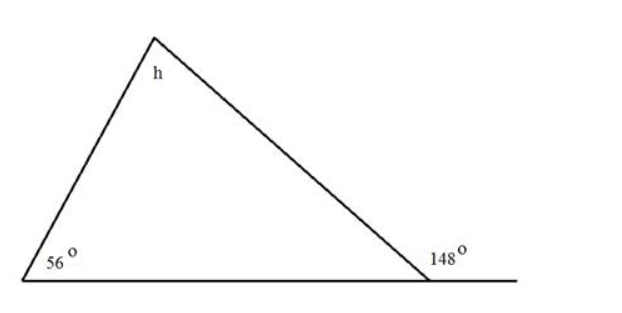
Find h.
32 degrees
92 degrees
56 degrees
not enough information


A student is trying to construct triangles using four different sets of angles. The angles in each set are given below. Which set will form a triangle?
45°, 65°, 70°
150°, 110°, 100°
50°, 50°, 50°
90°, 90°, 90°

Find the indicated angle. (What is ?)
91°
81°
89°
109°


Find the indicated angle measure. (What is ?)
51°
37°
167°
41°

Solve for x
49
58
70
94

Solve for x
70
23
120
130

Solve for x
60
120
40
65

