
 Worksheets
Geometry Quarter 1 Practice Test
Total questions: 105
Worksheet time: 3hrs 23mins

Write a rule for the translation.
(x -1, y + 2)
(x -2, y + 1)
(x +2, y - 1)
(x +1, y - 2)
Not enough information to write a rule.

Identify the transformation from ABC to A'B'C'.
90o clockwise rotation
90o counter clockwise rotation
Reflection across the y-axis
Reflection across the x-axis
Translation down 2 units

Identify the transformation from ABCD to A'B'C'D'.
Translation (x,y) -->(x-7,y)
Reflection across the y-axis
Reflection across the x-axis
90o counter clockwise Rotation
Translation (x,y) --> (x+7, y)

Identify the transformation from A to D.
90o Clockwise Rotation
180o Rotation
270o Clockwise Rotation
Y-Axis Reflection
X-Axis Reflection

Which rule would dilate shows a scale factor of 4
(x, y) → (y, x)
(x, y) → (x + 4, y + 4)
(x, y) → (x - 4, y -4)
(x, y) → (4x, 4y)
(x, y) → (1/4x, 1/4y)

What is the rule for the dilation pictured below?
(x, y) → (½x, ½y)
(x, y) → (x + 2, y + 2)
(x, y) → (2x, 2y)
(x, y) → (2x, 3y)
(x, y) → (1/3x, 1/3y)

What is the sequence of transformations?
Reflect over the y then reflect over the x
Reflect over the x then reflect over the y
Translate 4 units then rotate 90˚
Rotate 90˚ then reflect over the x
Rotation of 180 degrees

Which of the following describes the sequence of transformations shown?
Reflect across the x-axis and then rotate -90 (clockwise) around the origin
Rotate -90 (clockwise) degrees around the origin and then translate down.
Reflect across the x-axis and then reflect across the y-axis.
Translate up and then rotate 90 (counterclockwise) degrees about the origin.
Y-Axis reflection and then a x-axis reflection.

What types of transformations happened to get from shape 1 to shape 3, choose ALL that apply.
Rotation
Translation
Reflection
Dilation
Non-Rigid Transformation

Dilate Point B by a scale factor of 1/2
(1.5,-4)
(-1.5,1)
(-1,-1.5)
(-2,-2)
(-6,4)

Choose the correct transformations
rotate 90 degrees counter-clockwise around the origin, and then reflect over the x-axis
right 1, down 4, and then reflection over the y-axis
right 6, and then reflection over the x-axis
reflection over the line y=x, and then translate up 4, right 2
reflection over the y-axis, and then (x,y) --> (x-1, y+4)

Choose the correct transformations
rotate 90 degrees counter-clockwise around the origin, and then reflect over the x-axis
right 1, down 4, and then reflection over the y-axis
right 6, and then reflection over the x-axis
reflection over the line y=x, and then translate up 4, right 2
reflection of the x-axis, and then a translation to the left 6

Choose the correct transformations
rotate 90 degrees counter-clockwise around the origin, and then reflect over the x-axis
right 1, down 4, and then reflection over the y-axis
right 6, and then reflection over the x-axis
reflection over the line y=x, and then translate up 4, right 2
reflection over the x-axis, and then rotate 90 degrees clockwise around the origin

Describe the transformations that map ABC onto A"B"C"
translate 5 up and 1 left then reflect over y
translate 5 down and 1 left, then reflect over y
reflect over y=x then translate left 8
reflect over x then rotate 90 clockwise
reflect over the x-axis then translate 4 to the right

Name the series of transformations that maps ABC onto DEF
reflect over x then translate left 6 up 1
reflect over y then translate down 6 left 1
translate right 6 down 1, then reflect over x
rotate 90 clockwise then reflect over y
reflect over y then right 6 down 1

Choose the correct scale factor:
2
3
1/3
1/2
Not enough Information

What is the rule for the following reflection?
Reflection across y = −2
Reflection across x = −2
Reflection across x = 2
Reflection across y = 2
Reflection across y = x

Identify the smallest angle of rotation that maps the image to itself.
180°
360°
90°
No rotational symmetry
72°
The rule for dilation is
(x, y) --> _
(kx, ky)
(x, -y)
(-x, y)
(x+a, y+b)
(-x,-y)
The rule for reflection over the x-axis is
(x, y) --> _
(-x, y)
(x, -y)
(y, x)
(-y, -x)
(-x,-y)
The rule for rotation of 180 degrees is
(x, y) --> _
(-y, x)
(-x, -y)
(y, -x)
(-y, -x)
(-x, y)
Which rule describes the action of the coordinates when a figure is reflected over the line y = x?
(x, y)→(-y, -x)
(x, y)→(-x, y)
(x, y)→(-x, -y)
(x, y)→(y, x)
(x, y)→(-y, x)
A transformation that does not change the size or shape of a pre-image (pre-image and image are congruent) is called
Rigid Motion Transformation
Dilation
Non-Isometric
Non- Rigid Motion Transformation
Similar Figure Transformation
Which is NOT an Isometry?
Relection
Dilation
Rotation
Translation
Not Enough Information

Identify the smallest angle of rotation that maps the image to itself.
90°
180°
45°
60°
30°
A rigid motion creates figures that are ____________.
congruent
different sizes
similar
larger
dilated figures

What are the series of rigid motions that would map ∆ABC onto ∆A''B''C''?
a reflection followed by a rotation
a reflection followed by a translation
a translation followed by a rotation
a translation followed by a reflection
a rotation followed by a translation

Which of the following transformation will map the regular pentagon onto itself, choose ALL that apply?
x axis reflection
y axis reflection
90 degree rotation
180 degree rotation
72 degree rotation around the orgin

Which of the following transformation will map the trapezoid onto itself, choose ALL that apply?
x axis reflection
reflection across green line
rotation 90 degrees about (2,-1)
reflection across the blue line
rotation 180 degrees about (2,-1)
Which of the following transformation will map the regular pentagon onto itself?
reflection across blue line
reflection across green line
108 degree rotation about the origin
216 degree rotation about the origin
None of the transformation map onto the original penatgon

Which transformation will map the rectangle onto itself?
90 degree rotation about (-2,1)
540 degree rotation about (-2,1)
reflection across the x axis
reflection across the blue line
reflection across the x axis

Which of the following transformations will NOT map the regular hexagon onto itself?
270 degree rotation about the origin
x axis reflection
y axis reflection
180 degree rotation about the origin
120 degree rotation about the origin

Which transformation will map the parallelogram onto itself?
reflection x axis
reflection y axis
refection across the green line
reflection over the line y=x
none of these above

A straightedge and compass were used to creat the construction above. Arc EF was drawn from Point B, and arcs with equal radii were drawn from E and F. Choose all of the following that must be true.


Based on the construction above which of the following are always true, choose all that apply.

AB=CD
AE=EB
CE=ED
AC=BC
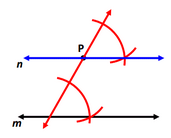
Name the construction.
Corresponding angles
Parallel line to a point not on the line
Perpendicular line to a point not on the line
Angle bisector
Alternate Interior Angles
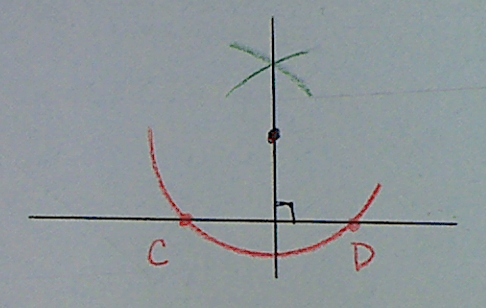
Name the construction.
Midpoint
Perpendicular through a point on the line
Perpendicular through a point NOT on the line
Circumcenter of a right triangle
Constructing the center of the circle on the y-axis

A line perpendicular to one of two parallel lines is perpendicular to the other.
Two lines are perpendicular if they intersect to form congruent adjacent angles.
When two lines are intersected by a traversal and alternate interior angles are congruent, the lines are parallel.
When two lines are intersected by a transversal and the corresponding angles are congruent, the lines are parallel.
When two lines are intersected by a traversal and same side exterior angles are congruent, the lines are parallel.
Which of the following is the construction of an equilateral triangle given side AB?


Not enough information without labeled side lengths
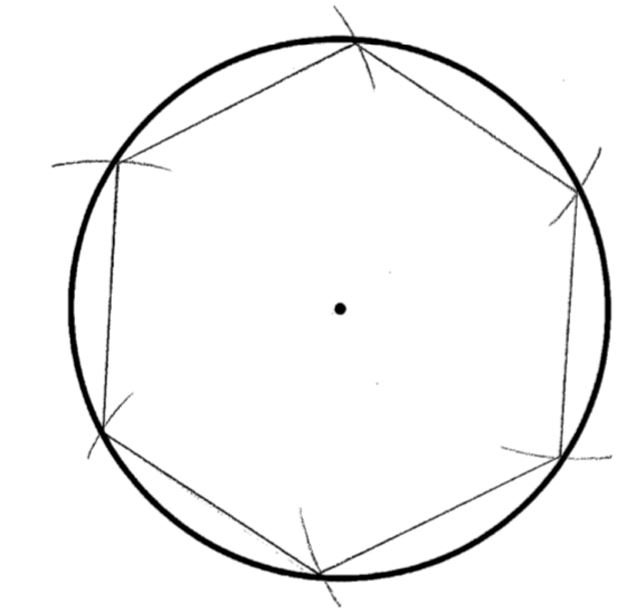
Name the pictured construction.
Circled Hexagon
Hexagon Inscribed in a Circle
Square Inscribed in a Circle
Triangle Inscribed in a Circle
Circumscribed Polygon with an Inscribed Circle

The following shows the steps of which construction?
inscribed triangle
inscribed hexagon
circumscribed square
inscribed square
circumscribed rhombus
Becky leaves school to go home. She walks 6 blocks North and then 8 blocks west. How far is Becky from the school?
14 blocks
12 blocks
10 blocks
8.5 blocks
13 blocks

Choose all pairs of vertical angles?
∠COB & ∠COA
∠AOD & ∠AOC
∠COB & ∠AOD
∠BOD & ∠AOD
∠COA & ∠BOD

What is the value of x?
37
72
108
18
74

Find the value of x.
74
37
52
105
75

What is the relationship of the two angles shown in the picture and what is the value of x.
Complementary; x=3.4
Complementary; x=45
Supplementary; x=20
Supplementary; x=175
Vertical Angles x= -5

Identify all the correct statement.
∠1 & ∠2
are corresponding angles
∠2 & ∠4
are vertical angles
∠5 & ∠8
are vertical angles
∠1 & ∠5
are corresponding angles
∠4 & ∠5
are alternate exterior angles
What are lines that intersect to make a right angle?
perpendicular
complementary
supplementary
corresponding
parallel
What are line segments or angles that have the same measure?
perpendicular
parallel
congruent
ray
similar
What are lines in a plane that do not intersect?
skew
parallel
perpendicular
transversal
straight

Find the measure of the missing angle.
72 degrees
108 degrees
18 degrees
90 degrees
36 degrees
The Triangle Sum Theorem states that the sum of the angles of a triangle equal how many degrees?
90
360
150
180
60
What do we call a triangle with three different side lengths?
scalene
isosceles
equilateral
Pythagorean Theorem
obtuse
What do we call a triangle with two equal sides and angles?
scalene
isosceles
equilateral
Pythagorean Theorem
obtuse
What do we call a triangle with three equal sides
scalene
obtuse
equilateral
right
isosceles

What is the value of b:
146
34
36
115
31
Supplementary angles equal what?
45 degrees
360 degrees
180 degrees
90 degrees
60 degrees
Equilateral Triangle
2 sides that are equal; 2 equal angles
No sides are equal; no equal angles
All 3 angles measure less than 90 degrees
All 3 sides are equal; all angles equal 60 degrees
2 equal base angles; no equal sides

What type of triangle is this?
Equilateral
Isosceles
Scalene
Obtuse
Equal-angular

What type of triangle is this, choose all that apply?
Equilateral Triangle
Scalene Triangle
Isosceles Triangle
Right Triangle
Acute Triangle

Given triangle JKL what is the measure of angle L?
9 degrees
25 degrees
47 degrees
52 degrees
108 degrees

What is the value of x?
60 degrees
5 degrees
10 degrees
15 degrees
30 degrees

What is the value of (?)
90 degrees
80 degrees
70 degrees
60 degrees
40 degrees

What is the value of x?
20o
60o
15o
40o
8 in.

What is the measure of angle 2?
50 degrees
57.5 degrees
65 degrees
115 degrees
180 degrees


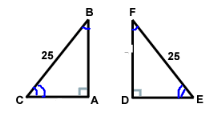
Triangle ABC has been reflected to form DFE. If ∠C is 40o find the measure of ∠F.
40o
50o
90o
45o
140o

How many lines of symmetry does the picture have?
0 lines of symmetry
1 line of symmetry
2 lines of symmetry
3 lines of symmetry
Not enough information

Which would be the best classification for the triangle shown?
right isosceles
obtuse scalene
obtuse isosceles
acute scalene
equilateral

Classifying the following the triangle as many ways as possible.
Acute, Scalene
Right, Scalene
Obtuse, Scalene
Acute, Isosceles
Obtuse, Isosceles
Which one is the easy way to remember trigonometric ratios?
Sah Coh Toa
Soh Cah Toa
Soh Cah Tao
Soh Cah Toh
Sah Coa Toh
If you are given the hypotenuse and an adjacent side, which trigonometric function should you use to find the angle?
sine
cosine
tangent
cotangent
Pythagorean theorem
We can use SOH-CAH-TOA for...
Any triangle ever
Non-right triangles only
Right Triangles only
Never
Classifying Triangles

Which method?
45-45-90 Triangle
30-60-90 Triangle
Trig (SOHCAHTOA)
Pythagorean Theorem
Inverse Trig (SOHCAHTOA)

Find Cos(A) as a decimal rounded the the nearest ten-thousandth.
.4706
1.875
.8824
.5333
61.92

Find Tan A
21/20
29/20
21/29
20/21
20/29

What is cos(B)?
a/c
b/c
a/b
b/a
c/a

What is sin(B)?
a/c
b/c
a/b
b/a
c/a

Choose the correct ratio.
cos(33)=x/14
sin(33)=x/14
cos(33)=14/x
sin(33)=14/x
tan(33)=14/x

Set up the problem...
sin X = 41/28
tan X = 41/28
cos X = 28/41
sin X = 28/41
tan X = 28/41

Based on the diagram, choose all the statements that are true.


Right triangle ABC is shown below. Which equation gives the correct value for BC?


Not enough information to solve BC

Find the measure of the missing angle.
49o
50o
41o
33o
57o
Which trigonometric ratios are correct?
cos C= adj/hyp
sin C= adj/hyp
tan C= adj/hyp
tan C=adj/opp
tan C= opp/adj
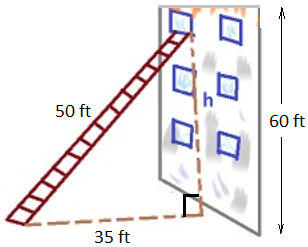
Find h
35.60
45.57
35.71
61.03
44.43

Find the length of the missing side.
17 cm
22 cm
15 cm
13 cm
10.9 cm
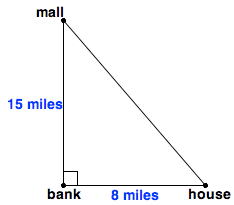
Casey travels from her house directly west to the bank and then directly north from the bank to the mall. She then travels home on the road connecting the mall and her house. What is her total distance traveled?
17 miles
32 miles
37 miles
40 miles
42 miles
A rectangular field is 50 yards wide and 100 yards long. Patrick walks diagonally across the field. How far does he walk?
111.8 yards
115 yards
127.3 yards
119 yards
86.6 yards
a = 2.1, b = 7.2,
c = 7.5
Given the three sides lengths choose all options that are true
The sides create an right triangle
The sides create an acute triangle
The sides create an obtuse triangle
The sides do not create a triangle
The sides create an scalene triangle
Which set of side lengths does not form a right triangle?
38, 80, 90
16, 63, 65
36, 77, 85
14, 15, 29
Not enough information to determine if the side lengths form a right triangle.
Jake built a skateboard ramp that covers a horizontal distance of 10 ft. The ramp rises a total of 3.5 ft. What angle does the ramp make with the ground? Round to the nearest degree.
19 degrees
20 degrees
45 degrees
70 degrees
71 degrees

Which of the following is correct for finding the measure of angle Z, choose all that are correct?
∠Z = tan-1 55/48
∠Z = sin-1 48/55
∠Z = cos-1 55/73
∠Z = tan-1 48/73
∠Z = sin-1 48/73

Solve for the missing angle
41.4
0.013
36.9
48.6
53.1

A yacht is anchored 90 feet offshore from the base of a lighthouse. The angle of elevation from the boat to the top of the lighthouse is 26 degrees. The distance between the yacht and the top of the lighthouse is about 100 feet. How far is the boat from the top of the lighthouse??
100 feet
45 feet
110 feet
135 feet
81 feet

Jose would like to know the height of the brick building shown in the picture, if the angle of elevation is 50 degrees and he is 36 feet from the building. Which of these is the calculator ready expression to find the building height?
36 Sin (50)
36 Tan (50)
36 Sin (50) + 6
36 Tan (50) + 6
36 Cos (50) + 6

Henry knows the angle of depression from the lookout and also knows from that angle it is 45 feet in the air. About how far is he from the middle of the lookout tower?
30 feet
45 feet
38 feet
54 feet
59 feet

Susan is flying a kite, which gets caught in the top of a tree. Use the diagram to estimate the height of the tree.
63 ft
65 ft
74 ft
87 ft
125 ft

Solve for the missing distance for the depth of the anchor.
18.9 m
19.5 m
47 m
27.5 m
24.3 m
The pilot of a traffic helicopter sights an accident at an angle of depression of 18 degrees. The helicopter’s altitude is 1560 ft. What is the horizontal distance from the helicopter to the accident? Round to the nearest foot.
507 ft
1640 ft
4801 ft
5048 ft
1884 ft
When the angle of elevation of the sun is 78 degrees, an statue casts a shadow that is 6m long. How far is the top of the statue to the end of its shadow?
5.87 m
28.86 m
28.23 m
1.25 m
13.00 m
Which are equal to the sin30o? Select all that apply.
1/2
0.5
cos 60o
cos 30o
tan 30o
If sin x = cos y, what must be true about x and y?
x + y = 90⁰
x = y
x = 2y
x + y = 180⁰
Not enough information
What is the value of x?
cos (2x - 17) = sin (x - 4)
13
17
21
37
53
cos 40⁰ = ?
sin 50⁰
cos 50⁰
tan 50⁰
sin 40⁰
tan 40⁰
If cosA = sinB then the two angles A and B have to be:
supplementary
Complementary
Adjacent
A linear pair
Parallel

