
 Worksheets
EC or nah?
Total questions: 105
Worksheet time: 2hrs 44mins
Name
Class
Date
1.

an angle that forms a square corner
a)
right angle
b)
rectangle
c)
acute angle
2.

lines that cross or meet and form angles
a)
parallel lines
b)
intersecting lines
c)
ray
3.

a shape with 4 equal sides and 2 pairs of parallel sides
a)
rhombus
b)
trapezoid
c)
rectangle
4.

a quadrilateral with exactly one pair of parallel sides
a)
square
b)
trapezoid
c)
parallelogram
5.

a shape with 2 pairs of parallel sides and two pairs of equal sides
a)
parallelogram
b)
trapezoid
c)
triangle
6.

formed by 2 rays or line segments that share the same endpoint
a)
line segment
b)
angle
c)
point
7.

lines that cross or meet to form a right angle
a)
line segments
b)
parallel lines
c)
perpendicular lines
8.

lines that never cross or meet and are the same distance apart
a)
intersecting lines
b)
parallel lines
c)
perpendicular lines
9.

a shape with 4 equal sides, 2 pairs of parallel sides, 4 right angles
a)
pentagon
b)
square
c)
trapezoid
10.

a shape with 2 pairs of equal sides, 2 pairs of parallel sides, and 4 right angles
a)
rectangle
b)
trapezoid
c)
octagon
11.

a)
isosceles triangle
b)
scalene triangle
c)
right triangle
d)
equilateral triangle
12.

a)
triangle
b)
perpendicular lines
c)
segments
d)
parallel lines
13.

a)
isosceles triangle
b)
right trianlge
c)
scalene triangle
d)
equilateral triangle
14.

a)
circumcenter
b)
perpendicular lines
c)
parallel lines
d)
segments
15.

a)
perpendicular lines
b)
perpendicular bisector
c)
parallel lines
d)
circumcenter
16.

a)
perpendicular bisector
b)
angle bisector
c)
line
d)
segment
17.
The original figure of a geometric figure is called a...
a)
Image
b)
Pre-image
c)
Shape
d)
None of the above
18.
The original figure of a geometric figure is called a...
a)
Image
b)
Pre-image
c)
Shape
d)
None of the above
19.
After the transformation, the figure is called the...
a)
Pre-image
b)
After-image
c)
Image
d)
Shape
20.
What type of transformation slides the pre-image to a different location without turning or changing it in any way?
a)
Transformation
b)
Translation
c)
Orientation
d)
Rotation
21.
If the pre-image and the image have the same size and shape, then they are...
a)
Congruent
b)
Similiar
c)
Different
22.
What type of transformation flips a figure across a line?
a)
Transformation
b)
Translation
c)
Reflection
d)
Rotation
23.
The image formed by a reflection is blank to the pre-image.
a)
Congruent
b)
Similiar
c)
Different
24.
What type of transformation turns a figure about a fixed point?
a)
Translation
b)
Reflection
c)
Rotation
d)
Orientation
25.
The direction of rotation can be...
a)
Clockwise
b)
Counterclockwise
c)
Both
26.
What transformation changes the size, but not the shape of a figure?
a)
Translation
b)
Orientation
c)
Dilation
d)
Rotation
27.
The scale factor of a dilation is the...
a)
Difference of length in pre-image than the length in the image
b)
Ratio of a length of the image to the corresponding length of the pre-image.
c)
A scale that shows factors
d)
None of the above
28.
What type of triangle contains one right angle?
a)
Isosceles
b)
Equilateral
c)
Right
d)
None of the above
29.
The side opposite the right angle is called the...
a)
Hypotenuse
b)
Leg
c)
Side Length
d)
None of the above
30.
The sides that are not opposite of the right angle are called the...
a)
Hypotenuse
b)
Legs
c)
Sides
d)
None of the above
31.
What unique relationship exists among the lengths of the sides of a right triangle?
a)
Equal Sides
b)
Pythagorean Theorem
c)
Hypotenuse and legs
d)
None
32.
Which of the following expresses the Pythagorean Theorem?
a)
a + b = c
b)
a2 + b2 = c2
c)
ax +bx = cx
d)
a + b + c = 0
33.

Name the angle with three arcs
a)
< FIE
b)
< IER
c)
< FIR
d)
< REF
34.

Name the angle with two arcs
a)
< FIE
b)
< EIR
c)
< FER
d)
< FIR
35.

What type of angles are <1 and <2?
a)
Linear Pair
b)
Supplementary Angles
c)
Adjacent Angles
d)
All of these
36.
Two angles that share a side and the vertex. Also called "next door neighbor" angles.
a)
Obtuse Angle
b)
Acute Angle
c)
Right Angle
d)
Adjacent Angles
37.
Two angles whose sum totals 180 degrees.
a)
Obtuse Angle
b)
Acute Angle
c)
Right Angle
d)
Supplementary Angles
38.

What type of angles are <1 and <2?
a)
Supplementary Angles
b)
Linear Pair
c)
Adjacent Angles
d)
Vertical Angles
39.
A segment or ray that divides an angle into two congruent halves.
a)
Midpoint
b)
Perpendicular Lines
c)
Angle Bisector
d)
Linear Pair
40.

What type of angles are <1 and <2?
a)
Alternate Exterior Angles
b)
Alternate Interior Angles
c)
Same-Side Interior Angles
d)
Corresponding Angles
41.

<1 is ______________ to <2.
a)
congruent
b)
supplementary
42.

What type of angles are <1 and <2?
a)
Alternate Exterior Angles
b)
Alternate Interior Angles
c)
Same-Side Interior Angles
d)
Corresponding Angles
43.

<1 is ______________ to <2.
a)
congruent
b)
supplementary
44.

m<4 = _____________________
a)
m<3
b)
m<1 + m<2
c)
m<1 + m<2 + m<3
d)
180
45.

Which two angles are the base angles in this isosceles triangle?
a)
<1 and <2
b)
<2 and <3
c)
<1 and <3
d)
What are base angles?
46.
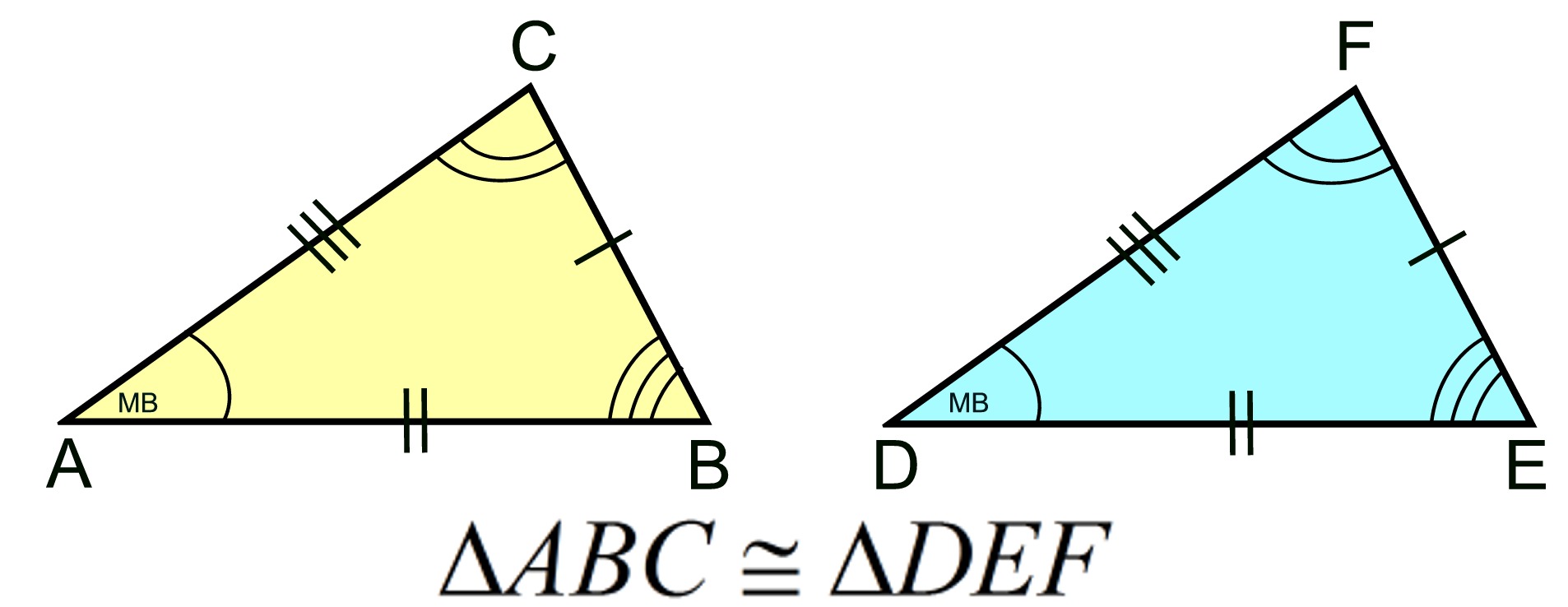
Two things are CONGRUENT if they are
a)
opposites
b)
different size and shape
c)
the same color
d)
the same size and shape
47.

Angles are SUPPLEMENTARY if their measurements total
a)
360 degrees
b)
180 degrees
c)
90 degrees
d)
75 degrees
48.

Angles are COMPLEMENTARY if their measurements total
a)
360 degrees
b)
180 degrees
c)
90 degrees
d)
75 degrees
49.

Angles are ADJACENT if they have
a)
2 sides
b)
a common side and a common vertex
c)
a starting point
d)
none of the above
50.

Describe the angles of this shape.
a)
4 right angles
b)
1 right angle
c)
3 right angles
d)
No right angles
51.

Describe the angles of this shape.
a)
3 right angles
b)
3 LESS THAN right angles
c)
3 GREATER THAN right angles
d)
2 LESS THAN right angles
52.

How many sides and angles does a QUADRILATERAL have?
a)
4
b)
2
c)
5
d)
3
53.
'Congruent' shapes are the same shape & size.
a)
True
b)
False
54.
If a polygon has all equal sides, then it can be called
a)
equilateral
b)
equiangular
c)
isosceles
d)
scalene
55.
Line segments that have the same length are called ______________________________.
a)
congruent segments
b)
congruent angles
c)
midpoint
d)
segment bisector
56.
Points that lie on the same line are called ___________________________________.
a)
collinear points
b)
noncollinear points
c)
defined Terms
d)
endpoints
57.
A point that divides, or bisects, a segment into two congruent segments is called a ___________________.
a)
midpoint
b)
congruent segment
c)
angle bisector
d)
endpoint
58.
A point, ray, line, segment, or plane that intersects a segment at its midpoint is called a _______________________________.
a)
segment bisector
b)
angle bisector
c)
line
d)
congruent segment
59.
A triangle with no equal sides is a(n) ________ triangle.
a)
equilateral
b)
isosceles
c)
scalene
60.
A triangle with two equal sides is a(n) ________ triangle.
a)
equilateral
b)
isosceles
c)
scalene
61.

Which are pairs of vertical angles?
a)
∠COB & ∠COA
b)
∠AOD & ∠AOC
c)
∠COB & ∠AOD
d)
∠BOD & ∠AOD
62.

Which are pairs of adjacent angles?
a)
∠COB & ∠DOA
b)
∠AOD & ∠AOC
c)
∠COB & ∠AOD
d)
∠BOD & ∠AOC
63.
Vertical angles are always
a)
acute
b)
total 180 degrees
c)
congruent (equal measures)
d)
adjacent angles
64.

Name this shape.
a)
Triangle
b)
Square
c)
Rectangle
d)
Cube
65.

Name this shape.
a)
Square
b)
Rectangular Prism
c)
Rectangle
d)
Circle
66.

Name this shape.
a)
Sphere
b)
Cube
c)
Rectangle
d)
Circle
67.

Name this shape.
a)
Rectangle
b)
Triangle
c)
Circle
d)
Square Pyramid
68.

is formed when two lines meet at a shared point.
a)
Angle
b)
Square
c)
Line
d)
Point
69.

What is a vertex?
a)
The point where two waves meet
b)
The point where two lines meet
c)
The point where two sides meet
d)
The point where two segments meet
70.

Why is a Triangle called Equilateral?
a)
It has two sides that match
b)
It has all 3 sides that match
c)
It has no sides that match
d)
It has four sides that match
71.

Why is a Triangle called Isosceles?
a)
It has two sides that match
b)
It has three sides that match
c)
It has no sides that match
d)
It has four sides that match
72.

Why is a Triangle called Scalene?
a)
It has two sides that match
b)
It has three sides that match
c)
It has no sides that match
d)
It has four sides that match
73.

Why is a Triangle called a Right Triangle?
a)
It has 3 right angles
b)
It has 2 right angles
c)
It has 1 right angle
d)
It has 0 right angles
74.

Why is a Triangle called an Acute Triangle?
a)
It has 3 acute angles
b)
It has 2 acute angles
c)
It has 1 acute angle
d)
It has 0 acute angles
75.

Why is a Triangle called an Obtuse Triangle?
a)
It has 0 obtuse angles
b)
It has 1 obtuse angle
c)
It has 2 obtuse angles
d)
It has 3 obtuse angles
76.

Is a quadrilateral that has opposite sides that are parallel and all of its sides are the same length
a)
Rhombus
b)
Trapezoid
c)
Rectangle
d)
Square
77.

Has 2 pairs of parallel sides.
a)
Trapezoid
b)
Triangle
c)
Parallelogram
d)
Rhombus
78.

Which Quadrilateral has 4 right angles, 2 sets of parallel sides, and is also a parallelogram?
a)
Rectangle
b)
Square
c)
Triangle
d)
Rhombus
79.

Which Quadrilateral has 4 right angles, 2 sets of parallel sides, and all of its' sides are the same length?
a)
Triangle
b)
Rhombus
c)
Rectangle
d)
Square
80.
If a shape can be folded on a line to form two equal halves that fit on top of each other it is _________?
a)
Obtuse
b)
Symmetric
c)
Normal
d)
Spacial
81.

The folded line that shows a shape has symmetric is called what?
a)
Line of Symmetry
b)
Line of Special
c)
Line of Obtuse
d)
Line of Noral
82.
What is the measurement of a right angle?
a)
70
b)
80
c)
90
d)
180
83.
Which is the measurement of an acute?
a)
0
b)
35
c)
180
d)
90
84.
Which is the measurement of an obtuse angle?
a)
90
b)
20
c)
130
d)
180
85.
Now that you know your basic angles which is biggest?
a)
Straight
b)
Obtuse
c)
Acute
d)
Right
86.
Which is smallest?
a)
Acute
b)
Obtuse
c)
Straight
d)
Right
87.
If you were to add a right angle plus a right angle it would equal what ____
a)
90
b)
91
c)
181
d)
180
88.
If you were to add a straight angle and a straight angle it would equal ____
a)
360
b)
180
c)
200
d)
90+90
89.

Write a rule for the translation.
a)
(x -1, y + 2)
b)
(x -2, y + 1)
c)
(x +2, y - 1)
d)
(x +1, y - 2)
90.

Identify the transformation from ABC to A'B'C'.
a)
90o clockwise rotation
b)
90o counter clockwise rotation
c)
Reflection across the y-axis
d)
Reflection across the x-axis
91.

Which rule would result in a translation of 2 units left and 3 units up?
a)
(x, y) → (2x, 3y)
b)
(x, y) → (x - 2, y + 3)
c)
(x, y) → (-x, -y)
d)
(x, y) → (x + 2, y - 3)
92.
The rule for reflection over the y-axis is
(x, y) --> _
(x, y) --> _
a)
(-x, y)
b)
(x, -y)
c)
(y, x)
d)
(-y, x)
93.
What would the new point be if you rotated the point (3,-5) 270° clockwise?
a)
a. (-3,-5)
b)
b. (-5,-3)
c)
c. (5,3)
94.
Dilate the figure by a scale factor of 3 with the origin as the center of dilation. What are the coordinates of the image?
A(3,3) B(6,6) C(9,3)
A(3,3) B(6,6) C(9,3)
a)
A'(9,9) B'(18,18) C'(27,9)
b)
A'(6,6) B'(9,9) C'(12,6)
c)
A'(0,0) B'(3,3) C'(6,0)
d)
A'(1,1) B'(2,2) C'(3,1)
95.

How many degrees was the figure rotated?
a)
90 degrees counterclockwise
b)
180 degrees
c)
90 degrees clockwise
96.

State the line of reflection.
a)
Reflection across y-axis
b)
Reflection across x-axis
c)
Reflection across x = 1
d)
Reflection across y = 1
97.
What are the coordinates after the following rotation?
A(2, −2), B(4, −1), C(4, −3)
90° counterclockwise about the origin
A(2, −2), B(4, −1), C(4, −3)
90° counterclockwise about the origin
a)
A'(-2, -2) B'(-1, -4), C'(-4, -3)
b)
A′(2, 2), B′(1, 4), C′(3, 4)
c)
A'(-2, 2) B'(-1, 4), C'(-3, 4)
d)
A'(2, −2), B'(4, −1), C'(4, −3)
98.

After a reflection over the y-axis, the coordinates of the triangle will be:
a)
(-5, -2), (-2, -3), (-6, -5)
b)
(5, 2), (2, 3), (6, 5)
c)
(5, -2), (2, -3), (6, -5)
d)
(-5, 2), (-2, 3), (-6, 5)
99.

The triangle is rotated 90o counter-clockwise. The new coordinates are
a)
(-1, 1), (-4, 1), (-1, 5)
b)
(1, -1), (4, -1), (1, -5)
c)
(1, 1), (1, 4), (5, 1)
d)
(-1, -1), (-1, -4), (-5, -1)
100.

The triangle is reflected over the x-axis. The new coordinates would be
a)
(-3, 2), (4, 2), (-1, 5)
b)
(3, 2), (-4, 2), (1, 5)
c)
(3, -2), (-4, -2), (1, -5)
d)
(-3, -2), (-4, -2), (-1, -5)
101.

The figure is translated 2 right and up 1. The new coordinates would be
a)
(-4, -2), (-2, -1), (2, -2), (0, -4)
b)
(-2, -1), (0, 0), (4, -1), (2, -3)
c)
(-3, -1), (-1, 0), (3, -1), (1, -3)
d)
(-6, -3), (-4, -2), (0, -3), (-2, -5)
102.
What is the rule for a rotation counter clockwise about the origin of 90o?
a)
(x,y) --> (x, -y)
b)
(x,y) --> (-x, y)
c)
(x,y) --> (-x, -y)
d)
(x,y) --> (-y, x)
103.
What is the rule for a rotation about the origin of 180o?
a)
(x,y) --> (x, -y)
b)
(x,y) --> (-x, y)
c)
(x,y) --> (-x, -y)
d)
(x,y) --> (-y, x)
104.
What is the rule for a reflection over the y=x line?
a)
(x,y) --> (x, -y)
b)
(x,y) --> (-x, y)
c)
(x,y) --> (-x, -y)
d)
(x,y) --> (y, x)
105.
What is the rule for a rotation about the origin of counter clockwise 270o ?
a)
(x,y) --> (x, -y)
b)
(x,y) --> (y, -x)
c)
(x,y) --> (-x, -y)
d)
(x,y) --> (-y, x)
100 %

