
 Worksheets
Gymnosperms
Total questions: 40
Worksheet time: 9hrs 48mins
Gymnosperms are seed plants that do not have fruit. This makes sense based on the greek/latin meaning of gymnosperm. Gymno means _________ and sperm means __________
Fruit, seed
Naked, seed
Fruit, plant
Naked, plant

Welwitschia is in the:
Gnetophyta
Ginkgophyta
Coniferophyta
Cycadophyta

Ginkgo is in the:
Gnetophyta
Ginkgophyta
Coniferophyta
Cycadophyta

Gnetum is in the:
Gnetophyta
Ginkgophyta
Coniferophyta
Cycadophyta

Ephedra is in the:
Gnetophyta
Ginkgophyta
Coniferophyta
Cycadophyta
This plant in the Gnetophytes contains secondary compounds similar to caffeine.
Gnetum
Ephedra
Welwitschia
This plant in the Gnetophytes grows in the Namib Desert.
Gnetum
Ephedra
Welwitschia
The gymnosperms (check all that apply):
have woody tissue from secondary growth.
have flowers.
have seeds
have cones
have fruit
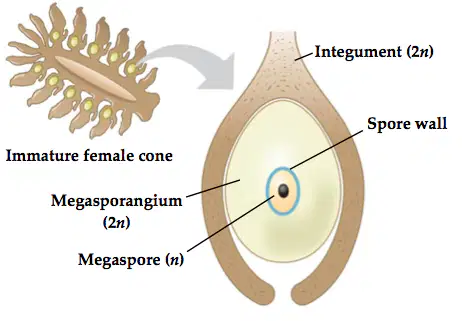
Another name for a seed is a:
microgametophyte
integumented megasporangium
fruit
hepatomicrocephalomeric spore
The megagametophyte
is a pollen grain that contains the egg cell.
a female gametophyte that contains the egg cell.
is a female gametophyte that contains the pollen grain.
is a pollen grain that is the male gametophyte.
The microgametophyte
is a pollen grain that contains the egg cell.
a female gametophyte that contains the egg cell.
is a female gametophyte that contains the pollen grain.
is a pollen grain that is the male gametophyte.
Gymnosperms are pollinated by:
bees, birds, bats, and moths.
bees only.
the wind.
Hold up, Smith. Gymnosperms do not have pollen.
Gymnosperms make lots of pollen compared to flowering plants because:
It is up to wind and chance to pollinate gymnosperms.
It is not energetically costly to produce lots of pollen.
They like making pollen for bees.
Pollen help them grow bigger and outcompete other plants around them.

Gymnosperms make male and female cones.
True
False
Why do conifers place the male cones below the female cones?
To transport the pollen shorter distances.
To prevent the male cones from fertilizing the female cones on the same tree.
Making the male cones is more energetically costly, so they do not have to move nutrients as high on the plant.
To attract bees.
To prevent self-fertilization, some conifers will (check all possible answers):
Make male cones lower than female cones on a tree.
Make male cones first, then female cones once the male cones are finished.
Only have male cones on one tree, and female cones on another tree.
Have resin ducts.

According to this phylogeny (check all that apply):
Cycads and Ginkgo are sister taxa.
Gnetales and Conifers are sister taxa.
Gymnosperms and Angiosperms are sister taxa.
Pteridophytes and Seed Plants are sister taxa.
Lycopods and Pteridophytes are sister taxa.
This living fossil was discovered in China:


What is the largest group of gymnosperms?
conifers
spruce
cedars
deciduous
Where do the seeds of a gymnosperm come from?
fruit
flowers
spores
cones
Female cones produce________.
spores
cones
pollen
eggs
A plant is ...
Heterotrophic, multicellular, eukaryote
Autotrophic, unicellular, eukaryote
Autotrophic, multicellular, eukaryote
Heterotrophic, unicellular, prokaryote
The two types of vascular tissue in plants are _____________ and _________________?
bark, wood
ground, dermal
roots, stem
phloem, xylem
Xylem carries ...
water
nutrients
blood
protein
Which is an example of a conifer?
Cedar tree
Pine tree
Spruce tree
Fir tree
All of these are conifers
The female cone on this plant becomes smelly and undesirable. That is why people selling trees will typically only sell male trees.
Though not a fern at all, this is sometimes called a 'tree fern' and in the Cycad group.
These make fancy, expensive indoor plants:
In seed plants a megaspore develops into?
pollen grain
male gametophyte
endosperm
female gametophyte
the (a) develops into the pollen grain

What does this picture represent?
Archegonia
male cones
Embryo
female cones
Gymnosperms have a dominant ______________ phase, just like ____________________.
gametophyte, pteridophytes
sporophyte, pteridophytes
sporophyte, bryophytes
gametophyte, bryophytes
Select all that have a dominant gametophyte stage:
Conifers
Cycads
Ferns
Mosses
Liverworts
Select all that have a dominant sporophyte stage:
Conifers
Cycads
Ferns
Mosses
Liverworts
True or False:
The more advanced plants have the dominant gametophyte.
True
False
A main difference between the gymnosperms and the pteridophytes is:
gymnosperms have vascular tissues and the pteridophytes do not.
gymnosperms have seeds and the pteridophytes do not.
gymnosperms have spores and the pteridophytes do not.
gymnosperms have flowers and the pteridophytes do not.
A main difference between the gymnosperms and the pteridophytes is:
gymnosperms have vascular tissues and the pteridophytes do not.
gymnosperms have secondary growth and the pteridophytes do not.
gymnosperms have spores and the pteridophytes do not.
gymnosperms have roots and the pteridophytes do not.

