wayground logo

Free Printable Worksheets

NEW

Font size

S
M
L
XL
Worksheets

Articles of Confederation

Total questions: 27

Worksheet time: 2hrs 0mins
Name
Class
Date
1.
Under the Articles of Confederation, which government had the MOST power?
a)
Legislative branch
b)
the president
c)
the state governments
d)
national government
2.
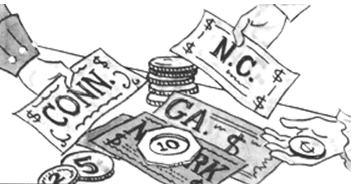
Which of the following weaknesses  in the Articles of Confederation does  this picture represent?
a)
no common currency (money)
b)
no executive branch
c)
no power to tax
d)
one vote for each state
3.
Under the Articles of Confederation, how many votes did each state get?
a)
Zero
b)
One
c)
Two 
d)
Three
4.
Which of the following is an example of a weakness in the Articles of Confederation?
a)
Congress couldn't collect taxes
b)
Weak national government
c)
Provided no common currency/money for all 13 states
d)
All of the  above
5.
Why was this first U.S. government so weak?
a)
King George III  was still in charge of USA
b)
Americans were afraid to give their new government too much power
c)
The American army did not win their independence from Great Britain and King George III
d)
ask; no
6.
The Articles of Confederation created a ________ national government.
a)
weak
b)
strong
c)
both strong and weak
d)
neither  strong nor  weak
7.
What is the name of the first written plan of government for the newly independent U.S.A.?
a)
Constitution
b)
Treaty of Paris
c)
Declaration of Independence
d)
Articles of Confederation
8.
Under the Articles of Confederation, the government consisted of _______________ branch of government.
a)
3
b)
2
c)
1
d)
4
9.
Under the Articles of Confederation Congress could only pass a law if ____________ out 13 states agreed. 
a)
13
b)
8
c)
9
d)
10
10.
One weakness of the Articles of the Confederation was ____________. 
a)
The ability of Congress to tax.
b)
The inability of Congress to tax.
c)
The ability of Congress to declare war.
d)
The ability of Congress to create courts.
11.
In order to change (amend) the Articles of Confederation,  __________ out of 13 states had to agree. 
a)
9
b)
10
c)
13
d)
15
12.

The main cause for many of the rules in the Articles of Confederation was that the delegates at the Continental Congress...

a)

did not want to give the states too much power because they'd proven they were willing to rebel against a government.

b)

wanted to create a government that was identical to England's government.

c)

were concerned about giving the central government too much power because the King had used his power unfairly.

d)

wanted to unify the states together, which included creating one army and one type of currency.

13.

Who was the president under the articles?

a)

George Washington

b)

Each governor voted on a president

c)

The most senior Senator

d)

There wasn't one

14.

How many colonies were there in total?

a)

12

b)

14

c)

13

d)

11

15.
One major problem with the Articles of Confederation is that Congress could not ______ the citizens to raise money.
a)
tax
b)
ask
c)
demand
d)
force
16.

What 2 rivers border the Northwest Territory?

a)

Ohio River & Mississippi River

b)

Missouri River & Mississippi River

c)

Hudson River & Ohio River

d)

Rio Grande River & Mississippi River

17.
 Which of the following weaknesses of the Articles of Confederation led to the government not having any money to pay their debts?
a)
There was no national court system.
b)
Congress was not allowed to collect taxes
c)
There was no single leader or group directed by government
d)
Congress had no power to enforce its laws
18.
Ultimately, the weaknesses of the Articles of Confederation lead to the adoption of:
a)
The Treaty of Paris
b)
The Affordable Care Act
c)
The U.S. Constitution
d)
The Declaration of Independence
19.
True or False?  The Articles of Confederation had a strong central government.
a)
True
b)
False
20.
How many states did it require to pass any law through Congress?
a)
5 out of 13
b)
10 out of 13
c)
9 out of 13
d)
2 out of 13
21.
In order to change (amend) the Articles of Confederation,  __________ out of 13 states had to agree. 
a)
9
b)
10
c)
13
d)
15
22.
Who led the farmers against the government of Massachusetts?
a)
Daniel Shays
b)
the Government
c)
all of the farmers were leaders
d)
Thomas Hobbes
23.

Shays' Rebellion represented...

a)

a success of the Articles of Confederation

b)

a failure of the Articles of Confederation

24.

The main cause for many of the rules in the Articles of Confederation was that the delegates at the Continental Congress...

a)

did not want to give the states too much power because they'd proven they were willing to rebel against a government.

b)

wanted to create a government that was identical to England's government.

c)

were concerned about giving the central government too much power because the King had used his power unfairly.

d)

wanted to unify the states together, which included creating one army and one type of currency.

25.

Who was the president under the articles?

a)

George Washington

b)

Each governor voted on a president

c)

The most senior Senator

d)

There wasn't one

26.
One major problem with the Articles of Confederation is that Congress could not ______ the citizens to raise money.
a)
tax
b)
ask
c)
demand
d)
force
27.
Americans were afraid that a __?__ would lead to tyranny, or oppressive rule.
a)
strong state government
b)
weak government
c)
strong central government
d)
legslature