Wayground logo

Free Printable Worksheets

Font size

S
M
L
XL
Worksheets

Unit 4 Quiz Review

Total questions: 30

Worksheet time: 16mins

Name
Class
Date
1.
What do we call the process of turning DNA into mRNA?
a)
Translation
b)
Transcription 
c)
Replication
2.
When the RNA gets to the ribosomes, which molecule transfers to the mRNA to amino acids?
a)
DNA
b)
mRNA
c)
tRNA
d)
Replicated RNA
3.
When transferring tRNA to amino acids, the process cannot begin until it reaches a...
a)
Beginning codon
b)
Start codon 
c)
Initiator codon
d)
Anticodon
4.
What is the correct amino acid sequence for the mRNA code AUGCCAGUAUGA?
a)
 Met-Pro-Val-Stop
b)
Met-Pro-Arg-Stop
c)
 Tyr-Gly-His
d)
Tyr-Gly-Arg-His
5.
Where does Translation occur?
a)
Proteins
b)
Mitochondria
c)
Ribosomes
d)
Cytoplasm
6.
What process is occurring in this photo?
a)
Transcription
b)
DNA unwinding
c)
Translation
d)
Transfer RNA is creating bases
7.

Where does transcription in prokaryotic cells take place?

a)
nucleus
b)
cytoplasm
c)
ribosome
8.

What ENZYME does transcription use?

a)

DNA polymerase

b)

ligase

c)

RNA polymerase

d)

helicase

9.

True or False: All of your body cells contain the same DNA

a)

True

b)

False

10.
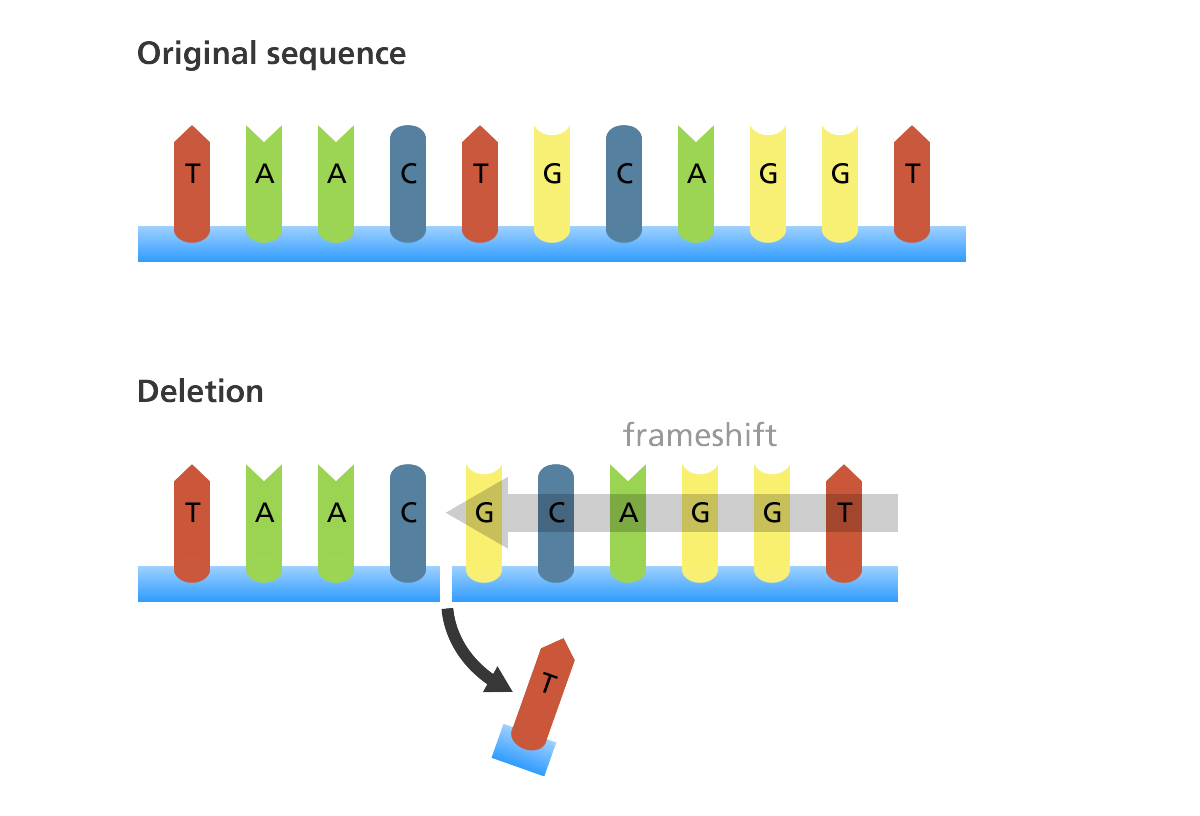
Why are insertion and deletion mutations so harmful?
a)
They change all of the codons from the mutation on down the line, which changes the amino acid sequence
b)
They insert things that an organism doesn't need.
c)
They often delete things that organisms need.
d)
Insertion and deletions are not any more harmful than substitution mutations.
11.
Which of the following statements regarding mRNA is correct?
a)
Exons are included in the protein sequence, while introns are left out
b)
Introns are included in the protein sequence, while exons are left out
c)
Exons and Introns can both be included or left out depending on the protein
d)
Exons and Introns are both part of the mRNA sequence, but only exons are part of the rRNA and tRNA
12.
How can a person's muscle cells have the same exact DNA sequences as their nerve cells even though the look and perform completely different?
a)
The two different cells become mutated
b)
The proteins expressed in each cell are different
c)
They actually have different DNA in the two types of cells.
d)
The genome of the different cells changes
13.

The complementary nucleotides to the codon located on mRNA that is carried by tRNA towards the translation site is called a(n):

(a)  

14.
what does a promoter do?
a)
it allows a gene to be transcribed
b)
it creates a DNA segment
c)
it is another word for ribosomes
d)
it is another word for RNA
15.
A protein that binds to the operator and blocks the RNA polymerase
a)
regulator
b)
repressor
c)
activator
d)
corepressor
16.
Any change in the sequence of DNA is...
a)
transgenic shift
b)
Single Genotype
c)
Monohybrid Trait
d)
Mutation
17.
What would be the tRNA anticodon for the mRNA codon CAG?
a)
GTC
b)
GUC
c)
CUG
d)
CAG
18.
Humans have ____ chromosomes.
a)
57
b)
22
c)
46
d)
100
19.

What mutation has occurred here?

T-G-A-C-C-A

T-G-A-G-C-A

a)

Substitution

b)

Deletion

c)

Insertion

d)

Frameshift

20.

Original: ATC CAT

Mutation: ATC GCAT

What mutation occurred?

a)

deletion

b)

insertion

c)

silent

d)

transverse

21.

Mutations can be...

a)

Harmful

b)

Beneficial

c)

Neutral

d)

All of the Above

22.
What structure in a cell is the site for making proteins?
a)
ribosomes
b)
mitochondria
c)
lysosome
d)
Golgi body
23.
1 and 2
a)
mitochondria
b)
nucleus
c)
ribosome
d)
endoplasmic reticulum
24.

Transcription is the process where...

a)

DNA is replicated

b)

DNA is copied into mRNA

c)

DNA is copied into tRNA

d)

DNA is copied

25.

If DNA is wrapped more tightly around histones, the less likely that DNA is going to be transcribed.

a)

True

b)

False

26.

Splicing removes exons and includes introns into the mature mRNA that is translated.

a)

True

b)

False

27.

When a substitution mutation causes no change to the protein, it is called a what?

a)

Frameshift mutation 

b)

Silent mutation

c)

Bad mutation 

28.

Translation is the process where...

a)

mRNA is created in the nucleus

b)

mRNA is decoded to form a protein

c)

glucose molecules are made

d)

lipids are synthesized

29.

On a karyotype, sometimes nondisjunction occurs resulting in a missing chromosomes called ________________ or an extra chromosomes called _____________.

a)

trisomy, monosomy

b)

monosomy, trisomy

c)

disorder, normal

d)

quadromy. trisomy

30.

1. What is a genome?

a)

a) A group of related genes

b)

b) The complete set of a species' genes

c)

c) Someone who studies genes