wayground logo

Free Printable Worksheets

Font size

S
M
L
XL
Worksheets

US 1 - Second Six Weeks Quizizz

Total questions: 108

Worksheet time: 3hrs 37mins

Name
Class
Date
1.

The sponsoring of overseas ventures and colonization by the monarch and/or private investors.

a)

Triangular Trade

b)

Joint Stock Company

c)

Headright System

d)

Mayflower Compact

2.

Labor contract in which a person agreed to work for a landowner for 4-7 years in order to receive safe passage from Europe to Colonial America.

a)

Traingular Trade

b)

Headright System

c)

Indentured Servitude

d)

Half-Way Covenant

3.

Religious revival in Colonial America that consisted of open-air sermons on the evils of Colonial America and the path to salvation.

a)

Great Awakening

b)

Quakers

c)

Great Migration

d)

English Restoration

4.

Influential colonist who played a key role in achieving Freedom of the Press for 18th century Colonial America.

a)

John Peter Zenger

b)

Benjamin Franklin

c)

William Berkley

d)

John Bacon

5.

In what year was Jamestown founded?

a)

1600

b)

1602

c)

1605

d)

1607

6.

Who decide the "No Work, No Food" policy?

a)

John Rolfe

b)

King James

c)

John Smith

d)

VA Company of London

7.

The first elective body of Virginia is known as the

a)

VA Company of London

b)

Parliament

c)

House of Burgesses

d)

Congress

8.

In what years did Africans and Women arrive in Jamestown?

a)

1607-1608

b)

1612-1613

c)

1617-1618

d)

1619-1620

9.
Besides "Pilgrims," the people who settled Plymouth were also called 
a)
Puritans
b)
Separatists
c)
Germans
d)
Saxons
10.
Pilgrims wanted to find religious freedom by separating from which church?
a)
Catholic Church
b)
Jewish Church
c)
Dutch Faith
d)
Church of England
11.
After 9 weeks at sea, the Mayflower landed on land that is now what US state?
a)
Virginia
b)
Massachusetts
c)
New York
d)
New England
12.
The name of the agreement the Pilgrims signed before going ashore in Plymouth was called the
a)
Mayflower Compact
b)
Pilgrim's Progress
c)
Magna Carta
d)
The Constitution
13.
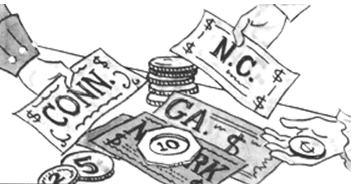
Which of the following weaknesses  in the Articles of Confederation does  this picture represent?
a)
no common currency (money)
b)
no executive branch
c)
no power to tax
d)
one vote for each state
14.
Under the Articles of Confederation, how many votes did each state get?
a)
Zero
b)
One
c)
Two 
d)
Three
15.
Which of the following is an example of a weakness in the Articles of Confederation?
a)
Congress couldn't collect taxes
b)
Weak national government
c)
Provided no common currency/money for all 13 states
d)
All of the  above
16.
Why was this first U.S. government so weak?
a)
King George III  was still in charge of USA
b)
Americans were afraid to give their new government too much power
c)
The American army did not win their independence from Great Britain and King George III
d)
ask; no
17.
The Articles of Confederation created a ________ national government.
a)
weak
b)
strong
c)
both strong and weak
d)
neither  strong nor  weak
18.
What is the name of the first written plan of government for the newly independent U.S.A.?
a)
Constitution
b)
Treaty of Paris
c)
Declaration of Independence
d)
Articles of Confederation
19.

When was the Constitution written?

a)

2001

b)

1787

c)

1900

d)

1776

20.

What is the Bill of Rights?

a)

A bill that the United States had to pay

b)

The bill you get when you become a citizen

c)

The first 10 Amendments to the Constitution

d)

Not important - who cares about that anyway?

21.
Who was the main writer of the Declaration of Independence?
a)
George Washington
b)
Thomas Jefferson
c)
John Adams
d)
Benjamin Franklin
22.
What are the three inalienable rights that all people have?
a)
Food, Shelter, and Clothing
b)
Life, Liberty and Death
c)
Life, Liberty and the Pursuit of Happiness
23.
When was the Declaration of Independence written?
a)
September 11, 1789
b)
July 4, 1776
c)
June 25, 1778
24.
What is the main purpose of government?
a)
To protect the rights of the people
b)
To protect the life of people's things
c)
To give people things
25.
What two groups of people were not included in the Declaration of Independence?
a)
Men and Women
b)
Women and Slaves
c)
Indentured Servants and Slaves
26.
Which of the following is NOT part of the Declaration of Independence?
a)
Grievances against the king
b)
George Washington's signature
c)
A formal statement declaring independence from Britain
27.
Who gives government the ability to govern?
a)
The people
b)
Parliament
c)
The King
d)
The Sons of Liberty
28.

Which of these best describes the outcome of the Battle of Bunker Hill?

a)

The British won, but suffered many losses.

b)

The militia won by a narrow margin.

c)

The British won decisively.

d)

The militia surrendered to the British.

29.

What effect did 'Common Sense' have in the colonies?

a)

It persuaded many colonists that America should be independent.

b)

It instilled fear of war in the colonies.

c)

It convinced the colonies to remain loyal to Great Britain.

d)

It petitioned the king to end the quarrel between the colonies and Great Britain.

30.

What was the purpose of the Olive Branch Petition?

a)

to ask King George to make peace with the colonies.

b)

to persuade British troops to leave Boston.

c)

to encourage colonists to join the army.

d)

to convince Parliament to repeal the Stamp Act.

31.

Why was the Declaration of Independence written?

a)

to explain why the colonies were separating from Great Britain

b)

the start the American Revolution

c)

to offer a peace settlement to Great Britain.

d)

to instruct how a county wins its freedom.

32.

The word tolerance means ________.

a)

to allow people to have differing beliefs.

b)

to disagree and strict to following rules.

33.

Quakers are a religious group that

a)

hates women.

b)

goes to war often.

c)

is very peaceful.

d)

kills Native Americans.

34.

William Penn founded

a)

Virginia

b)

Massachusetts

c)

New York

d)

Pennsylvania

35.

Quaker refuse to fight in wars.

a)

True

b)

False

36.

A nickname given to the Middle Colonies is

a)

New England Colonies

b)

Southern Colonies

c)

Breadbasket Colonies

37.

The word "haven" means

a)

a safe place.

b)

a scary place.

38.

Puritans believed women were equal to men.

a)

True

b)

False

39.

Puritans were terrified of the devil to the point of being overly paranoid.

a)

True

b)

False

40.

The Puritans founded

a)

the Massachusetts Bay Colony.

b)

the Plymouth Colony.

41.

Quakers left England because they were ___________ for their beliefs.

a)

persecuted

b)

applauded

c)

rewarded

42.
Which of the following documents limited the power of the King of England?
a)
English Bill of Rights
b)
Fundamental Orders of Connecticut
c)
Magna Carta
d)
Mayflower Compact
43.
Which of the following documents extended voting rights to non-church members?
a)
Mayflower Compact
b)
Magna Carta
c)
Virginia House of Burgesses
d)
Fundamental Orders of Connecticut
44.
Which statement explains the significance of the House of Burgesses?
a)
the assembly served as a model for other colonial legislatures
b)
colonists used the assembly to overrule decisions of the royal governor
c)
the assembly sent delegates to Parliament to represent Virginia
d)
the king revoked Virginia's charter because the assembly became too powerful
45.
*Distance from Great Britain
*Mayflower Compact
*Town hall meetings
The factors listed above contributed most to the
a)
creation of alliances between British settlers and American Indians
b)
election of British colonists to Parliament
c)
growth of representative government in the British colonies
d)
expansion of British trade in the Americas
46.
What is the significance of the Mayflower Compact?
a)
it provided the basis for a self-governing colony
b)
it established the first representative assembly in America
c)
it extended voting rights to non-church members
d)
It established the idea of due process
47.
Which of the following provided the model for the first ten amendments to the U.S. Constitution?
a)
Mayflower Compact
b)
English Bill of Rights
c)
Magna Carta
d)
Fundamental Orders of Connecticut
48.
The Mayflower Compact and the Fundamental Orders of Connecticut are most closely associated with
a)
abuses by absolute monarchs
b)
establishment of religious toleration
c)
steps toward colonial self-government
d)
adoption of universal suffrage
49.

Who fought in the French and Indian War?

a)

French vs. Indians

b)

British vs. French

c)

British vs. French and Indians

d)

Indians vs. British

50.

Why was there a war between the British and the French in 1756?

a)

Money

b)

land west of the Appalachian Mountains

c)

Trade

d)

Fighting for friendship with the Natives

51.

This created a temporary border at the Appalachian Mountains, restricting the movement of the colonists

a)

Appalachian Line of 1769

b)

Proclamation of 1763

c)

Northwest Ordinance of 1767

d)

Colonial Border of 1763

e)

Treaty of Paris 1763

52.

What was stated in the Proclamation of 1763?

a)

Colonists were BANNED from settling west of the Appalachian Mountains.

b)

The Proclamation ended the French and Indian War.

c)

Colonists were ENCOURAGED to begin settling west of the Appalachian Mountains.

d)

The Proclamation proclaimed independence for the American colonists.

53.

What was James Armistead occupation before become a spy?

a)

general

b)

slave

c)

soldier

d)

printer

54.

The name of the American Army traitor was

a)

James Armistead

b)

Marquis de Lafayette

c)

Benedict Arnold

55.

Because of information gathered by James Armistead, America won the final battle of the War for Independence

a)

false

b)

true

56.
African American double spy who provided information about British movement, as well as, information leading to British defeat at Yorktown.
a)
Crispus Attucks
b)
James Armistead
c)
Marquis de Lafayette
d)
Bernardo de Galvez
57.
Wife of John Adams; known for her letters to her husband that served as primary accounts of Revolutionary life
a)
Abigail Adams
b)
Mercy Otis Warren
c)
Martha Washington
d)
Marquis de Lafayette
58.
Author of the "Albany Plan of Union"; helped write the "Declaration of Independence"; convinced France to become our ally in the Revolution; negotiated the "Treaty of Paris". 
a)
John Paul Jones
b)
Thomas Jefferson
c)
George Washington
d)
Benjamin Franklin
59.
King of England during the American Revolution
a)
King George III
b)
Prince Harry
c)
Bernardo de Galvez
d)
George Washington
60.
President of the 2nd Continental Congress, first to sign the "Declaration of Independence"
a)
Patrick Henry
b)
Samuel Adams
c)
John Hancock
d)
Thomas Jefferson
61.
Fierce supporter of the patriot cause; best known for "Give me Liberty or give me death" speech.
a)
Wentworth Cheswell
b)
Patrick Henry
c)
Haym Salomon
d)
Crispus Attucks
62.
African American that made the midnight ride with Paul Revere
a)
James Armistead
b)
Crispus Attucks
c)
Wentworth Cheswell
d)
John Paul Jones
63.
Famous US Navy commander; won important naval victories like the Bonhomme Richards victory over the Serapis
a)
George Washington 
b)
Patrick Henry
c)
Bernardo de Galvez
d)
John Paul Jones
64.
Female Author whose writing supported the patriot cause. Wrote a history of the revolution.
a)
Mercy Otis Warren
b)
Martha Washington
c)
Abigail Adams
d)
Molly Pitcher
65.
African American who was the first to be killed at the Boston Massacre. 
a)
James Armistead
b)
Samuel Adams
c)
Crispus Attucks
d)
Franklin Douglas
66.
Delegate to the Continental Congress and member of the Declaration Committee; the most outspoken proponent for Independence. 
a)
Thomas Jefferson
b)
John Hancock
c)
Benjamin Franklin
d)
John Adams
67.
Author of "Common Sense" and " American Crisis" 
a)
Thomas Paine
b)
Thomas Jefferson
c)
Benjamin Franklin
d)
George Washington
68.
French Aristocrat and leader in French and American Revolution. Became a major-general in the Continental Army. 
a)
Bernanrdo de Galvez
b)
Marquis de Lafayette
c)
Haym Salomon 
d)
John Paul Jones
69.
Delegate to the Continental Congress; primary author of the "Declaration of Independence".
a)
Thomas Jefferson
b)
George Washington
c)
John Locke
d)
Samuel Adams
70.
Started the Sons of Liberty, participated in the Boston Tea Party.
a)
George Washington
b)
Patrick Henry
c)
John Paul Jones
d)
Samuel Adams
71.
Continental Army commander, delegate to 1st and 2nd Continental Congress.
a)
Thomas Jefferson
b)
John Adams
c)
Benjamin Franklin
d)
George Washington
72.
Spanish governor of Louisiana; kept the British from using the ports of New Orleans.
a)
Bernardo de Galvez
b)
Marques de Lafayette
c)
Mercy Otis Warren
d)
John Paul Jones
73.
Patriot and financial backer of the colonies. Provided the money for Washington's march on Yorktown. 
a)
Haym Salomon
b)
Crispus Attucks
c)
James Armestead
d)
John Hancock
74.

is there when times are not difficult but not there during difficult times

a)

health

b)

valley forge

c)

summer soldier

d)

continental army

75.

the legislative assembly issued the Declaration of Independence and framed Articles of Confederation

a)

continental congress

b)

casualties

c)

sunshine patriot

d)

George Washington

76.

someone who is a patriot only when they are winning

a)

sunshine patriot

b)

huts

c)

health

d)

tyranny

77.

Place where Washington's army spent the winter of 1777-1778, a 1/4th of troops died here from disease and malnutrition.

a)

encampment

b)

summer soldier

c)

Valley Forge

d)

rations

78.

who was the general of the british militia during the battle of Saratoga

a)

john Burgoyne

b)

george washington

c)

thomas jefferson

d)

ben franklin

79.

What American officer defied orders and led the decisive charge at Saratoga?

a)

Ethan Allen

b)

Nathaniel Green

c)

Benedict Arnold

80.

Who was the commanding Continental officer at the Battle of Saratoga?

a)

Johnny Burgoyne

b)

George Washington

c)

Horatio Gates

81.

Why is the battle of Saratoga important

a)

It was the first time an American army surrendered to a British army

b)

It was the turning point in the war

c)

It ended the Revolutionary war

82.

True or false After the Battle of Saratoga, the French decided to help the Americans in the war.

a)

true

b)

false

83.

What American general had a falling out with his commander Horatio Gates at the Battle of Saratoga?

a)

John Stark

b)

Benedict Arnold

c)

George Washington

d)

Enoch Poor

e)

Gentleman John Burgoyne

84.

Where was Benedict Arnold injured?

a)

In the arm

b)

In the head

c)

In the leg

d)

In the chest

e)

He was not injured

85.

What country decided to provide military support to the Americans after they won the Battle of Saratoga?

a)

France

b)

Canada

c)

Austria

d)

Germany

86.
What made the Battle of Yorktown significant?
a)
It was the first battle of the American Revolution
b)
It was the first battle of the American Civil War
c)
English Sarah was there
d)
It was the last major battle of the American Revolutionary War
87.
Who was the general in charge of the British troops at Yorktown?
a)
Benedict Arnold
b)
Charles Barkley
c)
George Washington
d)
Charles Cornwallis
88.
What was the date of the British Surrender?
a)
October, 19 1871
b)
October, 19 1776
c)
October, 19 1981
d)
October, 19 1781
89.
What country helped the Americans to win the  battle by defeating the British Navy and preventing the arrival of reinforcements?
a)
Spain
b)
Germany
c)
New England
d)
France
90.
Which forces were led by Comte de Rochambeau?
a)
German
b)
American
c)
Britsh
d)
French
91.
What are militia?
a)
People who are ready to fight in minutes
b)
Everyday people training for battle
c)
Soldiers coming from England
92.
Who jumped on the horse to warn the colonist that the British were coming?
a)
Paul Revere
b)
King George III
c)
John Adams
93.
The battle of Lexington was the result of…
a)
Boston Tea Party
b)
Boston Massacre
c)
General Gage ordering troops to get colonial weapons
94.
What are colonist ready to fight within a minutes notice called?
a)
Fasties
b)
Nerds
c)
Minutemen
d)
Hungry Hippos
95.
What was the goal of the 3/5th's Compromise?
a)
To get states to buy slaves
b)
To get rid of slavery
c)
To get the states to agree to the Constitution
d)
To get states to reject the Constitution
96.
What plan did the Northern states have for slavery?
a)
Slaves wouldn't count as people
b)
Slaves would count as 1 person
c)
Slaves would count as 3 people
d)
Slaves would count as 1/2 of a person
97.
What was the 3/5ths Compromise?
a)
Slaves counted as 2/4ths of a person
b)
Slavery was outlawed
c)
Slaves counted as 3/5ths of a person
d)
Slaves in the South were set free
98.
The Great Compromise was a compromise between--
a)
Mass. Plan and New Jersey Plan
b)
Virginia Plan and New Jersey Plan
c)
Virginia Plan and New York Plan
d)
Virginia Plan and Delaware Plan
99.
What kind of congress did the Great Compromise establish?
a)
1 House that controls everything
b)
2 Houses that have no power
c)
2 Houses that both vote on laws
d)
2 Houses that take turns being in charge
100.
The 3/5 Compromise settled the argument of--
a)
Representation in the Senate
b)
How slaves should be counted for representation
c)
How states should be represented
d)
Borders of states
101.
Congress is made up of two houses, which one is based on population?
a)
House of Burgesses
b)
Senate
c)
House of Representatives
d)
Continental Congress
102.
Congress is made up of two houses, which one has equal representation of 2 representatives per state?
a)
House of Burgesses
b)
Senate
c)
House of Representatives
d)
Continental Congress
103.

Those opposed to ratifying the U.S. Constitution were called...

a)

Federalist

b)

Anti-Federalist

104.

Those opposed to ratifying the U.S. Constitution were called...

a)

Federalist

b)

Anti-Federalist

105.

Which of the following arguments would authors of the Federalist papers most likely have agreed with?

a)

A bill of rights should be included in the Constitution before it is ratified

b)

Having a strong central government will make the country more stable and prosperous.

c)

The 3/5 Compromise will result in fair and equal representation.

d)

Universal suffrage should be constitutional guaranteed.

106.

What is the correct heading for Column A?

a)

Federalist

b)

Anti-Federalist

107.

Which excerpt is that of an Anti-Federalist?

a)

“The operations of the federal government will be most extensive and important in times of war and danger; those of the State governments, in times of peace and security.”

b)

“The Congress as therefore vested with the supreme legislative power, without control. In giving such immense, such unlimited powers, was there no necessity of a Bill of Rights, to secure the people their liberties?”

c)

“If men were angels, no government would be necessary.”

d)

“This power over the purse may, in fact, be regarded as the most complete and effectual weapon with which any constitution can arm the [people’s] immediate representatives.”

108.

Who were some leading Federalists?

a)

James Madison, Alexander Hamilton, John Jay

b)

George Washington, Thomas Jefferson, John Jay

c)

Patrick Henry, James Monroe, John Jay

d)

FDR, Patrick Henry, John Jay