
Font size
 Worksheets
Unit 2 Study Slides
Total questions: 46
Worksheet time: 23mins
What is Charles's Law?
The force pushing on a surface divided by the area of that surface
A principle that describes the relationship between the temperature and volume of a gas at constant pressure
A change directly from a gaseous state to solid without becoming a liquid.
A principle that describes the relationship between the pressure and volume of a gas at constant temperature
What are the three states of matter we learn about?
Liquid
Solid
Fire
Gas
Wind
Jam has a definite shape and volume. Which classification best describes the jam?
Amorphous Solid
Crystalline Solid
Liquid with high viscosity
Liquid with low viscosity
People who have certain lung diseases, such as emphysema or lung cancer, often have to use oxygen from tanks. A large volume of oxygen can be put into a small tank because oxygen is a gas, and gases can be
(a)
Chelsea went ice-skating. The ice, her skates, the Zamboni, and the rink building itself were all examples of solids she encountered. She developed a model of the particles in the ice. Which of these statements about the particles present in her model of a solid are true? Choose the three statements that apply.
They vibrate in place.
They slide past each other.
They are packed very closely together.
They cause the solid to have definite volume and definite shape.
They move quickly and spread out away from each other.
Many technologies use enclosed fluids. For example, a hydraulic press at an auto repair shop uses trapped water to lift heavy cars. Hot-air balloons heat trapped air to lift a basketful of people. Look at the two diagrams that model fluid particles. Which statement best identifies which of these models represents a gas?
Diagram B is a gas, because its particles move more slowly and are farther apart.
Diagram A is a gas, because its particles move more slowly and are closer together.
Diagram B is a gas, because its particles move more quickly and are farther apart.
Diagram A is a gas, because its particles move more quickly and are closer together.
Bela made scrambled eggs while camping. She placed the eggs in a pan on the grill, then turned on the flame to apply heat to the pan and to the eggs. By applying heat, Bela increased the _______________ of the eggs. She
could measure how much the _______________ increased with a thermometer.
potential energy, temperature
thermal energy, temperature
temperature, thermal energy
thermal energy, mass
Michael’s car ran over a nail, which made a hole in one of the tires. At what point will air stop pouring out of the hole in the tire?
When all of the air has escaped from the tire
When the air pressure in the tire is less than atmospheric pressure
When the air pressure in the tire is equal to atmospheric pressure.
When the air pressure in the tire is greater than atmospheric
pressure.

Kenneth warmed up a 100-mL sample of air in an expandable container. He displayed the results in the following graph. The results formed a straight line, so he extended the line the full length of the graph.
At what temperature did the gas have a volume of 110 mL?
19 K
20 K
110 K
300 K
What is Boyle's Law?
The force pushing on a surface divided by the area of that surface.
A principle that describes the relationship between the temperature and volume of gas at constant pressure.
Maintaining consistency between two variables.
A principle that describes the relationship between the pressure and volume of gas at constant temperature.
When a substance goes from solid directly to gas it is called...?
Vaporization
Condensation
Sublimation
Deposition

When a solid changes state to a liquid it is called what (number 10 in the picture)?
(a)

What is it called when a gas goes to a liquid state (number 9 in the picture)?
(a)

What is it called when a liquid goes to the gaseous state (number 8 in the picture)?
(a)
The process by which molecules at the surface of a liquid absorb enough energy to change to a gas.
Evaporation
Condensation
Sublimation
Melting

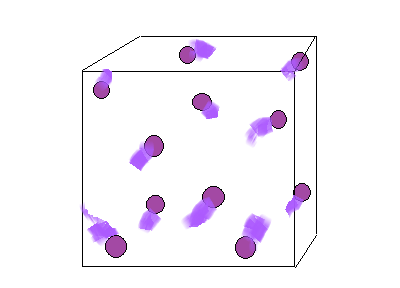
Which phase is represented in the model.
Solids
Liquids
Gas
Carousso
A substance's ______________ is when it changes from a liquid to a solid
melting point
boiling point
freezing point
triangle point
What is the phase change called when a gas becomes a liquid?
condensation
evaporation
sublimation
freezing
A solid takes up a certain amount of _____.
space
light
food
Gases keep their shapes and spread out.
true
false

Which choice correctly identifies each kinetic theory diagram with the correct order of molecules?
Solid, liquid, gas
Gas, solid, liquid
Liquid, gas, solid
gas, liquid, solid
Anything that takes up space and has mass is
Matter
Volume
Liquid
Atom
A solid
has particles that are far apart
has a size and shape of its own
takes the shape of its container
The smallest part of matter and makes up molecules
is an atom
is a molecule
is a gas
is matter
Oxygen is
a gas you can breathe
a solid you can eat
a liquid which changes shape
a brother to carbon dioxide
In a _______ the molecules are close together.
solid
liquid
gas
All _______ can move and flow.
liquids
solids
gases
An example of a solid is
a desk
oxygen
water
juice
An example of a liquid is
honey
a stapler
a water bottle
One similarity between solids, liquids and gases is
all three have atoms and molecules
all three have molecules that are close together
all three take the shape of their containers
A ________ has no shape and no size.
gas
liquid
solid

