wayground logo

Free Printable Worksheets

Font size

S
M
L
XL
Worksheets

Riley

Total questions: 128

Worksheet time: 3hrs 7mins

Name
Class
Date
1.

Where did The Boston Tea Party occur?

a)

England

b)

New York

c)

Boston

d)

North Carolina

2.
What act was the cause of the Boston Tea party?
a)
The Townshend act
b)
Tea Act
c)
Sugar Act
3.
Who was the King during the American Revolution?
a)
King Arthur
b)
Martin Luther King Jr.
c)
King George III
4.
What did the Boston Tea Party spark?
a)
Nothing
b)
A truce 
c)
A fight
d)
The Revolution
5.
What act taxed the tea that was brought into the colonies?
a)
The Quartering Act
b)
The Tea Act
c)
The Sugar Act
d)
The Stamp Act
6.
Was the Boston Tea Party a part of the causes of the revolution?
a)
yes
b)
no
c)
maybe
7.
What ship did the Boston Tea Party happen on?
a)
French
b)
British
c)
American Indians
d)
None of the above
8.
What ship did the Boston Tea Party happen on?
a)
French
b)
British
c)
American Indians
d)
None of the above
9.
The colonists/people were disguised as __________.
a)
British
b)
American Indians
c)
French
d)
None of the above
10.
What ship did the Boston Tea Party happen on?
a)
French
b)
British
c)
American Indians
d)
None of the above
11.
What did the Stamp Act tax?
a)
paper and documents
b)
houses
c)
farm animals
d)
imports
12.
The Stamp Act taxed _____________.
a)
tea
b)
newspapers
c)
sugar
d)
coffee
13.
Define boycott.
a)
An organized campaign to refuse to buy certain products
b)
import tax
c)
Citizen soldiers who could be ready to fight at a minute's notice
d)
to surrender
14.
What was the Tea Act?
a)
The Act of the British raising prices on colonial tea
b)
Smuggling Tea
c)
Boston Tea Party
d)
People drinking tea
15.
The colonist forced to buy tea from the East India Tea Company
a)
False
b)
True
16.
This American victory was the turning point in the war.
a)
Saratoga
b)
Yorktown
c)
Bunker Hill
d)
Lexington and Concord
17.
Who was the major author of the Declaration of Independence?
a)
Benjamin Franklin
b)
John Adams
c)
Thomas Jefferson
d)
Patrick Henry
18.
Surrounded by French and Continental armies, a large British army surrendered here.
a)
Saratoga
b)
Yorktown
c)
Bunker Hill
d)
Lexington and Concord
19.
This member of the Continental Congress helped gain French support for American independence.
a)
Thomas Jefferson
b)
Benjamin Franklin
c)
Patrick Henry
d)
John Adams
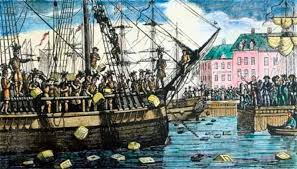
20.
What event is depicted in this image?
a)
Boston Massacre
b)
Boston Tea Party
c)
Battle of Bunker Hill
d)
Lexington and Concord
21.
This patriot made a daring ride to warn colonists that British soldiers were approaching.
a)
Patrick Henry
b)
Paul Revere
c)
Phillis Wheatley
d)
Samuel Adams
22.
Samuel Adams and Paul Revere led members of the Sons of Liberty in this protest against taxes.
a)
First Continental Congress
b)
Boston Massacre
c)
Boston Tea Party
d)
Stamp Act Congress
23.
This enslaved person wrote poems and plays supporting American independence.
a)
Harriet Tubman
b)
Benjamin Banneker
c)
Paul Revere
d)
Phillis Wheatley
24.
Of the following events, which happened first? 
a)
Saratoga
b)
Yorktown
c)
Declaration of Independence
d)
Treaty of Paris of 1783
25.
Of the following events, which happened last?
a)
First Continental Congress
b)
Boston Massacre
c)
Boston Tea Party
d)
Stamp Act
26.
Of the following people, who did not help write the Declaration of Independence?
a)
Thomas Jefferson
b)
Patrick Henry
c)
John Adams
d)
Benjamin Franklin
27.
What event is depicted in this image?
a)
Boston Massacre
b)
Saratoga
c)
Lexington and Concord
d)
Yorktown
28.
Which one of these is not an advantage that helped the American patriots defeat Great Britain.
a)
defense of their own land, principles and beliefs
b)
support from France
c)
superior numbers of soldiers and greater experience
d)
strong leadership from men like George Washington
29.
What patriot leader is represented by this image?
a)
John Adams
b)
Samuel Adams
c)
Paul Revere
d)
Patrick Henry
30.
The U.S. was founded on July 4, 1776, by the approval of this document.
a)
the Treaty of Paris
b)
the Constitution
c)
the Declaration of Independence
d)
the Virginia Charter
31.
Which of the following events occurred before the event illustrated?
a)
First Continental Congress
b)
Stamp Act
c)
Declaration of Independence
d)
Boston Tea Party
32.
The event illustrated happened before which of the following?
a)
First Continental Congress
b)
Lexington and Concord
c)
Saratoga
d)
Boston Tea Party
33.
The location of what event is shown on this map?
a)
Lexington and Concord
b)
First Continental Congress
c)
Saratoga
d)
Yorktown
34.
Where were the first armed conflicts of the American Revolution?
a)
Yorktown
b)
Saratoga
c)
Lexington and Concord
d)
Bunker Hill
35.
What was the name of the British king during the American Revolution?
a)
Charles III
b)
George III
c)
William III
d)
James III
36.
The French and Indian War was was fought between the
a)
French and the Indians
b)
Indians and the Spanish
c)
French and British against the Indians
d)
The French and Indians against the British and the colonists.
37.
What was the main cause of the French and Indian War?
a)
The French and British claimed the same land.
b)
The French and Indians claimed the same land.
c)
The Indians and British claimed the same land.
d)
The Indians wouldn't sell their land.
38.
Who was the young military leader from Virginia who fought in the French and Indian war?
a)
William Pitt
b)
Edward Braddock
c)
King George II
d)
George Washington 
39.
Why were many colonists angry about the Proclamation of 1763?
a)
They were unhappy because they could not settle on new lands.
b)
They wanted to travel all the way west to California.
c)
They wanted to share the land with the Native Americans.
d)
They wanted their money back for the land.
40.
What was the name of the fort built by George Washington in what is now Pennsylvania.
a)
Fort Moultrie
b)
Fort Sumter
c)
Fort Necessity
d)
Fort Duquesne
41.
Where was the key battle of the French and Indian War fought?
a)
Ohio River Valley
b)
Appalachian Mountains
c)
North America
d)
Quebec, New France's capital
42.
When and where did the French and Indian War begin?
a)
The war started in 1776 in New England.
b)
The war started in 1754 in New England.
c)
The war started in 1754 in the Ohio River Valley.
d)
The war started in 1776 in the Ohio River Valley.
43.
What impact did the French and Indian War have on the Native Americans?
a)
They were not affected by the war at all.
b)
The Native Americans' traditional lands were now part of the British Empire.
c)
The British and the Native Americans were allies after the war.
d)
The British and the Native Americans united to form one land.
44.
The Treaty of Paris 1763 marked the end of the French and Indian War.
a)
True
b)
False
45.
How was the land divided after the war ended with the signing of the Treaty of Paris in 1763?
a)
Britain got it all when they won the French and Indian War.
b)
The Native Americans got half and Britain got half.
c)
Spain got everything west of the Mississippi and Britain got most of New France.
d)
Spain got half and Great Britain got half.
46.
What did the Proclamation of 1763 say?
a)
France owned the land west of the Appalachian Mountains
b)
Natives owned the land west of the Appalachian Mountains
c)
Colonists could move west of the Appalachian Mountains
d)
Colonists could not move west of the Appalachian Mountains
47.
Who was Britain's King who issued the Proclamation of 1763?
a)
George III
b)
George Washington 
c)
Edward Braddock
d)
Hendrick
48.
What was a cause of the Proclamation of 1763?
a)
The Native Americans were asking for more money.
b)
The British did not want to keep on fighting with the Native Americans.
c)
The King was bored and wanted to make a new law.
d)
The King wanted to control his settlers so he made this Proclamation.
49.
Why did Britain seek to tax the colonists in the 1760s?
a)
The colonists were wealthier than most British citizens.
b)
Britain needed money to pay for the French and Indian War.
c)
The British wanted to punish the colonists for rebelling against the Proclamation.
d)
Britain needed money to protect the colonists from the French.
50.
Which phrase became popular after passage of the Stamp Act?
a)
“The rights of Englishmen”
b)
“Give me liberty or give me death”
c)
“Life, liberty, and the pursuit of happiness”
d)
“No taxation without representation“
51.
Captain Preston claimed that he was standing behind his men and gave no ________ to fire.
a)
command
b)
excuse
c)
reason
d)
gun
52.
Who is responsible for this rendering of the events on March 5, 1770?
a)
Sam Adams
b)
Paul Revere
c)
John Adams
d)
John Hancock
53.
This rendering of the events on March 5, 1770 is considered ____________ by some because it depicts the scene in a bias fashion against the British.
a)
propaganda
b)
historical
c)
fallacy
d)
fact
54.
This painting of the Boston Massacre supports the ___________ side of the story from March 5, 1770.
a)
British
b)
Sons of Liberty
c)
Patriots
d)
Second Continental Congress
55.
Which well-known Patriot represented the British soldiers in a trial after the Boston Massacre?  It was not that he liked the British soldiers but he wanted to prove that even a British soldier could get a fair trial in America.
a)
Sam Adams
b)
John Hancock
c)
Paul Revere
d)
John Adams
56.

Ideas, information. Distributed for purpose of winning people over, often without truth or fairness.

a)

Propaganda

b)

Debate

c)

Newspaper

d)

Political Cartoons

57.

Who was the British officer of the watch when the shooting occurred?

a)

Captain Morgan

b)

Colonel John Adams

c)

Captain Thomas Preston

d)

Sergeant Benedict Arnold

e)

General Thomas Gage

58.

True or False: The colonists were throwing things at the British and daring them to fire their guns.

a)

True

b)

False

59.

Was Paul Revere a Loyalist or Patriot?

a)

Loyalist

b)

Patriot

c)

Neither

60.

When did the Boston Massacre happen?

a)

1000 B.C.

b)

March 5, 1770

c)

March 15, 1770

d)

April 18, 1781

61.

Who was the first person killed in the Boston Massacre?

a)

Hector

b)

Crispus Attucks

c)

Sam Adams

d)

John Adams

62.

Where did the Boston Massacre occur?

a)

Boston

b)

King Street

c)

In front of the custom house

d)

All of the above

e)

None of the above

63.

How many colonists died in the Boston Massacre?

a)

1

b)

2

c)

5

d)

10

64.

1. Prior to the Boston Tea Party, Parliament

repealed most of the _______________________ .

a)

TOWNSEND ACTS

b)

SUGAR ACTS

65.

2. American merchants were ________________ in most of the tea in order to avoid paying customs duties.

a)

SMUGGLING

b)

SECURING

66.

3. Supporters of the Tea Act argued that less smuggling in the American colonies would result in more ____________________ for the empire.

a)

TAX REVENUE

b)

SUPPLY OF PRODUCT

67.

4. Colonists still saw the Tea Act as a direct and _________________ tax.

a)

VOLUNTARY

b)

INVOLUNTARY

68.

5. ______________ _ saw the Tea Act as an opportunity to bring English tea back into the colonies.

a)

THE AMERICANS

b)

PARLIAMENT

69.

6. The Townshend boycotts had __________________________ the British economy.

a)

DEVASTATED

b)

SUPPORTED

70.

7. Smuggling had caused so much damage that the East India Tea Company was in danger of ___________________ .

a)

RIOTING

b)

BANKRUPTCY

71.

8. Hundreds of Bostonians gathered inside the _______________ to discuss what to do about the tea in Boston Harbor.

a)

OLD SOUTH CHURCH

b)

PARLIAMENT

72.

9. The Sons of Liberty seized _______________________ , split them open, and tossed them into the harbor.

a)

342 CHESTS OF TEA

b)

350 CHESTS OF GOLD

73.

10. John Adams wrote, “The destruction of the tea is so bold, so daring, so firm, so intrepid and inflexible, it must have important ____________________________________________ ."

a)

CONSEQUENCES

b)

TAXES

74.

What did the Townshend Acts do?

a)

put a restriction on storage

b)

give everyone a curfew

c)

tax all imports

d)

color the town

75.

What happened to the Townshend Acts?

a)

they burned it

b)

repealed in 1769

c)

they forgot about it

d)

nothing, it's still going

76.

(2) Trade slowed down because colonists _________________ British goods.

a)

boycotted

b)

repealed

c)

responsible

d)

taxation

77.

(4) The Sons of _________________ took charge of Boston.

a)

Liberty

b)

finance

c)

troops

d)

jobs

78.

What did the Boston Committee of Correspondence suggest withholding from the British troops?

a)

tea, paper, glass

b)

money, paper, stamps

c)

sugar, stamps, clothes

d)

labour, straw, timber

79.

What types of news did the Committees of Correspondence share?

a)

how King George III was a great ruler

b)

info and news about what their colonies were doing to resist the British and their unfair policies

c)

directions on how to create a printing press

d)

laws and documents of how the colonies became the United States

80.

Why did the Committee say that items should be withheld from British troops?

a)

British troops were helping them

b)

to have favor with the king

c)

Colonist needed their help

d)

British troops were acting like enemies to the colonist.

81.

What was the purpose for establishing the Committees of Correspondence?

a)

To maintain communication with one another

b)

To start a war

c)

To communicate with King George III

d)

To invent the telephone

82.

Why was it so important that the colonies establish lines of communication with one another?

a)

to hide from British troops

b)

travel

c)

to share information and news

d)

to start a war

83.
Which founding father started the Committees of Correspondence?
a)
George Washington
b)
Abraham Lincoln
c)
Samuel Adams
d)
Barack Obama
84.
Which colony was originally colonized as a safe haven for Catholics? 
a)
Virginia
b)
Massachusetts 
c)
Pennsylvania 
d)
Maryland
85.
Short term enlistments hurt numbers - Not enough soldiers
a)
Patriot Advantage
b)
British Advantage
c)
Patriot Disadvantage
d)
British Disadvantage
86.
Well trained, well equipped, disciplined fighting force
a)
Patriot Advantage
b)
British Advantage
c)
Patriot Disadvantage
d)
British Disadvantage
87.
Which colonist were called Patriots?
a)
those who obeyed the laws
b)
those who were willing to fight
c)
those who wanted independence
d)
those who were loyal to the king
88.
Why did many colonist boycott tea and paper?
a)
to punish the storekeepers
b)
to protest taxes on those items
c)
to save money for future needs
d)
to make their own goods at home
89.
Benjamin Franklin
a)
Loyalist
b)
Patriot
90.
Samuel Adams
a)
Loyalist
b)
Patriot
91.
Short term enlistments hurt numbers - Not enough soldiers
a)
Patriot Advantage
b)
British Advantage
c)
Patriot Disadvantage
d)
British Disadvantage
92.
Had the most powerful Navy in the world
a)
Patriot Advantage
b)
British Advantage
c)
Patriot Disadvantage
d)
British Disadvantage
93.
Had professional soldiers
a)
Patriot Advantage
b)
British Advantage
c)
Patriot Disadvantage
d)
British Disadvantage
94.
Larger population = More people willing to fight
a)
Patriot Advantage
b)
British Advantage
c)
Patriot Disadvantage
d)
British Disadvantage
95.
Shortage of ammunition, clothing, food and medical supplies 
a)
Patriot Advantage
b)
British Advantage
c)
Patriot Disadvantage
d)
British Disadvantage
96.
Cooperation of American loyalists
a)
Patriot Advantage
b)
British Advantage
c)
Patriot Disadvantage
d)
British Disadvantage
97.
Did not have a Navy at all
a)
Patriot Advantage
b)
British Advantage
c)
Patriot Disadvantage
d)
British Disadvantage
98.
Superior leadership under George Washington
a)
Patriot Advantage
b)
British Advantage
c)
Patriot Disadvantage
d)
British Disadvantage
99.
Spirit of independence - motivation to fight
a)
Patriot Advantage
b)
British Advantage
c)
Patriot Disadvantage
d)
British Disadvantage
100.
Had to transport goods across the Atlantic Ocean
a)
Patriot Advantage
b)
Patriot Disadvantage
c)
British Advantage
d)
British Disadvantage
101.
Fighting on their home turf - familiar with the land
a)
Patriot Advantage
b)
British Advantage
c)
Patriot Disadvantage
d)
British Disadvantage
102.
Lack of proper training and discipline at the start of the war
a)
Patriot Advantage
b)
British Advantage
c)
Patriot Disadvantage
d)
British Disadvantage
103.
Unfamiliar with the land that they were fighting on
a)
Patriot Advantage
b)
British Advantage
c)
Patriot Disadvantage
d)
British Disadvantage
104.
Gained help from France (money and soldiers)
a)
Patriot Advantage
b)
British Advantage
c)
Patriot Disadvantage
d)
British Disadvantage
105.
Had more money for supplies 
a)
Patriot Advantage
b)
British Advantage
c)
Patriot Disadvantage
d)
British Disadvantage
106.
Well trained, well equipped, disciplined fighting force
a)
Patriot Advantage
b)
British Advantage
c)
Patriot Disadvantage
d)
British Disadvantage
107.

What is the name of the British government?

a)

Parliament

b)

Congress

c)

Supreme Court

d)

Government

108.

What was the protest in which colonists dumped British tea into Boston Harbor called?

a)

Boston Massacre

b)

Boston Tea Party

c)

Boston Celebration

d)

Boston Fiesta

109.

What are taxes?

a)

money paid to the colonists

b)

money paid to the government

c)

money paid to the Sons of Liberty

d)

money paid to another country

110.

What does representation mean?

a)

a person or group acting on behalf of themselves

b)

a person or group acting on behalf of King George

c)

a person or group acting on behalf of Patrick Henry

d)

a person or group acting on behalf of another person or group

111.

What is another word for liberty?

a)

parliament

b)

taxes

c)

peace

d)

freedom

112.

Who was the ruler of England during the American Revolution?

a)

George Washington

b)

King George III

c)

Patrick Henry

d)

Benjamin Franklin

113.

Who was an American intellectual, inventor, and politician who helped negotiate French support for the American Revolution?

a)

George Washington

b)

King George III

c)

Paul Revere

d)

Benjamin Franklin

114.

Who is famous for saying, "Give me liberty or give me death!"?

a)

Paul Revere

b)

Patrick Henry

c)

John Adams

d)

Benjamin Franklin

115.

Who was a patriot who helped warn colonists that the British were coming?

a)

Paul Revere

b)

Patrick Henry

c)

John Adams

d)

George Washington

116.

Who agreed to serve on the defense for the British soldiers responsible for the Boston Massacre?

a)

Paul Revere

b)

Patrick Henry

c)

John Adams

d)

George Washington

117.
A colonial group that encouraged colonists to burn stamps and attack tax collectors was called the:
a)
Sons of Liberty
b)
Stamp Act Congress
c)
Continental Congress
d)
militia
118.

During the protests, colonists brought back a popular phrase from Stamp Act protests. What was that phrase?

a)

"Taxing sugar is not so sweet"

b)

"No taxation without representation"

c)

"Britain doesn't have the right to tax, so let's give the king the axe"

d)

"Parliament's taxation is causing inflation"

119.

When Charles Townshend wrote these laws, he mistakenly thought that the colonist would support them because....

a)

It was an indirect tax (meaning it is built into the price of goods)

b)

It was only on materials that the colonies could not produce themselves

c)

It was a popular tax in Britains other colonies

d)

It was meant to expire after just one year

120.

Which of the following was not an item taxed under the townshend act?

a)

Paints

b)

Glass

c)

Lead

d)

Lumber

121.

Who did the King feel should pay for the war?

a)

British

b)

colonists

c)

Spain

122.

The Colonists were happy about paying the tax.

a)

TRUE

b)

FALSE

123.

The Stamp Act taxed all ________ goods.

a)

paper

b)

plastic

c)

pollution

124.

The colonists hope that the tax would be taken away, or ____________

a)

repealed

b)

lost

c)

given

d)

refocused

125.

This law placed a tax on all printed material in the colonies including wills, contracts, newspapers, and playing cards.

a)

The Declaratory Act

b)

The Stamp Act

c)

The Intolerable Acts

d)

The Coercive Acts

126.

When colonists became angry with taxes, they often boycotted the goods that the taxes were on. What do you think boycotted means?

a)

Cheering taxes

b)

Protesting out in the streets

c)

Putting a boy on a cot

d)

Deciding not to buy or pay for a certain thing as a way of protesting

127.

The colonists' riots and boycotts made England REPEAL the Stamp Act. What does repeal mean?

a)

Cancel something

b)

Peel something off

c)

Talk to Parliament

d)

Protest

128.

This man, the leader of the Sons of Liberty, told colonists to boycott British goods. Who was he?

a)

Benjamin Franklin

b)

Samuel Adams

c)

George Washington

d)

King George III