wayground logo

Free Printable Worksheets

NEW

Font size

S
M
L
XL
Worksheets

Cumulative #3 (SSUSH Standards 17-23)

Total questions: 50

Worksheet time: 37mins

Name
Class
Date
1.
President during the 1930s who was considered a failure because he couldn't fix the Great Depression.
a)
Franklin D. Roosevelt
b)
Herbert Hoover
c)
Margaret Mitchell
d)
Jessie Owens
2.
The president who promised the people a "New Deal" during the Great Depression.
a)
Jesse Owens
b)
Herbert Hoover
c)
Franklin D. Roosevelt
d)
George Washington
3.
Which was NOT a LONG-TERM cause of the Great Depression?
a)
Buying stock on margin
b)
Stock market crash (Black Tuesday)
c)
too much production and consumer spending
d)
Laisezz-faire economic policies
4.
What effect did the Dust Bowl storms have on the Great Depression?
a)
Many farmers were forced to leave the Great Plains.
b)
Unemployment decreased gradually.
c)
Many homes long the Mississippi River were flooded.
d)
Hoover was re-elected as president.
5.
After the Stock Market Crash, many people lost their life savings because _______________.
a)
banks closed
b)
banks gave away their money
c)
they couldn't remember where they put it
d)
someone stole it
6.
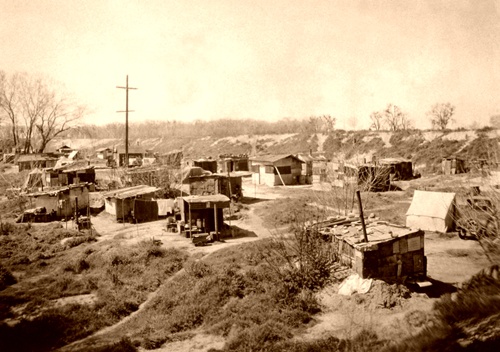
What were the villages full of shacks located in cities filled with unemployed Americans called?
a)
Hoovervilles
b)
Okies
c)
Bonus Army Bases
d)
Rooseveltowns
7.
Which economic factor contributed most directly to the start of the Great Depression?
a)
low worker productivity
b)
high income taxes
c)
decreasing tariff rates
d)
buying stocks on margin
8.
Which of the following was NOT an effect of the Great Depression?
a)
homelessness
b)
bank failures
c)
high tariffs
d)
struggling farmers
9.
The _______________________ was FDR's plan to help get the economy going again and help the unemployed find jobs.
a)
Hoovervilles
b)
German race
c)
The New Deal
d)
Pearl Harbor
10.
What is one way the New Deal was supposed to help the economy out of the Great Depression?
a)
by eliminating trading on the stock market
b)
by encouraging war with Germany and Japan
c)
by creating jobs through various new programs
d)
by giving people money through new bank laws
11.
Which program sets up a tax to help benefit retired people?
a)
FDIC
b)
Social Security
c)
TVA
d)
WPA
12.
What caused the U.S. to enter World War II?
a)
Germany invading Poland
b)
Sinking of the Lusitania
c)
Attack on Pearl Harbor
d)
France being taken over
13.
What was the purpose of the Lend Lease Act? 
a)
To help German Military  
b)
For the U.S. to officially enter WW2
c)
To let countries borrow or lease weapons to fight the Axis powers  
d)
To get more government funding for the War
14.
To pay for the War the federal government sold? 
a)
Stocks 
b)
War bonds 
c)
Land 
d)
Silver/Gold 
15.
What was the purpose for victory gardens? 
a)
To help raise money for the War 
b)
To have enough food for soldiers overseas 
c)
to help support the large number of growing men in the U.S.
d)
to fight obesity and to eat healthier 
16.
__________ and ___________ filled in the workforce for men overseas.
a)
Kids and Veterans 
b)
Immigrants and Children 
c)
Soldiers and Women 
d)
Women and Minorities 
17.
What event ended WW2?
a)
Dropping atomic Weapons
b)
Invasion of Poland
c)
Soviets capture Berlin
d)
Battle of Stalingrad
18.
Which 3 countries made up the Axis Powers?
a)
American, England, and Russia
b)
Sweden, Germany, and Denmark
c)
Italy, Russia, and Austria
d)
Italy, Germany, and Japan
19.
The Allies consisted of......
a)
Japan, Germany, and America
b)
America, France, and Australia
c)
America, Soviet Union, and Britain
d)
Germany, China, Japan, and Hawaii
20.
Rosie the Riveter encouraged women to...
a)
Stay at home for their children
b)
Work in factories
c)
Protest the war
21.
At the end of World War II, Soviet armies liberated the countries of Eastern Europe from Nazi Germany. The occupation of these countries by the Soviet Union contributed to the development of the Cold War by:
a)
contributing to conflict in the Middle East
b)
reunifying Germany
c)
strengthening the authority of the United Nations
d)
dividing Europe into communist and non-communist spheres
22.
How did the Brown v. Board of Education decision help the civil rights movement?
a)
It led to the overturning of many public segregation laws
b)
It caused Southern leaders to reevaluate their position on civil rights.
c)
It resulted in the appointment of the first African American Supreme Court Justice
d)
It led to the formation of the NAACP
23.
President Truman adopted a new foreign policy during the Cold War know as the Truman Doctrine. What was the main goal of the Truman Doctrine?
a)
To expand trade with Europe
b)
To limit the build up of nuclear weapons
c)
To stop the spread of communism
d)
to send financial aid to Europe
24.
The United States got involved in conflicts like Korea and Vietnam because they were afraid of the domino theory. What is the domino theory?
a)
If one country fell to democracy, others would follow
b)
If one country fell to communism, others would follow
25.
How did the Marshall plan try to stop the spread of communism in Western Europe after WWII?
a)
by providing government housing for refugees
b)
by providing military assistance to Vietnam
c)
by providing money to stop poverty
26.
In 1950, Korea fought a civil war over the spread of communism.  Communists from the north tried to take over the south.  What role did he US play in this war?
a)
The US and its allies went to Vietnam to fight Korean Communists.
b)
The US and its allies join the fight to keep communism from spreading.
c)
The US and its allies did not join the Korean War.
d)
The US and its allies fought to defend the North.
27.
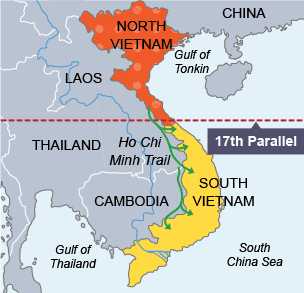
In the 1950s, the United States became involved in the Vietnam War. Why did the United States become involved in this war?
a)
to prevent the collapse of the government of North Vietnam
b)
to stop Vietnam from taking over Hong Kong
c)
to stop the spread of communism to South Vietnam
d)
to prevent attacks against United States shipping
28.
What was the name of the first satellite in space launched by the Soviet Union?
a)
Gagarin
b)
Apollo 11
c)
Sputnik
d)
Apollo 13
29.
Which of the following best describes the results of the Korean War?
a)
North Korea defeated South Korea, and now all of Korea is under Communist rule.
b)
China defeated Korea, and now all of Korea is under Chinese rule.
c)
The Korean War ended in a stalemate.  Today, North Korea is still a Communist nation, and South Korea is a free nation.
d)
The United States defeated Korea, and today Korea is a territory of the U.S.
30.

What court case made segregation of schools illegal in the 1950s?

a)

Guzman V. School

b)

Brown V. Board of Education

c)

Miranda V. Arizona

d)

Plessy V. Ferguson

31.

Which leader of the civil rights movement used non-violent civil disobedience to oppose segregation in the south?

a)

Dolores Huerta

b)

Malcom X

c)

Martin Luther King Jr.

d)

Ceaser Chavez

32.

What group during the Civil Rights Movement allowed members to use all necessary means to defend and provide for their community?

a)

Southern Peace Corps

b)

NAACP

c)

SNCC

d)

Black Panthers

33.

What acts of protest during the Civil Rights Movement encouraged the government to expand political and economic opportunities for minority citizens?

a)

March on Washington, Freedom Rides, Greensboro Sit-In, Montgomery Bus Boycott

b)

Black Panthers

c)

Mass Support Demonstrations

d)

Little Rock Nine

34.

This program created by Lyndon Johnson introduced programs like Head Start, HUD, Medicare, Food Stamps to reduce poverty and improve everyone’s quality of life-

a)

HUAC

b)

Great Society

c)

New Deal

d)

NAACP

35.

Cell phones and the Internet have both had the effect of

a)

reducing poverty and malnutrition.

b)

reducing trade barriers between nations.

c)

improving medical technology in developing countries.

d)

making the world a "smaller" place by increasing communication speeds.

36.

"You must pursue this investigation of Watergate even if it leads to the president. I'm innocent. You've got to believe me, I'm innocent. If you don't, take my job."


Richard Nixon, 1973

President Nixon made this statement during the investigation of what came to be known as the Watergate Scandal. What was the result of this investigation for President Nixon?

a)

He was cleared of any wrongdoing.

b)

Facing impeachment, he resigned from office.

c)

President Nixon lost his bid for re-election to Jimmy Carter.

d)

He was impeached, tried in the Senate, and removed from office.

37.

4) The primary cause of the first Gulf War (1990-1991) was

a)

the Iraqi army's sudden invasion of Kuwait.

b)

Iraqi possession of weapons of mass destruction.

c)

repeated attacks by the Iraqi navy on civilian targets within Israel.

d)

Iraq’s testing of a nuclear device as part of a test of its weapons program.

38.

6) Which group is generally held responsible for the terror attacks of September 11, 2001?

a)

Al-Qaeda

b)

Hezbollah

c)

PLO

d)

Taliban

39.

How did the War Powers Act of 1973 impact the role of the president?

a)

The act provided the President unlimited funds for spending on the armed forces.

b)

The act increased the ability of the President to send troops into hostile areas.

c)

The act placed a limit on the President's ability to send troops into hostile areas.

d)

The act gave the President the authority to declare war without Congressional approval.

40.

President Bill Clinton was impeached in 1998 for

a)

adultery and income tax evasion.

b)

obstruction of justice and perjury.

c)

violating the War Powers Act and the Voting Rights Act.

d)

misappropriation of funds and lifting sanctions with South Africa.

41.

What was Ronald Reagan's economic plan in the 1980s with regards to taxes and military spending?

A)

B)

C)

D)


a)

Ronald Reagan's policy favored cutting military spending to provide tax breaks to the middle class.

b)

Ronald Reagan focused on increasing taxes in order to increase military spending during the Cold War.

c)

Ronald Reagan implemented supply side economics to decrease taxes while increasing military spending.

d)

Ronald Reagan devoted his economic plan to balancing the budget by decreasing taxes and military spending.

42.

Which of these was a major foreign policy failure during the Carter presidency?

A)

B)

C)

D)

a)

American hostages taken in Iran

b)

loss of Panama to the Soviet Union

c)

failure to foster peace in the Middle East

d)

failure to protect West Berlin from communism

43.

The Presidential Election of 2008 resulted in a victory for which person?

a)

John McCain

b)

Barack Obama

c)

George W. Bush

d)

George H.W. Bush

44.

Which had the MOST significant impact on the Department of Defense budget increase between 2001 and 2014?


a)

increasing NATO troop levels

b)

fighting the war on terrorism

c)

protecting US embassies abroad

d)

rebuilding the military infrastructure

45.

One reason the United States became involved in the Vietnam War was to...

a)

prevent the spread of communism in Southeast Asia

b)

reduce French influence in Vietnam

c)

stop China from seizing Vietnam

d)

support the government of North Vietnam

46.
What event caused a negative shift in U.S. public opinion during the Vietnam War?
a)
The Geneva Accords
b)
Operation Rolling Thunder
c)
The Tet Offensive
d)
Gulf of Tonkin
47.
The Vietnam war prevented LBJ from focusing on what agenda?
a)
The Great Society
b)
The New Deal
c)
The New Frontier
d)
The Square Deal
48.

Who was the main enemy in the Pacific Theater?

a)

Japan

b)

Cuba

c)

Germany

d)

Britain

49.

Who was the main enemy in the European Theater?

a)

Japan

b)

Cuba

c)

Germany

d)

Britain

50.

The atomic bomb was created in the ___________ project.

a)

Des Moines

b)

Boston

c)

Manhattan

d)

Miami