
 Worksheets
Rock Cycle Summative Test
Total questions: 21
Worksheet time: 52mins

Which type of rock is changed due to great HEAT and PRESSURE?
Metamorphic
Igneous
Sedimentary

Which type of rock is made of cooling MAGMA or LAVA?
Metamorphic
Igneous
Sedimentary
How can a Metamorphic rock become an Igneous rock?
Weathering and Erosion
Compaction and Cementation
Heat and Pressurew
Melting and cooling
How does a Metamorphic rock become a Sedimentary rock?
Heat & pressure
Melting, cooling and solidification
Weathering, erosion, compaction and lithification
Cooling of magma over time
Define Igneous rock
Rocks form when particles of other rocks are deposited in layers and are compacted and cemented together.
Formed when lava or magma cools and solidifies. Lava cools quickly, magma cools slowly.
Formed deep underground where heat and pressure cause existing rocks to be changed.
Occurs when rock particles are pressed together or packed down by gravity and overlying rocks
The Law of Superposition states that
Igneous rock is the most superior because without it no other rocks could exist
Sedimentary rock is the most superior because it is made of sediment from all other rock types
Layers of sediment settle to the bottom of lakes and oceans in such a way that the oldest rock is at the top and the youngest is at the bottom
Sediment creates horizontal layers in which the oldest rock is at the bottom and the youngest rock is at the top
Which law states that younger rocks lie above older rocks if the layers have not been disturbed
Law of crosscutting
Law of superposition
Relative dating
Law of inclusion

Identify this rock type
Sedimentary - Conglomerate
Igneous - Slate
Metamorphic - Gneiss
The substance that is melted rock below the ground is called what?
Magma
Sediment
Gas
Water
What are the particles of weathered rock called?
Sediments
Fossils
Rocks
Minerals

Which missing rock type is the arrow pointing at?
Igneous
Sedimentary
Metamorphic

Which missing rock type is the arrow pointing at?
Igneous
Sedimentary
Metamorphic
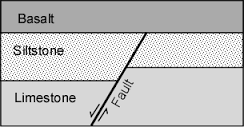


What is the correct order of the rock layers from oldest to youngest?
F, E, C, B, A, D
F, E, D, C, B, A
A, B, C, D, E, F
D, F, E, C, B, A

Which letter represents an intrusion (or a dike) ?
H
M
R
F
What is the order of youngest to oldest layer?
H, R, M, F, B, I Fault
I, H, B, F Fault, M, R
R, H, M, Fault, F, B, I
I, B, F, Fault, M, H, R

