
 Worksheets
Scharff Quiz #4
Total questions: 160
Worksheet time: 27mins
During the introduction, it is important to introduce the ________ and the ________.



What is the central idea of the passage?
The law was not exactly fair in the Middle Ages in Europe. Back then, you could blame someone in your town for committing a crime. The “criminal” could then challenge you to a fight to prove his guilt or innocence. If you lost the fight, you were charged as a liar and the criminal was believed to be innocent. If you won, the criminal was believed to be guilty.
Laws were unfair in the Middle Ages
Fighting is a good way to decide guilt or innocence.
Most people lied about crime in the Middle Ages.
Those who were innocent of crimes often won

What is the central idea of the passage?
In 1981, a new television channel was introduced to showcase musicians performing their songs in music videos. This channel was called MTV, or Music Television. Since the channel first went on the air, viewership has increased, and the channel has expanded to countries all over the world. Today, MTV not only shows music videos, but a variety of other television programming as well.
MTV has been a ground-breaking TV channel
MTV offers interesting videos
Watching MTV is a great way to see musicians
MTV is a channel that is broadcasted around the world

What is the central idea of the passage?
Jackie Robinson did something nobody had ever done before. He was not only a three-sport athlete at UCLA. He was the first African-American to play on a Major league baseball team, the Brooklyn Dodgers. Robinson had to deal with racism all over the country. He was treated very poorly by the by other players and fans in the stadiums he visited. But, whenever things got difficult, his courage and determination kept him going. Today his number 42 is retired on every team in major league baseball, and he is in the National Baseball Hall of Fame.
Jackie Robinson is an important figure in American History
Jackie Robinson played many different sports
Jackie Robinson is in the Baseball Hall of Fame
Jackie Robinson played for the Brooklyn Dodgers
Travis began the school year the same as always. He never studied or completed his homework. Each report card showed the same poor grades. Although his parents encouraged him, by the end of the year, he was still doing poorly.
What type of character is he?
dynamic character
static character
Even though she loved to dance, Shannon was nervous about joining the dance team. She tried out and made it, but never said a word to anyone. At each dance practice, Shannon got a little more comfortable with her team. By the end of the season, not only did she make friends, but she even taught the team a few dance moves.
What type of character is she?
dynamic character
static character
In the book (and movie) Harry Potter, the main character starts off as a powerless young boy to a powerful wizard. Is he a static character?
Yes
No
"Wow! With a top speed of one hundred fifty miles per hour, that car can almost fly!"


Which passage has a more cautionary mood?
1
2

Which passage has an unhappy mood?
1
2
What is point of view?
the time and place the story occurs
the author's purpose
who is telling the story
the main events
True or False: A character can also be a narrator
True
False
Which type of point of view is when a character from the story writes from his or her viewpoint?
1st Person
3rd Person
Which type of point of view is when a narrator who is not a part of the story tells the story?
1st Person
3rd Person
What point of view is this written?: "The day grew dark, but Michael kept searching for his lost keys. If he could only find them, he would not get in trouble. This was the second time this month he had lost his keys."
1st Person
3rd Person
What point of view is this written?: "Suddenly a mouse timidly poked its head out of the bathroom door. I jumped up on the couch and squealed in surprise. My sister screamed in fear at my response to the mouse."
1st Person
3rd Person
What kind of language and/or tone should you use in argumentative writing?
Humorous
Informal
Formal
Dramatic
Your opinion, thesis or argument is called :
evidence
reasoning/warrant
claim
subclaim
What is an example of a formal claim?
Space is cool
We should explore space.
Space medicine can help the suffering children.
We need help going to space.
What does it mean to cite text evidence?
We need to cite evidence?????
Make up facts that sound legit.
Copy down most of what the author said in an article and call it your own.
Use a direct quote or paraphrase a quote from a resource to support your reasons.
Which of these options is an example of a direct quote citation?
Thomas Jones often says, "only a human can experience what being in space feels like, and only a human can communicate this to others."
We should explore space.
Is there a price to inspiration and creativity?
Space exploration is not a drain on the economy.
How do we know a claim is strong?
It is a fact
It is a statement
It is debatable
It has an exclamation point
Realistic fiction has characters and plots that could actually happen in everyday life.
true
false
Realistic fiction is written in 2nd person point of view.
true
false
Realistic fiction is written in 1st or 3rd person point of view.
true
false
In realistic fiction, the story takes place in what could be a real setting.
true
false
In realistic fiction, at least one character has a conflict or problem.
true
false
What is 1st person point of view?
one of the characters tells the story as it happens to him or her
a narrator tells the story
What is 3rd person point of view?
one of the characters tells the story as it happens to him or her
a narrator tells the story
Realistic Fiction is the same as Nonfiction? True or False
True
False
Which problem are you most likely to find as the plot for a realistic fiction story?
A boy finds out he is a wizard.
A girl tries to be the best goalie on the team.
George Washington has trouble making friends.
A family faces hard times living on the moon.
Which character could not be in a realistic fiction book?
A bully
A unicorn
Someone's mom
A kid who climbs mountains
What does realistic mean?
True to life
Something that's like-real, but isn't
Kind of real
All of the above
Which is the most likely setting for a realistic fiction story?
In a teacup
Narnia
At the mall
On Darth Vader's Death Star
Writers use _____________ -they they saw, heard, touched, smelled, and tasted.
sensory details/imagery
main ideas
pictures
mood
Quotation marks are placed on both sides of a direct quote.
True or False?
bird's eye view
is an example of which sensory detail?
-is an example of which sensory detail?
I was busy doing my homework _________ my brothers were busy playing video games. (Which word means: "at the same time"?)
after
while
before
Which of the following is NOT a sequence word?
first
next
out
To sequence means to ____________.
put things in order
to tell what it's mostly about
to figure out what is happening
What are some clue words for sequencing?
as a result of, therefore
first, next, then, finally
main idea, details
A modifier is called "misplaced" when:
it is placed too close to the word it modifies
it is placed too far away from the word it modifies
Hannah kept all her medicine in the medicine cabinet that had been prescribed to her.
We are lucky to have access to clean safe water.
Coordinate (need a comma)
Not Coordinate (no comma needed)
Yipping loudly, the happy carefree poodle played in the backyard.
Coordinate (need a comma)
Not Coordinate (no comma needed)
Ella hung up the lime green curtains in her room.
Coordinate (need a comma)
Not Coordinate (no comma needed)
In the drawer, the girl found a delicate diamond necklace.
Coordinate (need a comma)
Not Coordinate (no comma needed)
- for example
- is like
- including
-first
-now
-later
-(actual dates)
-if/ then
-therefore
-becasue
-so that
-question/answer
- puzzle is solved
-both
-alike
-different
-yet
Did you know that not all deserts are
hot? Both hot and cold deserts are very
dry, but unlike hot deserts, cold deserts have long
winters when the temperatures can reach below
freezing. Cold deserts also get a great deal of
snow, which is certainly not true for hot deserts.
compare and contrast
problem and solution
description
sequence/chronological
No one knows exactly what causes tornados, but some scientists believe that when warm air meets cold air, a tornado may form. The reason for this is that the warm air is lighter than the cold air, so it rises up fast and meets different winds moving different directions. Under the right conditions, this can cause a tornado. Though there is still much mystery surrounding tornados, many people believe that when warm moist air meets cool dry air, tornados can result.
problem & solution
cause & effect
compare & contrast
sequence/chronological

The dodo bird used to roam in large flocks across America. Interestingly, the dodo wasn’t startled by gun shot. Because of this, frontiersmen would kill entire flocks in one sitting. Unable to sustain these attacks, the dodo was hunted to extinction.
Problem and Solution
Cause and Effect
Sequence/Chronological
Compare and Contrast

This morning was crazy. My alarm clock was set for PM instead of AM, so I woke up really late. I just threw on some clothes and ran out the door. I rode my bike as fast as I could and thought that I was going to be late for sure, but when I got there everyone was outside and there were firetrucks all lined up in front of school. I guess somebody pulled the fire alarm before class started. It worked out though, because nobody really noticed or minded that I was tardy.
Sequence/Chronological
Cause and Effect
Problem and Solution
Compare and Contrast

Apples and oranges are both fruits, which means that they have seeds inside of them. Each has a skin, but orange skins are thick and easy to peel. Apple skins are thinner and do not peel easily. Oranges also contain more acid than apples, but both fruits are delicious.
Problem and solution
Compare and Contrast
Sequence/Chronological
Cause and Effect

Scenario:
"Ms. Aden really wanted to go to a concert, but the only problem was that her car was in the shop. Ms. Aden lived 10 minutes from the metro. Because of this, she was able to go to the concert!"
What text structure is being used in this scenario?
Compare and Contrast
Sequence/Chronological
Problem and Solution
Cause and Effect

What is the Cause? What is the Effect?
Effect: Ray forgot to charge his iPad.
Effect: Ray's iPad was dead.

How is the text structured?
A hurricane is a large storm with heavy winds and rain that begins in the ocean and builds up strength as it moves across the water. While some of the damage caused by hurricanes is from high winds, most of it is usually from tidal surge, flooding entire cities, and killing large numbers of people. A tornado is a storm that develops on land, with no warning, and moves in a circular motion with heavy winds with a funnel shape, picking up and carrying dirt, dust and even objects. The damage caused by tornadoes is from the high velocity winds, which are extremely destructive and deadly. They can demolish entire neighborhoods in a matter of a few seconds to a few minutes. Tornadoes can form when hurricanes make landfall, as their winds at ground level slow down, while the winds near the top keep their momentum, but a hurricane cannot be created by a tornado.
Sequence/Chronological
Compare and Contrast
Problem/Solution
Cause and Effect
How is the text structured?
Hurricane Katrina began as Tropical Depression Twelve over the southeastern Bahamas on August 23, 2005. The depression later strengthened into a tropical storm on the morning of August 24, where the storm was also named Katrina. Katrina continued to move into Florida and became a Category 1 hurricane only two hours before it made landfall around Hallandale Beach on the morning of August 25. The storm weakened over land, but became a hurricane again while entering the Gulf of Mexico.
Compare and Contrast
Problem Solution
Cause and Effect
Sequence/Chronological
How is the text structured?
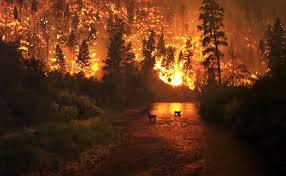
Fire needs three things to burn: oxygen, fuel, and heat. Fuels can be wood, tinder, coal, or any other substance that will easily oxidize. Therefore, a fire can be stopped in three different ways, by removing any of the three things it needs to burn.
*The fuels can be removed. If a fire burns through all of its fuel and extra nearby fuel is removed, the fire will stop burning.
*The oxygen can be removed. This is called "smothering" a fire. Fires cannot burn in a vacuum or if they are covered in carbon dioxide.
*The heat can be removed. The most common way to remove heat is to use water to absorb that heat, putting the fire out.
cause and effect
problem solution
sequence/chronological
compare and contrast
What type of text structure?
Avalanches - Avalanches (when a lot of snow falls from a mountain) may bury people under them. If the people are not found rapidly enough by rescue teams they will die of suffocation (not getting enough air) or of hypothermia (freezing cold). The chance of surviving an avalanche is as follows: 92% if found within 15 minutes 30% if found within 35 minutes (victims die of suffocation) nearly zero after two hours (victims die of injuries and hypothermia)
Compare and contrast
Sequence/Chronological
Cause and effect
Problem and solution
helps you figure out the pronunciation of a word, key words are defined, generally found in the back of the book.
index
table of contents
glossary
timelines
How does a caption help a reader understand an informational text?
it explains a photograph or illustration and gives information that may not be in the text
It provides the reader with an image to show a visual representation of the text
it provides the meaning of a word
It summarizes the overall meaning of the text
Why is the index easier to use when looking for a specific topic?
it gives the meaning and page numbers
the index is organized in chapters and gives page numbers for each chapter
the index is arranged in alphabetical order by topics, not in chapters and it allows you to quickly find the topic and page number
it gives you pictures and illustrations to explain the information
Why would a reader use a glossary when reading an informational text?
To find a specific topic
To find the meaning of a bold or highlighted work from the text
to find out more information about the topic
to locate information to see how it is organized
Visual representation of facts and details
headings/subheadings
title
timeline
tables and graphs
Help the reader better understand the order of events and how one event may have led to another, show important events in chronological order
timeline
caption
title
heading/subheading
Help the reader understand information that may or may not be in the text, describes an illustration
heading
subtitle
caption
title
How does a caption help a reader understand an informational text?
It provides the reader with an image to show a visual representation of the text
it provides the meaning of a word
It summarizes the overall meaning of the text
It explains a photograph or illustration and gives information that may not be in the text
present information in a visual way, allow readers to have a visual of the topic
captions
timelines
titles
photographs/illustration
help the reader to locate information in the text, printed in large or bold print to make them stand out.
headings/subheadings
captions
titles
index
Lists the major parts of the book along with their page numbers, helps readers to locate information in a book or magazine and see how everything is organized, located in the front of the book.
title
glossary
table of contents
captions

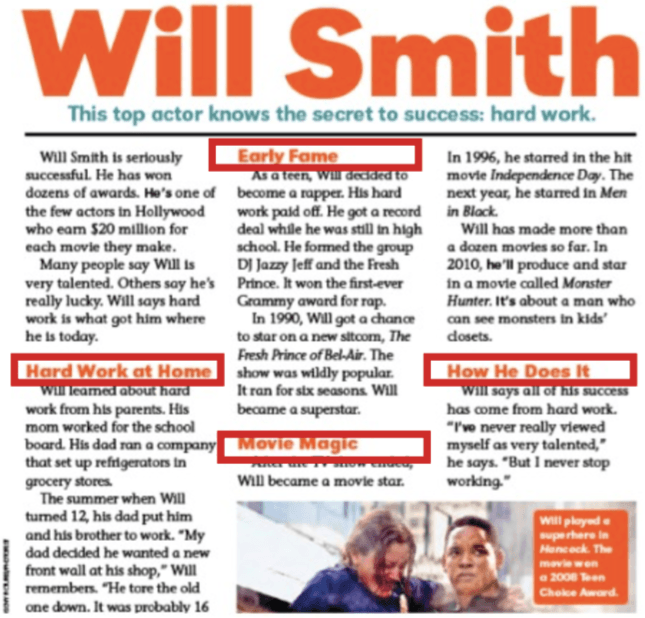
This is considered a
caption
glossary
title
timeline
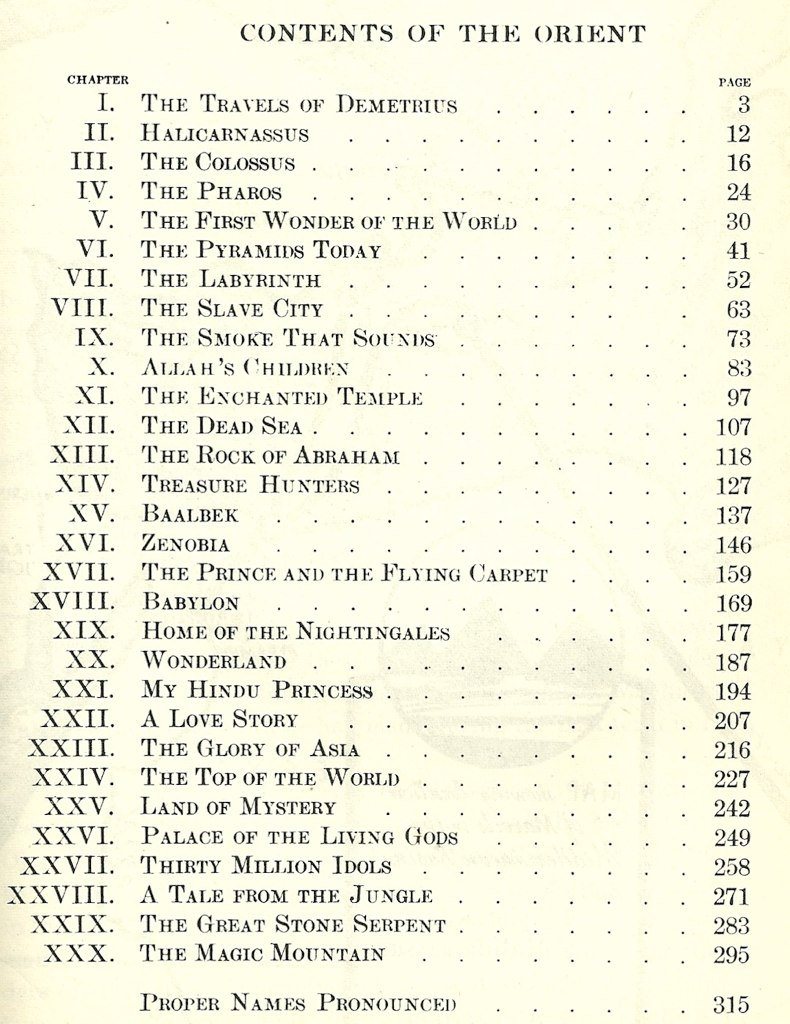
What is this an example of?
Glossary
Index
Footnotes
Table of Contents
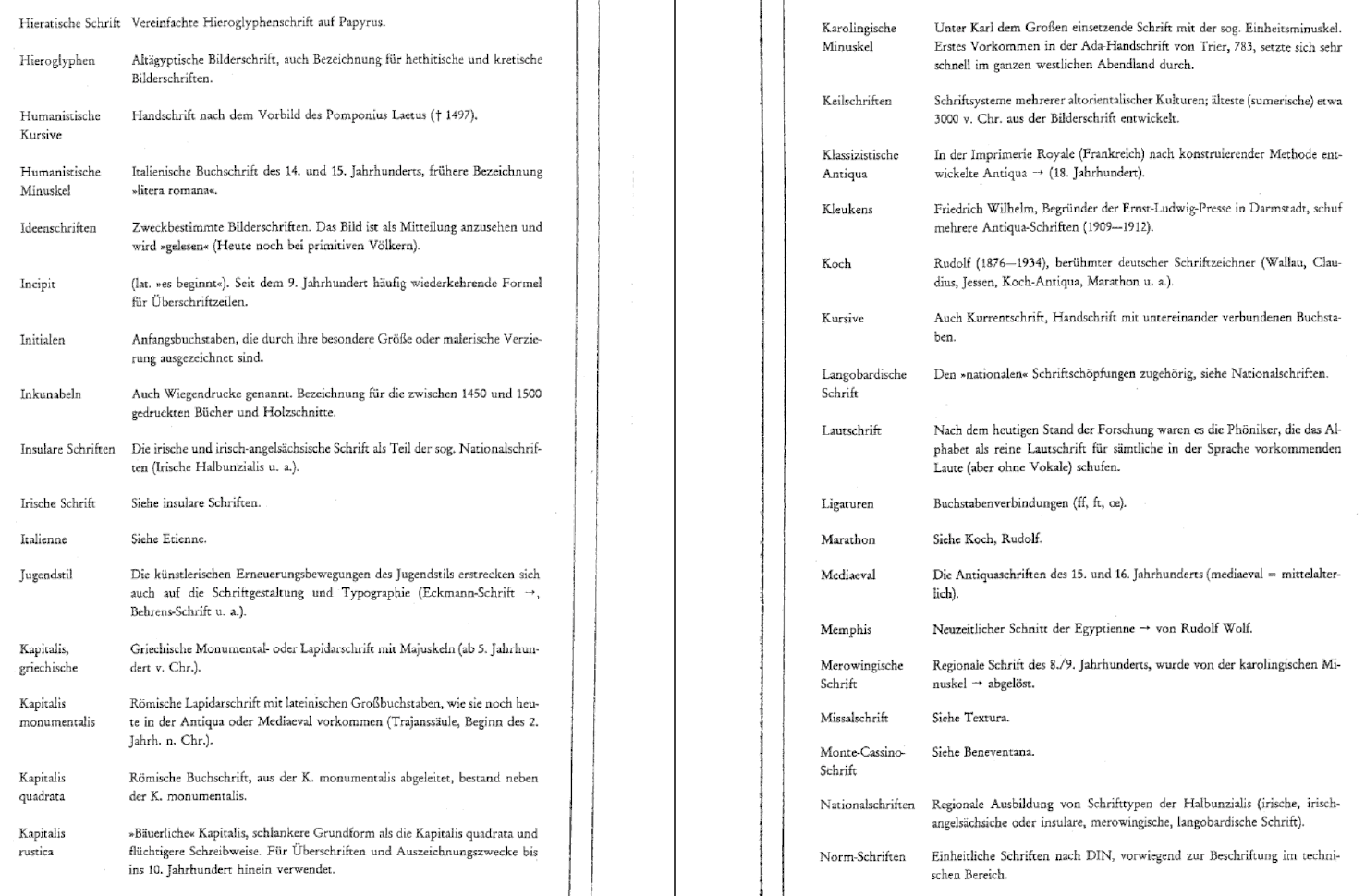
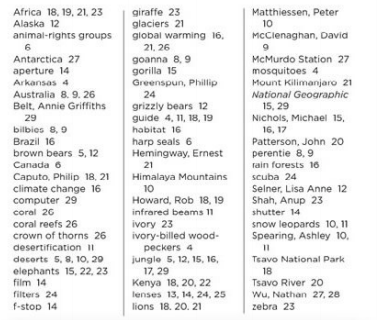
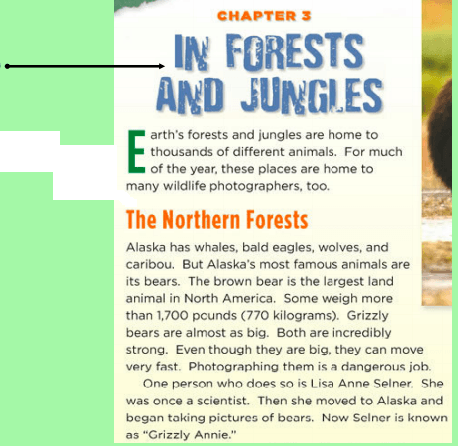
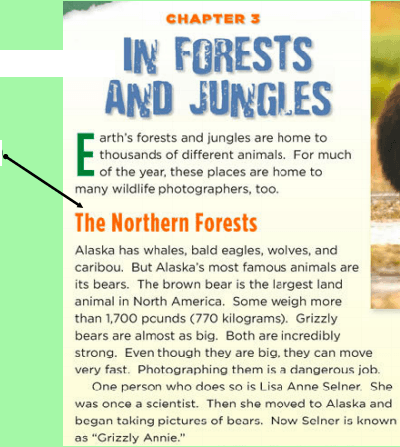
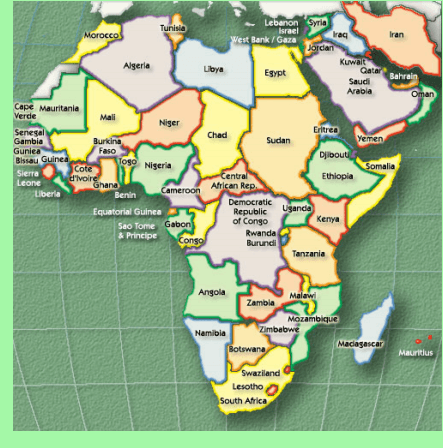
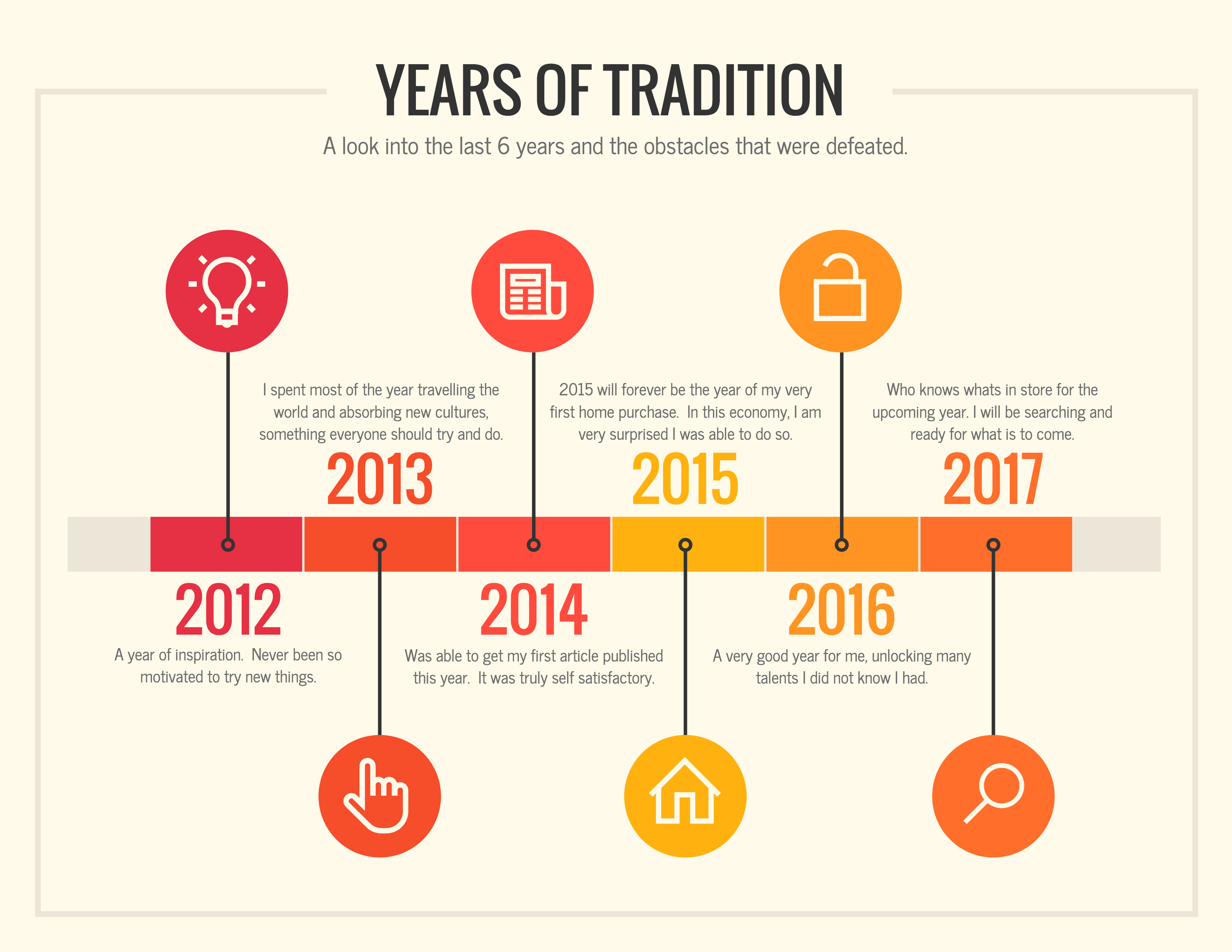
Which of these is an example of a timeline?
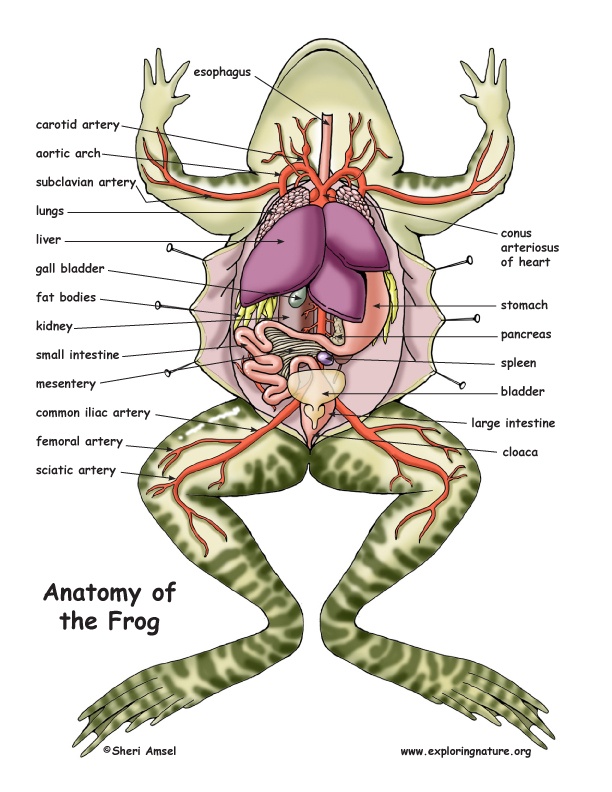
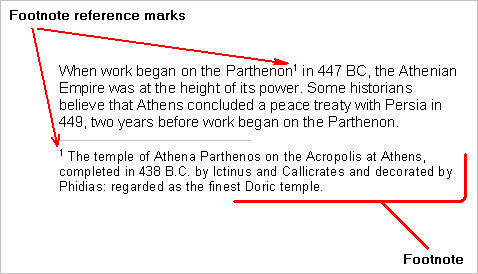
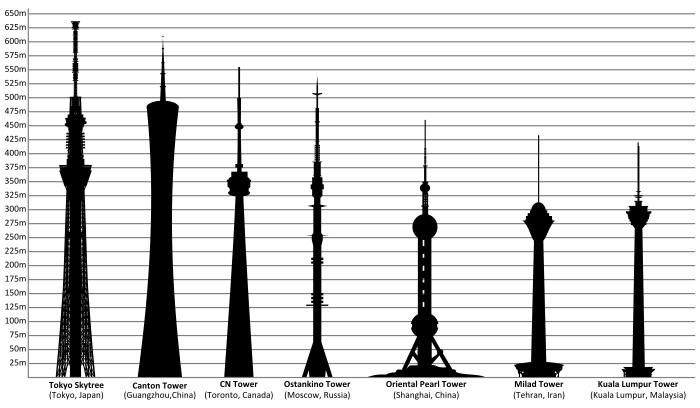
The text feature on the far right of the page is called a
caption
diagram
timeline
sidebar
The Battle of Gettysburg is an example of what text feature?
Highlight
Underline
Bold
Italicized
When taking notes over a topic with several main points or details, this is one of the easiest ways to organize:
Parenthesis
Style
Index
Bullets/Numbers
Using different fonts, styles, size, or color:
Highlights the important information in the text.
Makes the text look more entertaining.
Summarizes the topic.
Calls attention to misprints in the text.
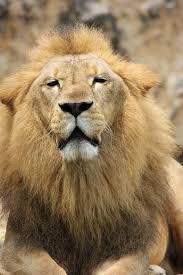
The lion (Panthera leo) is a species in the family Felidae. Which text feature is utilized?
Sidebar
Chart
Caption
Parenthesis

