
 Worksheets
(Biological) Macromolecules
Total questions: 53
Worksheet time: 3605secs
Can a change in pH alter the active site of an enzyme
yes
no

What is indicated by letter C?
enzyme
product
substrate
active site
What is indicated by letter B?
enzyme
product
substrate
active site

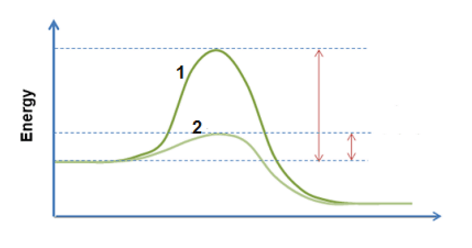
Trypsin is an enzyme that is secreted into the small intestine to further break down peptides into their amino acids. If trypsin is mixed in with a solution of starch molecules, which of the following is most likely to happen?
Trypsin will break down the starch if the pH is within the optimum range.
Trypsin will break down the starch if the temperature is within the optimum range.
Trypsin will not break down the starch because enzymes are substrate specific.
Trypsin will not breakdown the starch if the solution is not in the small intestine.
In what ways do enzymes help a cell carry out its chemical reactions?
Enzymes lower the amount of reactants needed for the reaction to occur.
Activation energy and the rate of reaction are both increased by enzymes.
Enzymes speed up chemical reactions by lowering the activation energy needed.
Enzymes slow the reaction down by increasing the amount of energy produced.
Lipase is produced by the pancreas to help digest fat. Lipase breaks down the fats into fatty acids.
Identify the substrate in this reaction.
lipase
fats
fatty acids
pancreas
What are the building blocks (or monomers) of carbohydrates?
Nucleotides
Monosaccharides
Amino Acids
Glycerols
Which of the following is the polymer of carbohydrates?
triglycerides
proteins
nucleotides
polysaccharides
Which of the structures below shows a nucleic acid?


Which of the structures below shows a protein?


DNA and RNA are examples of
Carbohydrates
Lipids
Proteins
Nucleic Acids

Which macromolecule is shown?
lipid
protein
nucleic acid
carbohydrate


The chemical equation for photosynthesis is
Carbon dioxide + Water + Light --> Glucose + Oxygen
Glucose + Carbon Dioxide + Light --> Oxygen + Water
Oxygen + Carbon Dioxide --> Light + Glucose + Water
Light + Carbon Dioxide --> Oxygen + Water + Glucose
A student is collecting the gas given off from a plant in bright sunlight at a temperature of 27°C. The gas being collected is probably ________.
oxygen
carbon dioxide
nitrogen
glucose
After photosynthesis, plants store their energy as _________ .
Water
Carbon Dioxide
Glucose (sugar)
Oxygen

