Wayground logo

Free Printable Worksheets

Font size

S
M
L
XL
Worksheets

Magnets and Magnetism

Total questions: 53

Worksheet time: 56mins

Name
Class
Date
1.
A ____________ is a special metal that attracts other metals.
a)
coil
b)
magnet
c)
bunker
d)
repellant
2.
Magnets attract to __________________.
a)
iron
b)
nickel
c)
cobalt
d)
all of the above
3.
_______________________ is the invisible force that flows through a magnet.  
a)
repel
b)
copper
c)
attraction
d)
magnetism
4.
What happens when the North pole of a magnet interacts with another magnet's north pole?
a)
attract
b)
repel
5.
A magnet can lose its magnetic properties if you ___________________
a)
drop or hit the magnet
b)
put the magnet in a strong magnetic field that is opposite of its own
c)
heat up the magnet
d)
all of the above
6.
True or False:  An electromagnet can function without electricity.
a)
True
b)
False
7.
True or False:  A permanent magnet stays magnetized for a long time
a)
True
b)
False
8.
True or False:  A temporary magnet remains magnetized for a long period of time
a)
True
b)
False
9.
True or False:  The Earth is a giant magnet
a)
True
b)
False
10.
In this image, matching north poles from two magnets are introduced.  What do you predict will be the outcome?
a)
There will be no interaction.  The poles of magnets do not have an effect on one another.
b)
The two north poles will attract each other
c)
The two north poles will repel each other
d)
The two magnets will combine and become one magnet
11.
Which of the following is true about a bar magnet?
a)
Its magnetic field is strongest near its center.
b)
It is surrounded by a magnetic field.
c)
The north pole is stronger than the south pole.
d)
The south pole is stronger than the north pole.
12.
If you cut a magnet in half, what happens to the poles?
a)
One half gets the North Pole, the other half gets the South Pole
b)
Both halves get only a North Pole
c)
Both halves get only a South Pole
d)
Both halves get a North pole and a South Pole
13.

A _________________________ is the invisible force that surrounds a magnet.

a)

bar magnet

b)

a gravitational force

c)

a magnetic field

d)

gravity

14.
What do the lines around this magnet represent?
a)
North Pole
b)
South Pole
c)
Magnetic Declination
d)
Magnetic Field
15.
Why does a compass needle point north?
a)
The compass is a bar magnet
b)
Because north is up
c)
Because it's magic
d)
It lines up with the Earth's magnetic field
16.
Magnetic NORTH is actually geographic _________
a)
SOUTH
b)
NORTH
c)
EAST
d)
WEST
17.
Any material that attracts iron and materials that contain iron
a)
maglite
b)
Magnet
c)
magnetism
d)
electricity
18.

Magnetism is a force of ____________________________ that occurs between two _____________ objects.

a)

attraction or repulsion, magnetic

b)

external or internal, magnetic

c)

external or repulsion, electronic

d)

attraction or internal, electronic

19.

The Earth produces its own ________ field.

a)

spectrum

b)

electric

c)

magnetic

d)

progressive

20.

A compass points toward the south pole of Earth's magnetic field, located near the Earth's geographical ________.

a)

north

b)

south

c)

east

d)

west

21.

If two magnets are close together, the magnetic force will be ________.

a)

smelly

b)

weak

c)

strong

d)

positive

22.

Although magnetic fields are _____________, one common way that people investigate them is to use ________ filings.

a)

invisible, iron

b)

touchable, iron

c)

invisible, plastic

d)

touchable, plastic

23.

By sprinkling iron filings in a magnetic field on a flat surface, it is possible to see the __________ of a magnetic field.

a)

shape

b)

distance

c)

mass

d)

density

24.
Where is the strongest attraction force of the magnet?
a)
at the poles
b)
in the middle
c)
above the magnet
d)
below the magnet
25.

All atoms have magnetic fields with north and south poles. Where these atoms are located are called ______. (see image for help)

a)

Atoms

b)

Domains

c)

Arrows

26.
In un-magnetized materials the domains are __________ aligned.
a)
super
b)
slightly
c)
randomly
d)
always
27.

The history of Magnet is from...

a)

Lodestone

b)

Red stone

c)

Magnetized

d)

Black stone

28.

Which of the following metals are non-magnetic?

A Iron

B Steel

C Copper

D Aluminium

a)

A and B only

b)

A and C only

c)

B and C only

d)

C and D only

29.

Janet had two identical magnets, A and B, which attracted the same number of steel paper clips. She then dropped magnet A on the floor 300 times.


What would she likely observe of she brought magnets A and B near the same steel paper clips as shown above?

a)

Magnet A attracted more steel paper clips than magnet B.

b)

Magnet A attracted less steel paper clips than magnet B.

c)

Both magnets A and B did not attract any steel paper clips.

d)

Both magnets A and B attracted the same number of steel paper clips.

30.

What could happen if you beat up a magnet with a hammer?

a)

You'd create lots of little working magnets.

b)

It would just stick to the hammer because it's made of steel.

c)

It wouldn't hurt the magnet at all.

d)

You could demagnetize it so it didn't "work" anymore.

31.

What is a lodestone?

a)

Something only found in Minecraft.

b)

A natural magnet.

c)

A rock that people charged to become magnetic.

d)

A really heavy stone.

32.

Which of these metals IS NOT ferromagnetic?

a)

Steel

b)

Aluminum

c)

Iron

d)

Nickel

33.
Electric motors are devices that convert _____ energy into  _____ energy.
a)
electrical; mechanical
b)
mechanical; electrical
c)
chemical; potential
d)
mechanical; kinetic
34.
What kind of magnet can be turned on and off?
a)
refridgerator magnet
b)
electromagnet
c)
magnetite
d)
iron
35.
Region around a magnet in which magnetic force can act.
a)
Magnetic field 
b)
Magnetic force
c)
Domain
d)
Perimeter
36.
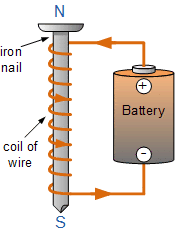
A simple electromagnet can be made with which of the following?
a)
an electric current
b)
a turbine and nail
c)
a nail, a wire, and a battery
d)
a compass and a battery
37.
__________is an imbalance of electric charges within or on the surface of a material that builds up.
a)
static electricity
b)
current electricity
c)
circuits
d)
load
38.
How do you make an electromagnet stronger?
a)
Add a motor and/or lightbulbs
b)
Add more light bulbs and/or wire coils
c)
add more wire coils and/or a switch
d)
add more wire coils and/or batteries
39.
What does a loudspeaker use to turn electric energy into sound?
a)
a permanent magnet
b)
an extension cord
c)
an electromagnet
d)
a series circut
40.
In order for an electromagnet to be formed, an __________ current must pass through a coil of __________ wrapped around an ________ core.
a)
wire, iron, electric
b)
electric, wire, iron
c)
iron, electric, wire
d)
excited, hair, apple
41.
An electromagnet's poles may be reversed by:
a)
decreasing the voltage of the coil
b)
increasing the number of coils
c)
changing the direction of current flow
d)
altering the material used to make the coils
42.
A pathway for electricity to travel is called___________
a)
current
b)
static electrcity
c)
circuit
d)
circle
43.

Which of the following is the purpose of an electrical cell?

a)

To change mechanical energy to electrical energy

b)

To change electrical energy to chemical energy

c)

To change electrical energy to mechanical energy

d)

To change chemical energy to electrical energy

44.

What term is given to the process that takes place inside a cell?

a)

Electrochemical action

b)

Electromagnetic action

c)

Piezoelectric action

d)

Electromechanical action

45.

With respect to recharging a primary or secondary cell, of the following statements, which one is correct?

a)

The secondary cell can be recharged by passing current through it in the proper direction

b)

The primary cell can only be recharged by changing the electrolyte

c)

The primary cell can be recharged by passing current through it in the proper direction

d)

The secondary cell can only be recharged by changing the electrodes

46.

The lead-acid cell is an example of which of the following types of cells

a)

The dry cell

b)

The primary cell

c)

The voltaic cell

d)

The secondary cell

47.

In a dry cell, what is the consistency of the electrolyte?

a)

Paste

b)

Solid

c)

Powder

d)

Liquid

48.

Of the following types of cells, which one is a primary cell?

a)

Lithium organic

b)

Nickel cadmium

c)

Silver zinc

d)

Silver cadmium

49.

What are the three basic parts of a cell

a)

Anode, load, depolarizer

b)

Electrodes, electrolyte, container

c)

Electrodes, acid, water

d)

Anode, cathode, ions

50.

What causes negative ions to be attracted to the cathode of a primary cell while the cell is discharging?

a)

A negative charge caused by a loss of electrons

b)

A positive charge caused by an excess of electrons

c)

A positive charge caused by a loss of electrons

d)

A negative charge caused by an excess of electrons

51.

Which of the following actions will recharge a secondary cell?

a)

Adding more active ingredient to the electrolyte

b)

Connecting the negative terminal of a voltage source to the cathode of the cell and the positive terminal of the voltage source to the anode of the cell

c)

Connecting the negative terminal of a voltage source to the anode of the cell and the positive terminal of the voltage source to the cathode of the cell

d)

Adding more water to the electrolyte

52.

A battery is rated according to a 20-hour rate of discharge at 300 ampere-hours. Which of the following currents is the maximum current that will allow the battery to deliver its rated capacity?

a)

25 amperes

b)

30 amperes

c)

15 amperes

d)

20 amperes

53.

An example of a secondary cell is:

a)

A button cell

b)

An alkaline cell

c)

A fuel cell

d)

A car battery