
NEW
Font size
 Worksheets
Unit 2 - Motion and Stability Test Review
Total questions: 45
Worksheet time: 1hrs 1mins

Resistance of any physical object to any change in its state of motion (moving or still)
Mass
Matter
Inertia
Rule of Thumbs

Force caused by one object rubbing against another.
Inertia
Friction
Matter
Mass

A push or a pull of an object resulting from the object's interaction with another object.
Matter
Friction
Inertia
Force

The overall force acting on an object; the sum of all forces acting on an object.
Force
Net Force
Friction
Inertia

For every action there is an equal and opposite reaction.
Unbalanced Force
Newton's 2nd Law
Newton's 1st Law
Newton's 3rd Law
Newton's second law is:
For every action there is an equal and opposite reaction.
F = ma
An object at rest will remain at rest and an object in motion will reamin in moition until opposed by an unbalanced force.
None of the above
An object in rest stays in rest and an object in motion stays in motion unless opposed by an unbalanced force. What law of motion is this?
Newton's First Law
Newton's Second Law
Newton's Third Law
A non-contact force that pulls things to the Earth (or other large object)...
gravity
magnetism
friction
motion

When your position changes, you're in ____________.
motion
force

Which law best describes inertia
1
2
3
All of the above
Which is newtons first law states
An object at rest will remain at rest unless a force is applied
An object is moving
An object has stopped
An moving object will keep going when a force is applied to it

What is the force of gravity on a person or object on the surface of a planet?
Gravity
Weight
Mass
Force
A ______________ force is when two equal forces push/pull in the opposite direction.
Ex. Two men are pushing on a cart (on opposite sides) with the same exact amount of
force and the cart does NOT move because it is balanced.
balanced
unbalanced
A ____________ force is when one force is larger than the other. The object will then
change its speed or the direction it is moving in.
balanced
unbalanced
If a baseball is thrown in a straight path, what two forces cause the ball to eventually stop moving?
gravity and friction
mass and ground force
wind resistance and mass
negative acceleration and gravity
If the masses of objects increase and their distance from each other remains the same, then the force of gravity between the two objects
decreases
increases
remains the same
increases and decreases


Two factors that affect the strength of the force of gravity between 2 objects are...
mass and distance
mass and matter
distance and weight
weight and mass


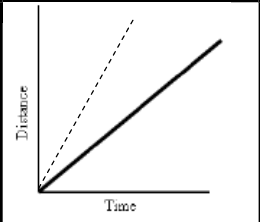
The yellow-orange line represents the fastest centipede because the slope is the steepest
True
False
What is an elastic collision?
An elastic collision is an encounter between two bodies in which the total kinetic energy of the two bodies is different.
An elastic collision is an encounter between two bodies in which the total kinetic energy of the two bodies remains the same.
An inelastic collision is an encounter between two bodies in which the total kinetic energy of the two bodies remains the same.
What is an inelastic collision?
When two objects collide, becoming stuck together and internal kinetic energy is lost (but not really lost, it transfers to different forms of energy)
When two objects collide, becoming stuck together and internal kinetic energy is lost
When two objects don't collide, becoming stuck together and internal kinetic energy is lost (but not really lost, it transfers to different forms of energy)

Lilly's cat ran through your yard. The cat has a mass of 5 kg. He is running at a speed of 3 m/s. What is the kinetic energy of the cat as he runs? (KE = 1/2mv2)
8.5 J
45 J
7.5 J
22.5 J
A 50 kg skater pushed by a friend accelerates 5 m/sec2. How much force did the friend apply?
45 N
15 N
10 N
250 N
What is the equation for momentum
p=mv
s=d/t
kg*m/s
F=ma
What is the momentum of a 15kg girl moving at a speed of 1.3m/s?
16 kg*m/s
20 kg
20 m/s
20 kg*m/s

