Wayground logo

Free Printable Worksheets

Font size

S
M
L
XL
Worksheets

Rivers

Total questions: 57

Worksheet time: 36mins

Name
Class
Date
1.
Which is NOT a method of transportation?
a)
Abrasion
b)
Saltation
c)
Traction
d)
Suspension
2.
Where would you find a waterfall?
a)
Upper course
b)
Middle Course
c)
Lower Course
3.
What landform can you see in the picture?
a)
Floodplain
b)
Delta
c)
Waterfall
d)
Oxbow lake
4.
"Rocks rolled along the river bed" is what type of transportation?
a)
Saltation
b)
Suspension
c)
Traction
d)
Solution
5.
"When rocks scrape along the river bank and bed" is what type of erosion?
a)
Attrition
b)
Abrasion
c)
Solution
d)
Hydraulic Action
6.
"This is where plants, trees, or buildings collect the precipitation" What am I?
a)
Interception
b)
Infiltration
c)
Percolation
d)
Surface runoff
7.
"Where the water filters into the ground and into the tiny pores in the soil" What am I?
a)
Infiltration
b)
Percolation
c)
Precipitation
d)
Interception
8.
"I am the movement of water sideways through the soil" What am I?
a)
Throughflow
b)
Rock flow
c)
Soil flow
d)
Groundwater flow
9.
"I am a smaller river joining a larger river" What am I?
a)
Confluence
b)
Tributary 
c)
Drainage Basin
d)
Watershed
10.
I am the land that gets flooded when the river overflows. What am I?
a)
Levee
b)
Delta
c)
Floodplain
d)
Meander
11.

A river's ________________ is the starting point of the river.

a)

source

b)

triutaries

c)

mouth

d)

drainage basin

12.

The place where the river end in the sea or large lake is called the ___________.

a)

source

b)

tributaries

c)

mouth

d)

drainage basin

13.

The area of land DRAINED by a river system is called the _____________

a)

drainage basin

b)

mouth

c)

tributaries

d)

source

14.
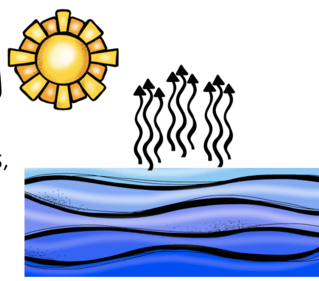
What part of the water cycle does this picture show?
a)
condensation
b)
precipitation
c)
evaporation
d)
transpiration
15.
Evaporation happens when the sun ___________ water and turns it into vapor.
a)
cools
b)
heats up
c)
freezes
d)
lights up
16.
What are three things that rivers do naturally?
a)
a.erode, transport, and deposit
b)
b. dissolve, precipitate, sublime
c)
c. evaporate, percolate, infiltrate
d)
d.none of these
17.

What landform can you see in the picture?

a)

U shaped valley

b)

V Shaped Valley

c)

Floodplain

d)

Waterfall

18.
 Deposition is a process that
a)
Dissolves sediment
b)
Breaks down rock to form sediment
c)
Removes sediment from land forms
d)
Drops sediment to form landforms
19.

Which landform can be seen in the photo?

a)

Waterfall

b)

Estuary

c)

Inter-locking Spur

d)

Meander

20.

What is the deep water called beneath a waterfall?

a)

Plunge bath

b)

Mermaids retreat

c)

Plunge pool

d)

Pool

21.

What landform can you see in the picture?

a)

Meanders

b)

Rapids

c)

Estuary

d)

V shaped valleys

22.
What helps create Waterfalls?
a)
Abrasion
b)
Solution
c)
Silting
d)
Hydraulic Action
23.
The high ground around a river where rain seldom falls is called the ...
a)
Mountains
b)
Watershed
c)
Drainage Basin
d)
Valley
24.
Attrition is when ..
a)
large rocks smash against each other.
b)
small rocks rub against each other.
c)
sand and other fine particles float.
d)
water flows into the rocks.
25.
Which best explains why runoff is important?
a)
It returns water to other locations on Earth
b)
It increases the chance of flooding
c)
It makes evaporation occur faster
d)
It increases condensation
26.
Snow, sleet, hail, and rain are all examples of  ________________. 
a)
evaporation
b)
condensation
c)
accumulation
d)
precipitation
27.
What is it called when plants give off water vapor as a waste product?
a)
condensation
b)
evaporation
c)
sublimation
d)
transpiration
28.
What is the energy source for the water cycle?
a)
the sun
b)
the earth
c)
water
d)
the moon
29.
What is a layer of rock or sediment that holds water?
a)
glacier
b)
well
c)
aquifer
d)
natural spring
30.

As a part of the water cycle, water from Earth's surface enters the clouds and finally falls back to the ground in the form of rain. What is the correct sequence of processes water undergoes?

a)

Evaporation, Condensation, Precipitation

b)

Precipitation, Condensation, Evaporation

c)

Condensation, Evaporation, Precipitation

d)

Evaporation, Precipitation, Condensation

31.

What is another name or synonym for the water cycle?

a)

Geologic cycle

b)

Hydrologic cycle

c)

Geosphere

d)

Carbon cycle

32.

The _________ is an area of land that separates water flowing into different drainage basins.

a)

Watershed

b)

Source

c)

Confluence

d)

Tributary

33.

The valley walls of a river are the steepest at which river course?

a)

Upper

b)

Middle

c)

Lower

34.

Where does deposition mostly occur?

a)

Upper Course

b)

Middle Course

c)

Lower Course

35.

What do we call the point where one river joins another?

a)

confluence

b)

tributary

c)

delta

d)

erosion

36.

Sediment deposits that form where a river flows into still water. Shaped like a triangle.

a)

confluence

b)

valley

c)

delta

d)

tributary

37.

The force of the moving water and air wears away the banks and bed of the river. Water forces air to be trapped in the banks and the pressure eventually cracks and breaks the banks.

a)

attrition

b)

abration

c)

solution

d)

hydraulic action

38.

Which one of these processes is the movement of particles 'leap frogging' along the river bed?

a)

traction

b)

suspension

c)

saltation

d)

solution

39.

Which one of these processes is the movement of material that is carried within the water flow?

a)

traction

b)

suspension

c)

saltation

d)

solution

40.

Which one of these river processes is the movement of material that is dissolved in water?

a)

traction

b)

suspension

c)

saltation

d)

solution

41.
Particles in a river will get bigger as we move downstream.
a)
True
b)
False
42.
The steepness or vertical drop of a stream or river
a)
discharge
b)
runoff
c)
gradient
d)
channel
43.

Which term best describes the general flow of water over land?

a)

runoff

b)

precipitation

c)

transpiration

d)

condensation

44.

What are the 2 macro scale types of erosion?

a)

Lateral and vertical

b)

Horizontal and diagonal

c)

Dendritic and radial

d)

Zig-zag and random

45.

Match the verb to the correct process: Rolling

a)

Traction

b)

Suspension

c)

Saltation

d)

Solution

46.

Which process does the following link to : Sandpaper effect

a)

Attrition

b)

Abrasion

c)

Hydraulic action

d)

Saltation

47.

Match the verb to the correct process: bouncing

a)

Traction

b)

Saltation

c)

Solution

d)

Suspension

48.

The river discharge is greater in the...

a)

Upper course

b)

Lower course

49.

The occupied channel width is greater in the...

a)

upper course

b)

lower course

50.

What do we call a chart of a river from source to mouth?

a)

long profile

b)

length profile

c)

extent profile

d)

elongated profile

51.

The load particle size is greater in the...

a)

Upper course

b)

Lower course

52.

The channel depth is greater in the...

a)

Upper course

b)

Lower course

53.

Channel bed roughness is greater in the...

a)

Upper course

b)

Lower course

54.

The slope angle (gradient) is greater in the...

a)

Upper course

b)

Lower course

55.

Average velocity is greater in the...

a)

Upper course

b)

Lower course

56.

Load quantity is greater in the...

a)

Upper course

b)

Lower course

57.

A diagram that pretends to slice a river like a cake, so you can see sideways bank-to-bank is called a...

a)

Cross profile

b)

Width profile

c)

Side profile

d)

Intersect profile