wayground logo

Free Printable Worksheets

Font size

S
M
L
XL
Worksheets

IB ESS 2.3 Flows of energy and matter

Total questions: 55

Worksheet time: 31mins

Name
Class
Date
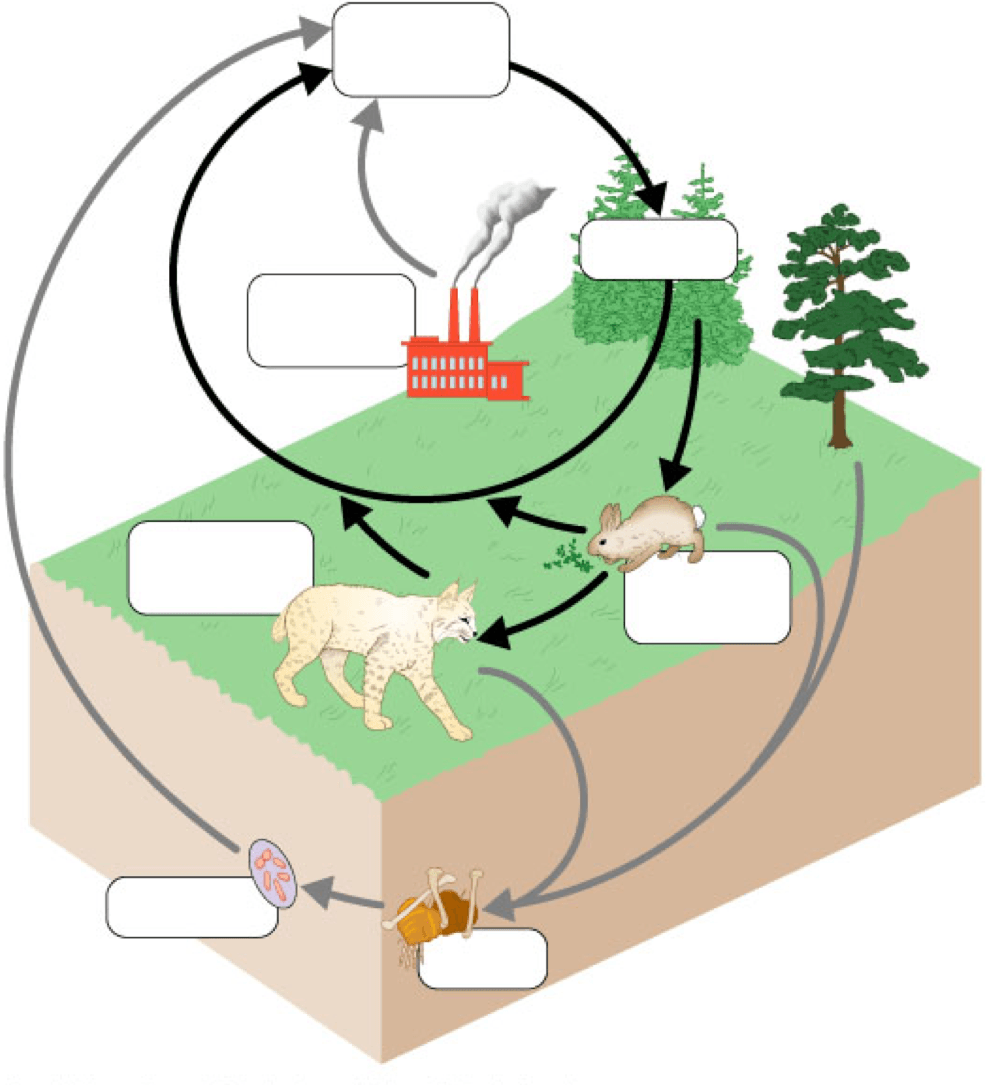
1.

Energy flows and matter (a)  

2.
The rate at which photosynthetic primary producers incorporate energy from the sun is called
a)
Gross Primary Production
b)
Photosynthetic Primary Production
c)
Net Primary Production
d)
Primary Production
3.
If the Senagal Gum Acacia contains 3,000 kilocalories, how many of those calories will the lion get?
a)
1
b)
300
c)
3,000
d)
30
4.

Productivity is a measure of gain in energy or biomass in a unit of _____ per a unit of _______.

a)

area, time

b)

mass, area

c)

time, energy

d)

energy, area

5.
In the first law of thermodynamics, energy can neither be ___________nor ______________.
a)
measured, assessed
b)
created, destroyed
c)
homogeneous, heterogeneous
d)
biotic, abiotic
6.
According to the 2nd law of thermodynamics, as energy is transferred or transformed, it becomes more and more ____________.
a)
hot
b)
dissipated
c)
disordered
d)
intense
7.

Photosysnthesis and respiration are important because

a)

they make mutualism possible

b)

they are the building blocks of life

c)

they are the 6 characteristics of life

d)

they cycle matter and energy between autotrophs and heterotrophs

8.

To calculate Gross Secondary Productivity, you must (a)   food eaten and fecal loss.

9.
Which of the following is NOT a "cycle"?
a)
Water
b)
Energy
c)
Nitrogen
d)
Phosphorus
10.
Plants rely heavily on ____ in the nitrogen cycle to incorporate nitrogen into organic compounds
a)
bacteria
b)
viruses
c)
fungi
d)
oxygen
11.
Given enough time, all water eventually returns to the...
a)
oceans
b)
lakes
c)
streams
d)
atmosphere
12.
In the carbon cycle, organisms exchange ___ with the atmosphere
a)
glucose
b)
carbon dioxide
c)
oxygen
d)
nitrogen
13.

Choose all the pathways which make energy from the sun unavailable to ecosystems.

a)

absorption by inorganic matter

b)

radiation entering the atmosphere

c)

reflection back into the atmosphere

d)

conversion of light energy to chemical energy

14.

Choose the pathways which cause REFLECTION loss of solar radiation

a)

Scatter

b)

Molecules and dust

c)

Clouds

d)

Ground

15.

Choose the pathways which cause ABSORPTION loss of solar radiation

a)

Scatter

b)

Molecules and dust

c)

Clouds

d)

Ground

16.

Energy (a)   and matter cycles

17.

The conversion of energy into biomass for a given period of time is measured as what?

(a)  

18.

Which of the following is the correct formula for respiration?

a)

R=NPP + GPP

b)

R=NPP-GPP

c)

R=GPP-NPP

d)

R=GPP/NPP

19.

What unit is used when illustrating energy in a system model?

a)

biomass per unit area

b)

J m-2yr-1

c)

g m-2

d)

productivity

20.
How to calculate Net Primary Production:
a)
(GPP)(respiration)=NPP
b)
GPP/respiration=NPP
c)
GPP+respiration=NPP
d)
GPP-respiration=NPP
21.

__________ primary productivity = the organic materials that remain after photosynthetic organisms in the ecosystem have used some of these compounds for their cellular energy needs (cellular respiration).

a)

Gross

b)

Total

c)

Net

d)

Secondary

22.

__________ primary productivity is the total amount of energy that producers convert to chemical energy in organic molecules per unit of time.

a)

Net

b)

Total

c)

Gross

d)

Secondary

23.

The GPP of a certain producer is 5,000 gC/m2yr and the NPP is 4,000 gC/m2yr. What is the repsiratory energy needed by the autotrophs?

a)

cannot be determined from the information given

b)

1,000 gC/m2yr

c)

9,000 gC/m2yr

d)

-1,000 gC/m2yr

24.

NSP calculations refer to

a)
b)
c)

animals

d)

producers

25.

If gross primary productivity is 5 gC/m2yr, and the producers need 1.5 gC/m2yr for their own respiration, what is the net primary productivity?

a)

3.5 gC/m2yr

b)

6.5 gC/m2yr

c)

-3.5 gC/m2yr

d)

7.5 gC/m2yr

26.

What unit is used when illustrating productivity in a system model?

a)

biomass per unit area

b)

J m-2yr-1

c)

g m-2

d)

energy per unit area

27.

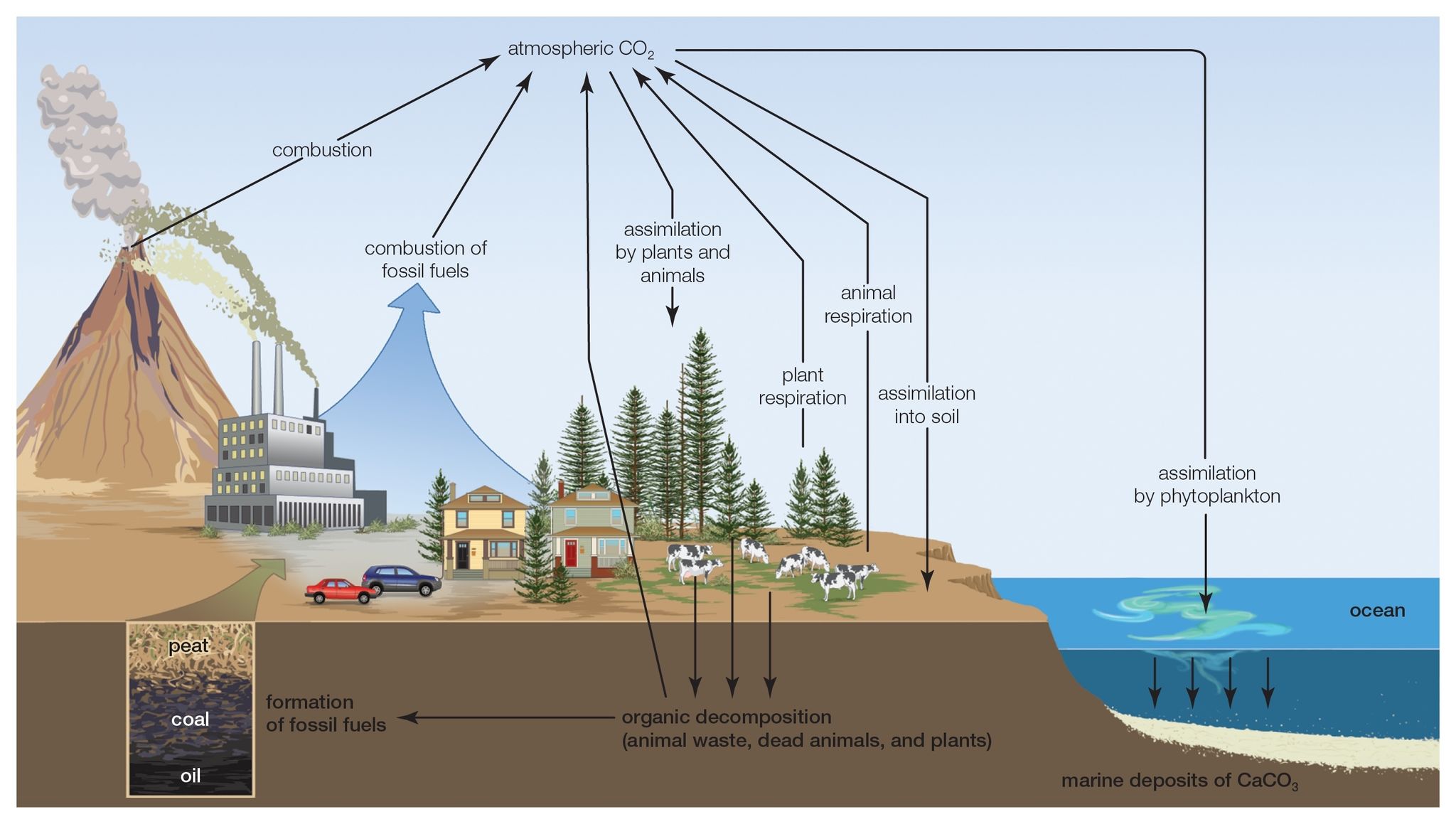
Which of the following are stores in the Carbon Cycle?

a)

soil

b)

oceans

c)

organisms

d)

fossil fuels

e)

atmosphere

28.

Which of the following are stores in the Nitrogen Cycle?

a)

oceans

b)

fossil fuels

c)

organisms

d)

forests

e)

atmosphere

29.

Which of the following are flows in the Carbon cycle?

a)

assimilation

b)

death & decomposition

c)

dissolving

d)

photosynthesis

e)

respiration

30.

Which of the following are flows in the Nitrogen cycle?

a)

assimilation

b)

death & decomposition

c)

dissolving

d)

consumption

e)

respiration

31.
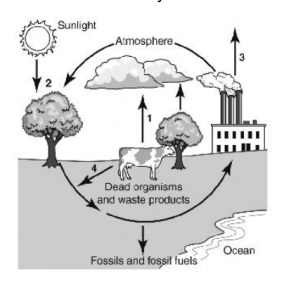
What is happening at 1?
a)
respiration: releasing CO2
b)
decomposing CO2 in the soil
c)
photosynthesis: absorbing CO2
d)
turning CO2 from the atmosphere into organic molecules
32.
How much of the atmosphere is composed of nitrogen gas?
a)
87%
b)
38%
c)
78%
d)
21%
33.
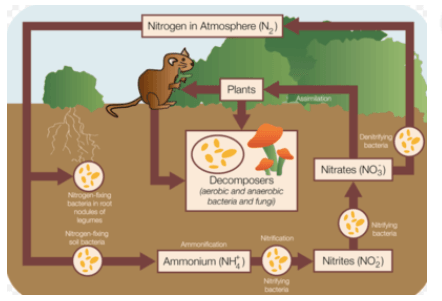
How nitrogen is "fixed" into useable form for plants
a)
only through action of bacteria
b)
only through lightning
c)
through action of bacteria & lightning
d)
through photosynthesis
34.
Nitrogen fixing bacteria, lives in nodules on the root of a plant called
a)
Broccoli
b)
Legumes
c)
Beats
d)
Carrots
35.
Which of the following add carbon dioxide to the atmosphere?
a)
volcanoes
b)
combustion of fossil fuels
c)
animal and plant respiration
d)
all of these
36.
Suppose the inputs and outputs to the atmospheric carbon reservoir each year were as shown below. How much carbon would the atmosphere contain in ten years?
a)
780 GtC
b)
790 GtC
c)
810 GtC
d)
820 GtC
37.

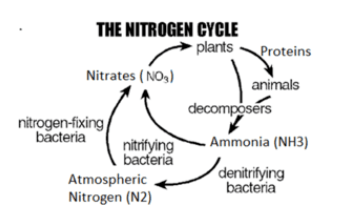
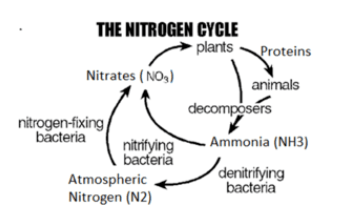
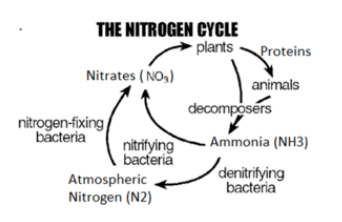
According to this diagram, plants use nitrogen to make _________________________

a)

bacteria

b)

animals

c)

proteins

d)

decomposers

38.

According to this diagram, plants absorb

a)

nitrates

b)

nitrogen fixing bacteria

c)

animals

d)

decomposers

39.

According to this diagram, animals get proteins from eating ________________________

a)

decomposers

b)

bacteria

c)

plants

d)

sunlight

40.

A correct path that nitrogen could take would be

a)

air -> animals -> plants -> bacteria

b)

animals -> air -> bacteria -> plants

c)

bacteria -> air -> plants -> animals

d)

air -> bacteria -> plants -> animals

41.

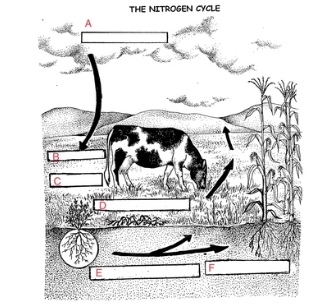
In the nitrogen cycle, what does label A in the diagram represent?

a)

Gas

b)

Clouds

c)

Carbon dioxide in the atmosphere

d)

Nitrogen in the atmosphere

42.

All plants have nitrogen fixing bacteria in their roots.

a)

True

b)

False

43.
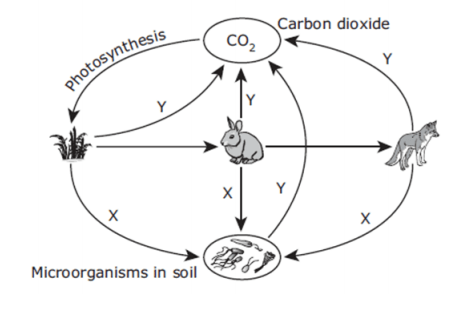
The diagram shows the flow of organic molecules through an ecosystem. What two processes are identified by the labels X and Y?
a)
X : Respiration
Y : Predation
b)
X : Adaptation
Y : Decomposition
c)
X : Fermentation
Y : Nitrogen Fixation
d)
X : Decomposition
Y : Respiration
44.
In what process is Carbon transformed into chemical energy?
a)
Photosynthesis
b)
Respiration
c)
Primary Production
d)
Secondary Production
45.
If the removal of many plants and trees increase in a forest, what effect could this have on the carbon dioxide and oxygen cycle?
a)
CO2 levels decrease
b)
CO2 levels increase
c)
Nitrogen levels decrease
d)
Oxygen levels increase
46.
What causes an increase in the oxygen level in the atmosphere?
a)
Oxygen inhaled by animals.
b)
Oxygen released by animals.
c)
Oxygen released by plants.
d)
Oxygen taken in by animals.
47.
Why is the ocean important to the carbon cycle?
a)
It keeps sediment containing carbon underwater for millions of years
b)
The ocean gives out more carbon then it takes in (increases global warming)
c)
The ocean isn't important to the carbon cycle.
48.
What is happening in step
1?
a)
Animals are decomposing and realizing carbon into the soil.
b)
Animals are releasing energy into the environment and storing carbon.
c)
Animals are turning carbon dioxide from the atmosphere into organic molecules.
d)
Animals are breaking down organic molecules and releasing carbon dioxide into the atmosphere.
49.
What number represents combustion in this diagram?
a)
1
b)
2
c)
3
d)
4
50.
What number would represent photosynthesis in this
diagram?
a)
1
b)
2
c)
3
d)
4
51.
How is combustion similar to cellular respiration?
a)
It can occur only in living things.
b)
It removes energy from the environment.
c)
It increases the amount of carbon dioxide in the environment.
d)
It needs glucose and oxygen to occur.
52.
How does the concentration of carbon dioxide in the atmosphere affect climate?
a)
As carbon dioxide concentrations increase, temperatures increase
b)
As carbon dioxide concentration increase, temperatures decrease.
c)
Carbon dioxide concentrations have no affect on climate
d)
As carbon dioxide concentrations increase, temperatures become more random.
53.
According to most scientists, activities like fossil fuel burning and deforestation have affected the global carbon cycle.
a)
True
b)
False
54.

The creation of less photosynthesis by building cities and roads is the process of what?

(a)  

55.

Which activities impact energy flows & cycles of matter?

a)

Urbanisation

b)

Burning fossil fuels

c)

Deforestation

d)

Fossilization

e)

Agriculture