wayground logo

Free Printable Worksheets

NEW

Font size

S
M
L
XL
Worksheets

Ecology Quiz : BSC 2021

Total questions: 60

Worksheet time: 47mins

Name
Class
Date
1.
An example of a behavioral adaptation is
a)
The long neck of a giraffe
b)
Penguins huddling together for warmth
c)
A camel's hump used to store water
d)
A polar bear's white fur used for camouflage
2.
An example of a physical adaptation is...
a)
a turtle hiding inside its shell
b)
The spikes on a porcupine fish
c)
a rabbit burrowing underground
d)
a viper biting when threatened
3.
An animal's color or pattern that helps it blend into its surroundings
a)
Environment 
b)
Mimicry
c)
Camouflage
4.
_________ cannot make their own food, so they need to consume (eat) plants or animals.
a)
consumers
b)
producers
c)
decomposers
5.
____ make their own food through photosynthesis. 
a)
consumer
b)
decomposer
c)
producer
6.
What does a food chain contain? Choose ALL correct answers.
a)
consumer
b)
producer
c)
decomposer
d)
all of the above
7.
_______are animals that eat only plants.
a)
herbivore
b)
carnivore
c)
omnivore
8.
_________ are animals that eat BOTH plants and animals. 
a)
omnivore
b)
carnivore
c)
herbivore
9.
a _______ shows how each living thing gets food and how nutrients and energy are passed from organism to organism. 
a)
ecosystem
b)
food chain
10.
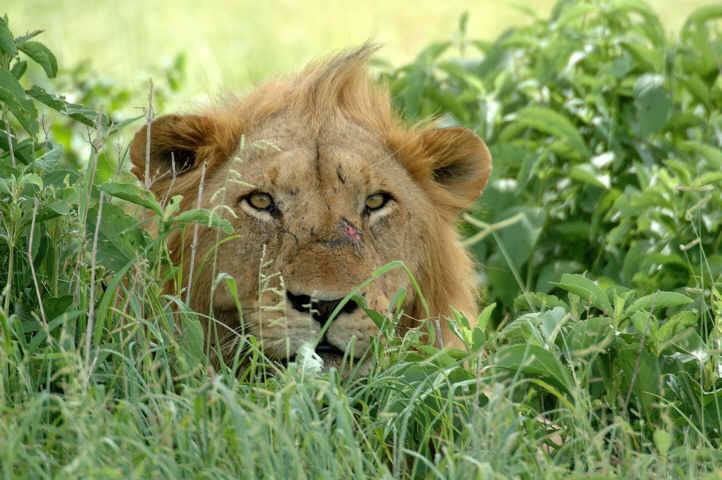
what is a lion considered?
a)
producer
b)
consumer
c)
decomposer
11.
Where does the energy start in this food chain?
a)
Plant
b)
Sun
c)
Deer
d)
Wolf
12.
What is the role of decomposers in a food chain?
a)
Use sunlight to make food
b)
Eat other organisms to gain energy
c)
Make the food for the whole food chain
d)
Break down dead organisms and add nutrients to the soil
13.
Which is the correct food chain order?
a)
Plant-->1st Consumer--> 2nd Consumer 
b)
Plant <-- 1st Consumer <-- 2nd Consumer
c)
2nd consumer     --> 1st consumer  --> Plant
d)
1st Consumer      --> 2nd consumer --> Plant
14.

Which of the following organisms is a producer?

a)

grass

b)

rabbit

c)

fox

d)

snake

15.
The relationship between ALL the organisms in a community showing who eats whom is called a ___________________________.
a)
Food Web
b)
Food Chain
c)
Abiotic Factors
d)
Biotic Factors
16.
In the food web shown, the snail would be considered...
a)
primary consumer
b)
secondary consumer
c)
tertiary consumer
d)
producer
17.
Identify the correct food chain that demonstrates the energy flow of this food web
a)
Plant > Caterpillar > Bluebird > Eagle
b)
Plant > Lizard > Snail
c)
Plant >Lizard > Snail >Eagle
d)
Eagle >Lizard>Caterpillar>Plant
18.

Plants use ____________ to make their own food

a)

Water

b)

Sunlight

c)

Carbon dioxide

d)

All of these

19.

The process of plants turning carbon dioxide and water into oxygen and sugar is called

a)

Respiration

b)

Oxidation

c)

Photosynthesis

d)

Combustion

20.

How do plants affect the air that animals and people breathe?

a)

Plants use oxygen from the air to make their own food

b)

Plants release pollution into the air

c)

Plants take in carbon dioxide and release oxygen

d)

Plants take in oxygen and release carbon dioxide

21.

Which gas do animals release, that plants depend on for survival?

a)

Carbon dioxide

b)

Oxygen

c)

Sunlight

d)

Water

22.

How does the human body return carbon to the atmosphere in the carbon cycle?

a)

Waste products

b)

Photosynthesis

c)

Cellular respiration

d)

Formation of glucose

23.
What is deforestation?
a)
Clearing Earth's forests on a massive scale
b)
Eating too much vegetables
c)
Going to a forest and pulling weeds
d)
Clearing the five trees in my backyard
24.
Why does cutting down trees increase global warming?
a)
trees soak up carbon dioxide
b)
trees provide shade which counteracts global warming
c)
trees absorbs the sun's energy without radiating back into the atmosphere
d)
trees drain greenhouse gases like methane from soil
25.
Organisms that do not decompose can be buried and become what?
a)
water
b)
nutrients
c)
air
d)
fossil fuels
26.

Why is burning fossil fuels harmful?

a)

they cause cancer

b)

They can get extremely hot

c)

it increases the amount of carbon dioxode/greenhouse gases in the air

d)

this would destroy fossils

27.
Which one of these does not add CO2 to the atmosphere?
a)
cooking with gas
b)
planting trees
c)
burning wood
d)
riding in a bus
28.
Which of the following removes carbon from the atmosphere?
a)
Combustion
b)
Respiration
c)
Photosynthesis
d)
Death
29.

Which compound does NOT contain carbon atoms?

a)

carbon dioxide

b)

ammonium

c)

calcium carbonate

d)

methane

30.
When humans burn fossil fuels, most of the carbon quickly enters the                       as carbon dioxide.
a)
Water
b)
Atmosphere
c)
Sun
d)
Air
31.
How do living organisms return carbon to the atmosphere in the carbon cycle?
a)
respiration and photosynthesis
b)
 decomposition and respiration
32.
How does the carbon in grass become part of a lion?
a)
The lion eats the grass
b)
Carbon from grass doesn't end up in a lion. 
c)
The carbon ends up in the lion's food chain. 
d)
The lion breathes in carbon given out by the plant
33.
All of the carbon in existence is continually recycled in the carbon cycle
a)
True
b)
False
34.
1. Oxygen exists in the atmosphere as which state of matter?
a)
solid
b)
liquid 
c)
gas
d)
plasma
35.
The process of burning is called _____.
a)
decomposition
b)
combustion
c)
respiration
36.
How is the burning of fossil fuels related to global warming?
a)
Magic
b)
Fuels are hot
c)
Greenhouse effect
d)
Photosynthesis
37.

What converts nitrogen gas into a usable form for plants and animals?

a)

bacteria

b)

rain

c)

fungi

d)

car exhaust

38.

The process in which nitrogen circulates and is recycled is called

a)

The nitrogen cycle

b)

The carbon cycle

c)

The water cycle

d)

The phosphorus cycle

39.

Organisms that need nitrogen to survive.

a)

only plants

b)

only animals

c)

only bacteria

d)

all living things

40.

How is nitrogen "fixed" into a usable form for plants?

a)

Through action of bacteria only

b)

Through lightning only

c)

Through action of bacteria and lightning

d)

Through photosynthesis

41.

How do animals get the nitrogen they need?

a)

From the air they breathe

b)

From the water they drink

c)

From the food they eat

d)

From the sun

42.

Gas that makes up 78% of our atmosphere.

a)

Oxygen

b)

Nitrogen

c)

Hydrogen

d)

Carbon Dioxide

43.

What is the process of combining nitrogen gas with other elements to make nitrogen into usable compounds?

a)

nitrogen composition

b)

nitrogen fixation

c)

ammonia

d)

denitrification

44.

What is the formula for atmospheric nitrogen?

a)

N

b)

N2

c)

NH3

d)

NO3

45.

What process occurs when dead plant and animal matter decomposes and nitrogen is released back into the atmosphere?

a)

Assimilation

b)

Fixation

c)

Ammonification

d)

Denitrification

46.

Plants and animals cannot use nitrogen directly from the air.

a)

True

b)

False

47.

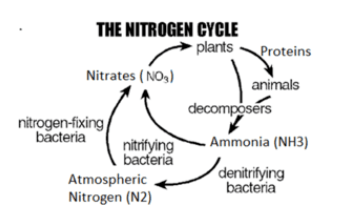
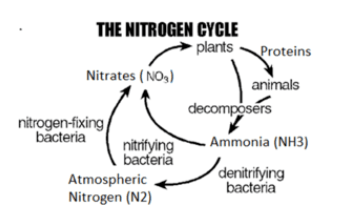
According to this diagram, plants use nitrogen to make _________________________

a)

bacteria

b)

animals

c)

proteins

d)

decomposers

48.

According to this diagram, plants absorb

a)

nitrates

b)

nitrogen fixing bacteria

c)

animals

d)

decomposers

49.

The process that allows organisms to use nitrogen

a)

assimilation

b)

denitrification

c)

fixation

d)

ammonification

50.

A correct path that nitrogen could take would be

a)

air -> animals -> plants -> bacteria

b)

animals -> air -> bacteria -> plants

c)

bacteria -> air -> plants -> animals

d)

air -> bacteria -> plants -> animals

51.

Bacteria fix nitrogen from the atmosphere into a form plants can use.

a)

True

b)

False

52.

Bacteria create a form of nitrogen that animals can use directly.

a)

True

b)

False

53.

What do free living bacteria in the soil do?

a)

Make clouds

b)

Turn atmospheric nitrogen into nitrates

c)

Make carbon dioxide for plants to go through photosynthesis

d)

Help plants take in water

54.

All plants have nitrogen fixing bacteria in their roots.

a)

True

b)

False

55.
What does biotic mean?
a)
Living
b)
Non living
c)
Man made
56.
How is water an important abiotic factor?
a)
You drink it and hydrate
b)
Animals live in it
c)
Plants need it to grow
d)
Allows you to carry out life proecess
57.
Which of the following is abiotic?
a)
Soil
b)
Car
c)
Construction paper
d)
Mushroom
58.
Which of the following is biotic?
a)
Fire
b)
Bacteria
c)
Planet
d)
Soil
59.
All of the living and nonliving things in an area that interact with each other are called a/an ______.
a)
community
b)
habitat
c)
population
d)
ecosystem
60.
Different populations living and interacting with each other in the same area
a)
Biome
b)
Ecosystem
c)
Community
d)
Niche