Wayground logo

Free Printable Worksheets

Font size

S
M
L
XL
Worksheets

Atomic Structure Review

Total questions: 50

Worksheet time: 31mins

Name
Class
Date
1.

Subatomic particles with a negative charge

a)

Electrons

b)

Neutrons

c)

Protons

d)

Quarks

2.
Subatomic particles with a positive charge
a)
neutrons
b)
atomic mass
c)
protons
d)
isotopes
3.
Subatomic particles that are neutral in charge
a)
Neutrons
b)
Protons
c)
Nucleus 
d)
Electrons
4.
This is how you find the number of neutrons in an atom. 
a)
Subtract the atomic number from the atomic mass
b)
Subtract the atomic mass from the atomic number 
c)
Add the atomic mass to the atomic number 
d)
Divide the atomic mass by the atomic number 
5.

Found orbiting outside the nucleus, this subatomic particle has a negative charge.

a)

Neutron

b)

Proton

c)

Electron

d)

Idontknowatron

6.

How many protons does indium have?

a)

49

b)

66

c)

114

d)

115

7.
What is the mass number?
a)
the number of protons
b)
the number of protons and neutrons
c)
the number of neutrons
d)
the number of protons and electrons
8.
What is the atomic number?
a)
the number of protons
b)
the number of protons and neutrons
c)
the number of neutrons
d)
the number of protons and electrons
9.
What are the 3 subatomic particles that make-up the atom?
a)
protons, neutrons, and isotopes
b)
neutrons, isotopes, and electrons
c)
positives, negatives, and electrons
d)
protons, neutrons, and electrons
10.

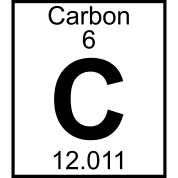
What is "C" labeling?

a)

electrons

b)

neutrons

c)

nucleus

11.

What is an electron cloud?

a)

It contains the protons and neutrons

b)

It surrounds the nucleus and contains the electrons

c)

It is the basic building block of all matter

12.

Where are the protons located in an atom?

a)

In the nucleus

b)

In the electron cloud

c)

In the empty space

13.

What is the charge of an electron?

a)

Neutral

b)

Postive

c)

Negative

14.

What is the charge of a neutron?

a)

Positive

b)

Neutral

c)

Negative

15.

What is the charge of a proton?

a)

Positive

b)

Neutral

c)

Negative

16.

No two elements are exactly the same. True or False?

a)

True

b)

False

17.

For an atom to be neutral (no charge), it must have an equal number of _____ and ______.

a)

protons and neutrons

b)

protons, neutrons, and electrons

c)

protons and electrons

18.

An atom's atomic number comes from its number of ________.

a)

electrons

b)

protons

c)

neutrons

19.
Where is most of the mass in an atom located?
a)
in the nucleus
b)
in the protons
c)
in the neutrons
d)
in the electrons
20.

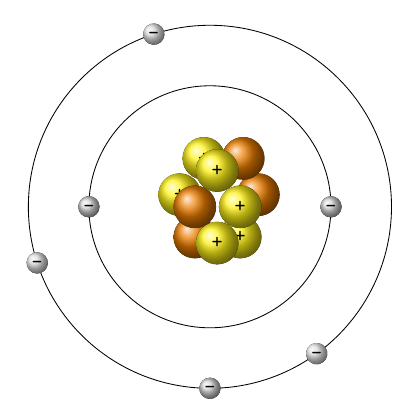
How many electrons does this atom have?

a)

2

b)

4

c)

6

d)

10

21.
What subatomic particles would you find in the nucleus of an atom?
a)
Protons only
b)
Protons and Neutrons
c)
Neutrons and Electrons
d)
Protons and Electrons 
22.
The _____________ determines the identity of an object.
a)
# of Protons
b)
# of Electrons
c)
# of Neutrons
d)
Atomic Mass
23.
Who believed that electrons were scattered amongst positively charged material.
a)
JJ Thomson
b)
Ernest Rutherford
c)
John Dalton
d)
Niels Bohr
24.
Believed that atoms are small, hard particles that were "indivisible"
a)
Democritus
b)
Aristotle
c)
Schrodinger
d)
Greek Philosophers
25.
Did experiments to show that atoms form compound in set ratios.
a)
John Dalton
b)
Schrodinger
c)
Niels Bohr
d)
JJ Thomson
26.
Discovered that the atom has a small, dense, positively charged nucleus.
a)
Ernest Rutherford
b)
Heisenberg
c)
Democritus
d)
JJ Thomson
27.
Believed that electrons traveled around the nucleus in definite paths.
a)
Niels Bohr
b)
John Dalton
c)
Modern Atomic Theory
d)
Ernest Rutherford
28.
How many protons does an atom with an atomic number of 28 and a mass number of 40 have?
a)
28
b)
68
c)
12
d)
40
29.
The Bohr model below depicts which element?
a)
Scandium
b)
Titanium
c)
Calcium
d)
Potassium
30.
What is the mass number of the element pictured?
a)
7
b)
9
c)
16
d)
25
31.
What is the atomic number of the element pictured?
a)
7
b)
9
c)
16
d)
25
32.
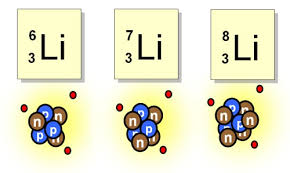
According to the isotope notation shown below, how many neutrons does lithium have?
a)
3
b)
4
c)
7
d)
10
33.
How many protons, neutrons, and electrons are in 59Ni+2?
a)
59p+, 59n0, 61e-
b)
26p+, 31n0, 30e-
c)
28p+, 31n0, 26e-
d)
28p+, 59n0, 31e-
34.
How many protons, neutrons, and electrons are present in 72As3-?
a)
72p+ , 72n , 69e-
b)
33p+ , 30n , 33e-
c)
33p+ , 39n , 36e -
d)
33p+ , 39n , 30e-
35.

Which of these has the same number of neutrons as Co-60

a)

Ni-60

b)

Fe-61

c)

Cu-62

d)

Co-61

36.

Which is NOT true about this isotope?

a)

53 protons

b)

131 neutrons

c)

53 electrons

d)

all of these are true

37.
In a correctly written symbol what would be located in the "A" position?
a)
number of neutrons
b)
atomic number
c)
number of electrons 
d)
mass number
38.
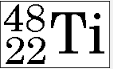
How many protons does this isotope of titanium have?
a)
48
b)
22
c)
26
d)
70
39.
which atom has  4 neutrons?
a)
Li-6
b)
Li-7
c)
Li-8
d)
they have the same # of neutrons
40.
An atom becomes _________ when it gains electrons.
a)
Positive
b)
Negative
c)
Neutral
d)
Invinsible
41.
An atom becomes _______ when it loses electrons.
a)
Positive
b)
Negative
c)
Neutral
d)
Invinsible
42.

How many electrons in an ion of sodium with a +1 charge?

a)

1

b)

11

c)

10

d)

-1

43.
How many electrons does a neutral atom of Neon have?
a)
10
b)
18
c)
20
d)
30
44.
An element with a mass number of 11 and an atomic number of 5 has how many neutrons?
a)
11
b)
5
c)
6
d)
16
45.
What is the mass number of this atom?
a)
9
b)
10
c)
19
d)
27
46.

If a neutral atom has 10 electrons, how many protons does it have?

a)

0

b)

1

c)

10

d)

5

47.
An element has the mass number 12 and atomic number  6. The number of neutrons in it is:
a)
6
b)
10
c)
4
d)
8
48.

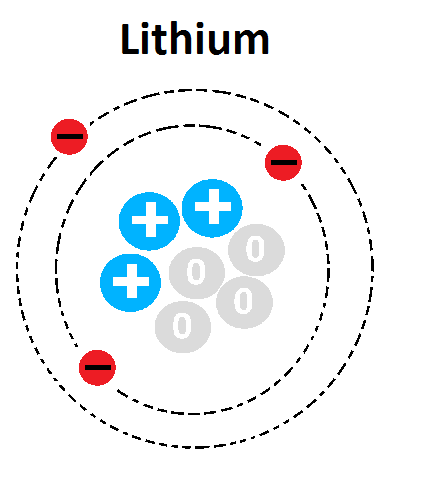
What is the mass number of this atom?

a)

1

b)

3

c)

4

d)

7

49.

What does the 6 represent?

a)

Atomic mass

b)

atomic number

c)

chemical symbol

d)

element name

50.
What does the C represent?
a)
atomic mass
b)
atomic number
c)
element name
d)
chemical symbol