
 Worksheets
G11Reg-EOT 1- Revision
Total questions: 173
Worksheet time: 10hrs 57mins

What axis is the image reflected over?
X-axis
Y-axis

What are the coordinate points for point A?
(7, 2)
(2, 7)
(2, 6)

What are the coordinate points for point E?
(2, 0)
(0, 2)
(2, 2)

What would be the coordinates of point K if it was reflected over the Y-axis?
(-5, 2)
(5, 2)
(5, -2)


Translate the pink shape to the blue shape...
5 Right
2 Down
5 Left
2 Up
3 Right
1 Down
3 Left
1 Up

Translate shape A to shape B...
3 Right
5 Up
3 Left
5 Down
2 Left
4 Up
2 Right
4 Down

Determine how to translate triangle ABC to triangle A'B'C'.
(x - 9 , y + 2)
(x + 2, y - 9)
(x - 2, y + 5)
(x - 2, y + 9)

How is trapezoid ABCD translated to trapezoid A'B'C'D'? Select all that apply.
Translation: (x, y) --> (x - 8, y + 5)
Translated 5 units down and 1 unit right
Translated 8 units down and 5 units right
Translated 5 units down and 5 units right
Translation: (x, y) --> (x + 5, y - 8)

How would you translate point P to P'? Select all that apply.
Translate 2 units to the right and 8 units down
Translate 4 units down and 2 units to the right
Translation: (x, y) --> (x - 8, y + 2)
Translation: (x, y) --> (x + 2, y - 8)
Translation: (x, y) --> (x + 8, y - 2)
Describe the given translation:
(x, y) ----> (x + 2, y - 3)
slide up 2 units and left 3 units
slide right 2 units and up 3 units
slide right 2 units and down 3 units
slide left 3 units and right 2 units
Point M (-3, 5) is translated using this rule.
(x, y) ----> (x - 1, y)
What are the coordinates of M'?
(-4, 5)
(-2, 5)
(-4, 4)
(-3, 4)
What is the image of (-9, 3) after it is translated 4 units down and 3 units right?
(-6, -1)
(-13, 6)
(-5, 6)
(-6, 7)
What is the arrow notation for a translation 2 units right and 5 units up?
(x, y) --> (x - 2, y - 5)
(x, y) --> (x + 2, y + 5)
(x, y) --> (x + 5, y + 2)
(x, y) --> (5x, 2y)


State the image of the point.

is symmetrical
not symmetrical


Determine if the figure has line, point, and/or rotational symmetry. Check all that apply.
Line
Point
Rotational
None

Determine if the figure has line, point, and/or rotational symmetry. Check all that apply.
Line
Point
Rotational
None


A triangle is rotated 270° counterclockwise with the origin as the center of rotation to create a new figure. Which rule describes rotating 270° counterclockwise?
(x, y)→(y, -x)
(x, y)→(x, y)
(x, y)→(-y, x)
(x, y)→(-x, -y)

Rotate the point (5, 5) around the origin 180 degrees counterclockwise. State the image of the point.
(5, -5)
(5, 5)
(-5, 5)
(-5, -5)

What will be the coordinates of the image of ABC after it is rotated 180 degrees clockwise about the origin?
(-4, -3), (-1, 0), (-2, -5)
(3, -4), (0, -1), (5, -2)
(-3, 4), (0, 1), (-5, 2)
(4, 3), (1, 0), (2, 5)

The red triangle represents what type of rotation:
180° Clockwise
90° Counter Clockwise
90° Clockwise (-90)
270° Counter Clockwise
Solve the equation by graph: y=x2−3x+2
-1 and -2
No Solution
2
1 and 2
Solve the equation by graphing: −x2−7x=6
x=1 and x=6
x=−6
x=−6 and x=−1
No Solutions

Determine the solutions of the graph:
No Solutions
(-3, 0) and (-1, 0)
Infinity Many Solutions
(-1, 0)
Solve the equations by graphing: y=−0.5x2−x−6
(-2.606,0) and (4.606,0)
No Solution
(-6, 0)
(-1, 0) and (1.2, 0)

Determine how many solutions:
One Solution
Two Solutions
No Solutions
Infinitely Many Solutions

Determine how many roots:
One Solution
Two Solutions
No Solutions
Infinitely Many Solutions

Which graph has the function f(x)=−(x+2)2 ?


f(x)=(x+2)2−1 Which graph has the function equation


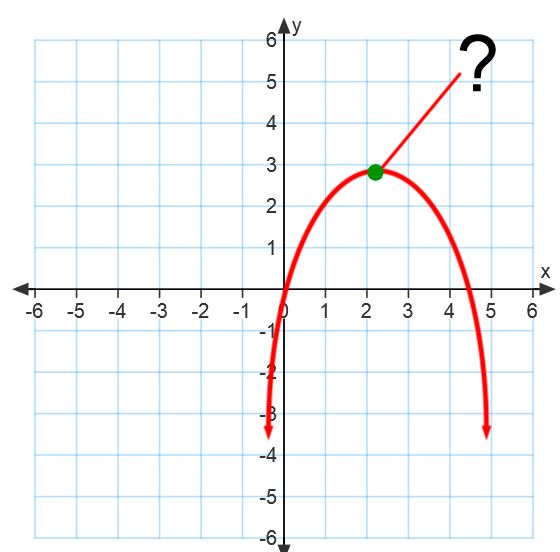

Which method would be most efficient for solving the equation?
factoring
graphing
square roots
quadratic formula

Solve the equation
x = 1; x = -6
x = ⅓, x = -6
x = 6; x = 3
x = 6; x = - ⅓

What is the maximum or minimum value of the quadratic function pictured?
Minimum: y = 1
Maximum: x = -2
Minimum: x = -2
Maximum: y = 2

This table was used to graph a quadratic equation, where are the zeros (solutions)?
*Check ALL that apply
x = -3
x = -2
x = 3
x = 0
2x2 + 4x - 5
f(x) = 3x2 + 2x - 7
Identify the 'a' value: y = 16x2 -8x -24
16
8
-8
-24
Find the y-intercept y = x2 - 6x + 5
(0, 8)
(0, - 6)
(5, 0)
(0, 5)
Which is the vertex of y = x2+ 16x + 71 ?
V(-8, 7)
V(-8, 3)
V(8, 10)
V(16, -2)
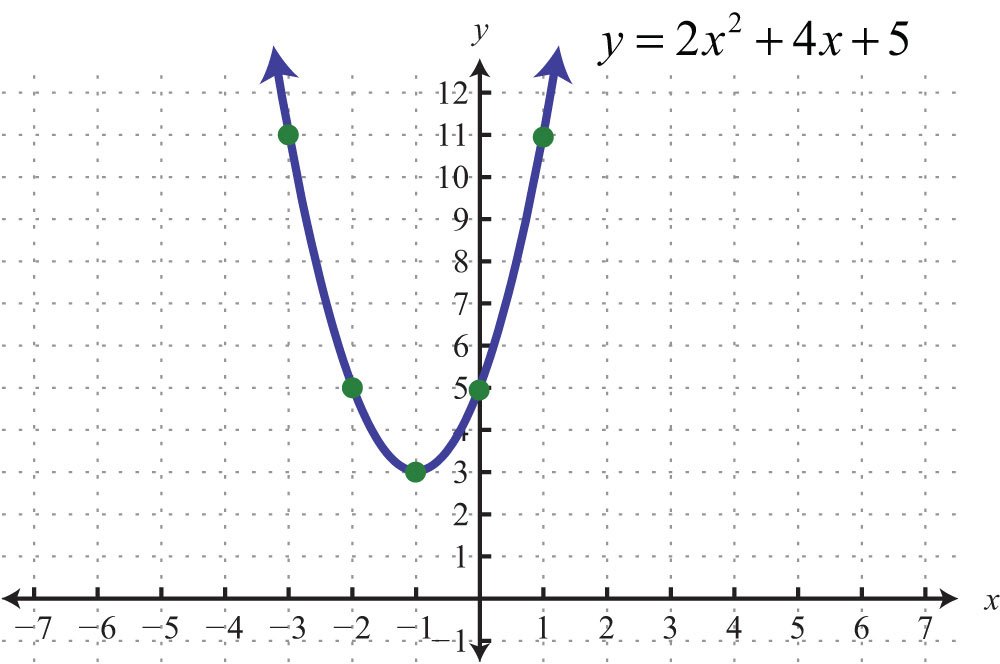


i7
3x2 - 5 = -446
√-108
(4 – 3i)(-7 – 2i)
(-6 - 2i)2

(10+ 15i)-(48 - 30i)
3i - (4 + 7i)
(2i)(3i)
(4 – 3i)(7 + 2i)

Simplify
(-10+6i)/17
(1+50i)/61
(-23+36i)/25
(-21+33i)/34

n² - 2n = 0
Solve by factoring
20x2 + 100x
x = 0 and -5
x = 5 and 0
x = 0
x = 20 and 4
Solve
(n +7)(n + 9) = 0
n = -7 or n = 4
n = 7 or n = -9
n = -3 or n = 10
n = -7 or n = -9
x2 + 6x = 5
(2x - 1)2 = 49
x2 -4x = 5
x2 - 4x + 4 = 20,
what goes in the blank?
(x - __ )2 = 20
Write the following quadratic expression in completed square form...
x2 + 4x + 10
(x + 4)2 + 6
(x + 2)2 + 6
(x + 4)2 - 6
(x + 2)2 - 6
Which equation shows x2+8x+9=0 after the method of completing the square has been applied?
(x+2)2=−5
(x+4)2=7
(x+8)2=55
x2=−(8x+9)
Solve 4x2+5x+2=0 .
x=85±87
x=−85±87i
x=−85±87
x=85±87i
y = x2 +5x +7, match each leading coefficient with its correct letter
Solve by the Quadratic Formula:
9u2−11u+7=0
18−11±131
1811±131
−1811±131
1811±i373
Solve by the Quadratic Formula:
18j2 +9j +16=12+7j2
22−9±i95
22−9±95
229±i95
229±95
If b2-4ac is positive, the quadratic equation has:
Two real solutions that are different
Two imaginary solutions that are different
One real solution
One imaginary solution
If b2-4ac is negative, the quadratic equation has:
Two real solutions that are different
Two imaginary solutions that are different
One real solution
One imaginary solution
If b2-4ac is 0, the quadratic equation has:
Two real solutions that are different
Two imaginary solutions that are different
One real solution
One imaginary solution
If the discriminant is negative, you will have....
two real solutions
two irrational solutions
no solution
one solution
For the function below, is the discriminant positive, negative, or zero?
___________
y = x² + 4x + 4
Positive
Negative
Zero
Not Sure
How many solutions will this quadratic equation x2+8x+16 has?
2 real solutions
2 imaginary solution
1 solution
3 solutions
y < 2x2 -3x+1

Solve:
2x2 + 5x ≥ 12
[-4, 1.5]
(−∞, -4) U (1.5, ∞)
(−∞, -4] U [1.5, ∞)
no solution

Which inequality is represented by the graph?
y > (x - 3)² - 3
y ≥ (x + 3)² - 3
y > (x + 3)² - 3
y ≥ (x - 3)² - 3

Which inequality is represented by the graph?
y > -(x - 4)² + 1
y > -(x - 1)² + 4
y < (x - 4)² + 1
y > (x + 4)² + 1
Determine the solution of the given quadratic inequality.
x≤45 or x≥4
45≤x≤4
What is the solution of the quadratic inequality x2 - x ≥ 12?
{x / -3 ≥ x ≥ 4}
{x / -3 ≤ x ≤ 4}
{x / x ≤ -3 U x ≥ 4}
{x / x ≤ 4 U x ≥ -3}
x + 2y = -3
x - y = -12
y = 4x+1
3x + 2y = 13


Identify the degree of the polynomial and the sign of the leading coefficient
Degree - Even
Degree - Odd
Degree - Even
Degree - Odd
From the functions below, find the LINEAR Function.
f(x)=3x−9
f(x)=3x2−11x+9
f(x)=2x4−9x3+11x2−9x−10
f(x)=x3−8x2−10x+9
Which is NOT a graph of polynomial function?


What is the degree of the polynomial function whose graph appears below?
1
2
3
4
What number, n, cubed is equal to 27?
9
3
-3
-9

Simplify the operation combining exponent operations!
(200a8c2)/(b7)
(200a8c2)/(b10)
(200ac2)/(b10)
(200a7c)/(b10)

Classify the polynomial below by degree and number of terms:
Quadratic binomial
Linear and quadratic binomial
Quartic binomial
Quartic duonomial

Classify the polynomial below by degree and number of terms:
20th degree monomial
Quintic Monomial
20th degree polynomial of 5 terms
Quartic Monomial
Let f(x)=6x4−2x3+x−3 and
g(x)=−3x4+5x2−10x+7.
Then, f(x)+g(x)=
3x4−2x3+5x2−9x+4
3x4−7x3−9x+10
3x4−2x3−5x2+11x−10
9x4−2x3+5x2−9x+4
Let f(x)=6x4−2x3+x−3 and
g(x)=−3x4+5x2−10x+7.
Then, f(x)−g(x)=
3x4−2x3−5x2+11x−10
9x4−2x3−5x2+11x−10
9x4−2x5+5x2−9x+4
3x4−2x3+5x2−9x+4
If f(x)=5x2−3 and
g(x)=−2x3+3x−1,
then what is f(x)×g(x)?
−10x5−5x2+6x3+3
−10x5+21x3−5x2−9x+3
−10x6+21x3+5x2+3
−10x6+15x3+6x2−3
Simplify (x−4)3.
x3+12x2+48x−64
64−48x+12x2−x3
x3+12x2−16x−4
x3−12x2+48x−64
Simplify the expression (4x2+9)2 using your knowledge of polynomial identities.
(4x2−9)2+144x2
(2x−3)2+12x2
(4x2−9)2+5184x2
(2x2−3)2+144x2
5n³-10n²+3n-6
x3(2x2+3x)
x² - 12x + 36
(x + 6)²
(x - 12)²
(x - 6)²
Factor by grouping:
3x3-x2+6x-2
(x2+2)(3x+1)
(x2+2)(3x-1)
(3x3+6x)(x2-2)
none of the above
What is the leading coefficient in the polynomial?
7x2 + x4 - 2 + 22x
7
1
22
2
What is the DEGREE of the polynomial 3x3 + 2x4 + 5x ?
5
3
1
4
Fill in the blank: The maximum number of turning points is ____ less than the degree of the polynomial.
3
0
1
-2
What are the roots of the polynomial function? y = (x + 2)(x - 7)3
-2, 7 multiplicity 3
-2, 7, 3
2, -7 Multiplicity
2, -7, 3
Odd Multiplicities have which of the following effects on the x-axis?
Cross the x-axis
Touch the x-axis

For synthetic division what would be the number in the upper left handed box?
0
1
-2
2

Determine if the degree of the polynomial shown is even or odd.
Even
Odd
Not enough information to tell
Determine the end-behavior of the function f(x)=−3x5+4x4−x3+5x2−x+2 .


Determine the end-behavior of the function f(x)=6x4−5x3+x2−3x−7 .

Determine how many relative maximum points are on the polynomial shown on the graph.
1
2
3
0

How many real zeros does the polynomial shown have?
2
3
4
5
(3x3y5)4

Simplify
x8y4x28y12
x20y8
(2x+5)4
How many terms are the in the expansion of (1+b)5
5
6
25
50
3
Select the correct expansion of
(1 - 2y)3
1 + 6y + 12y2 + 8y3
1 − 6y + 12y2 − 8y3
1 − 3y + 3y2 − y3
1 + 3y + 3y2 + y3
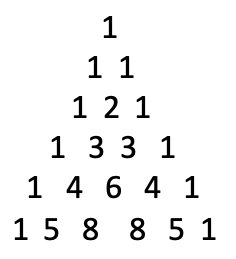
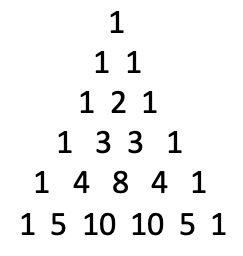
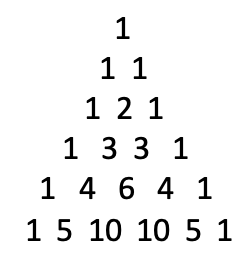
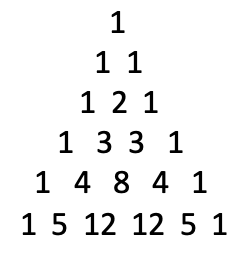
Choose the right Pascal's triangle
Factor Completely:
2n3 + 7n2 - 2n - 7
cannot be factored
(n - 1)2(2n + 7)
(n2 - 1)(2n + 7)
(n + 1)(n - 1)(2n + 7)
Factor Completely:
k4 - 10k2 - 39
(k2 - 13)(k2 + 3)
(k - 13)(k + 3)
(k2 + 15)(k2 - 3)
(k + 13)(k - 3)
P(x) = x3 -3x2-5x+15
f(x) = x4+8x2-9

What are the zeros for this function?


What are the zeros for this function?


(2x3 - 5x - 7) ÷ (x - 2)
(2x3 - 5x - 7) ÷ (x - 2)



