
NEW
Font size
S
M
L
XL
 Worksheets
Evolution
Total questions: 20
Worksheet time: 21mins
Name
Class
Date
1.

Darwin wrote that organisms with traits that are best suited to the environment will ________________
a)
increase in number
b)
become extinct
2.
Which of the following is NOT an example of natural selection?
a)
People selectively breeding hamsters.
b)
Insect populations developing resistance to certain pesticides.
c)
Bacteria becoming resistant to antibiotics.
d)
Male birds of certain species developing colorful feathers to attract female mates.
3.
Which term refers to the process by which individuals that are better suited to the environment survive and reproduce therefore passing down their genes to their offspring?
a)
Evolution
b)
Variation
c)
Adaptation
d)
Natural Selection
4.
The environment around Manchester, England, changed during the Industrial Revolution. How did this change affect peppered moths living in the area?
a)
Natural selection favored moths with dark wings because predators could not see them on the soot-colored trees.
b)
Natural selection favored moths with white wings that were easy for predators to see.
c)
Natural selection favored moths with white wings because predators could not see them on the soot-colored trees.
d)
Natural selection caused moths with white wings to become extinct.
5.
This scientist came up with the idea of natural selection.
a)
Jean Baptiste Lamarck
b)
Gregor Mendel
c)
Charles Darwin
d)
Thomas Malthus
6.
Inherited trait that helps an organism survive is a(n) __________.
a)
Fossil
b)
Adaptation
c)
Ancestor
d)
Natural selection
7.
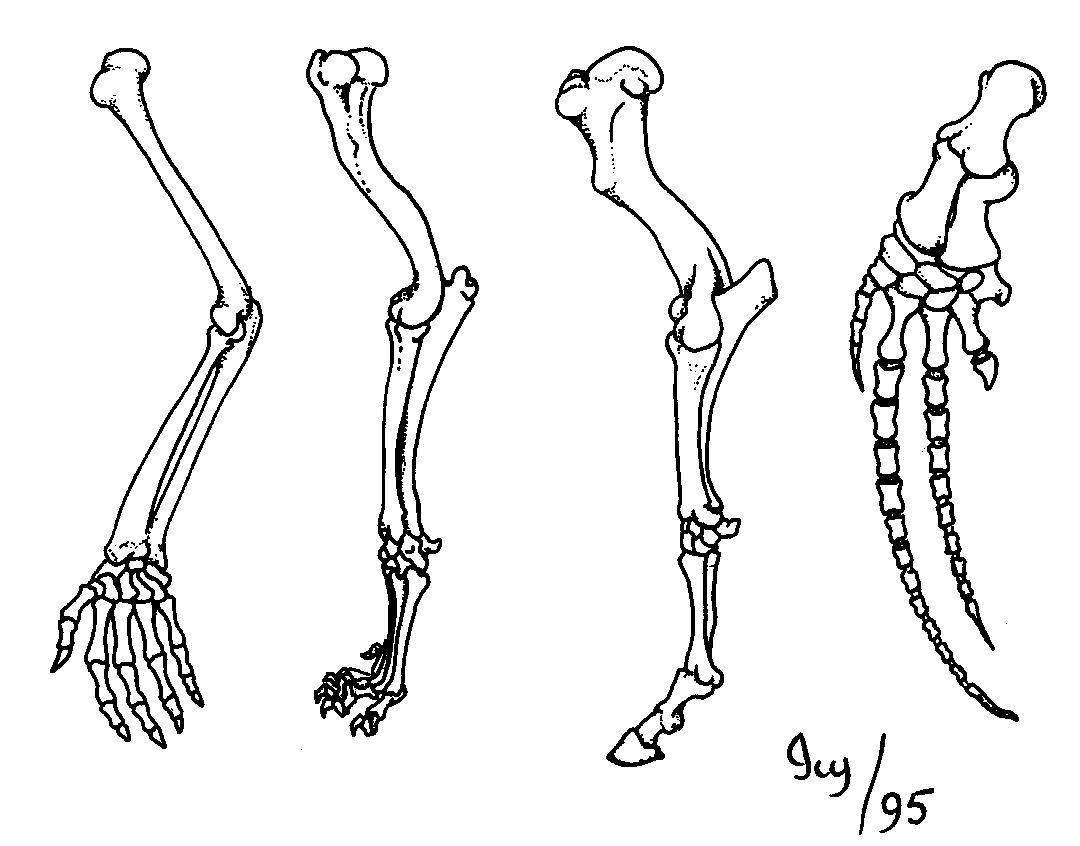
Structures with the same parts have different functions; suggests that organisms share a common ancestry
a)
vestigial structures
b)
homologous structures
c)
adaptive radiation
d)
fossil
8.
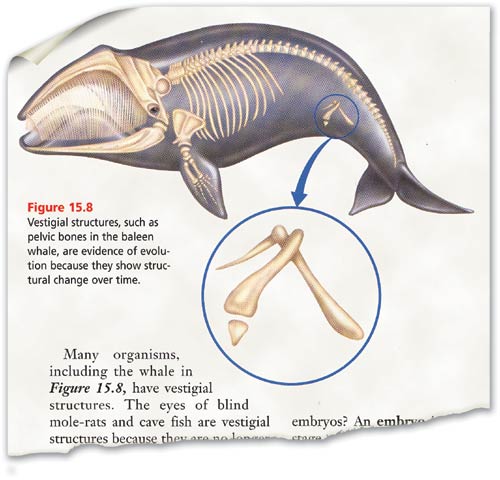
Which of the following is an example of a vestigial structure?
a)
the wings of a red-tailed hawk
b)
the hind limbs of a house cat
c)
the fins of sharks
d)
the tailbone of a human
9.
What is embryology?
a)
the age of organisms
b)
the oldest stage of development
c)
the life span of an organism
d)
the study of how organisms develop before they are born
10.

Comparing human hemoglobin of chimpanzees, horses, kangaroos, and chickens, reveal that humans have the fewest amino acid differences with
a)
Kangaroos
b)
Horses
c)
chickens
d)
chimpanzees
11.
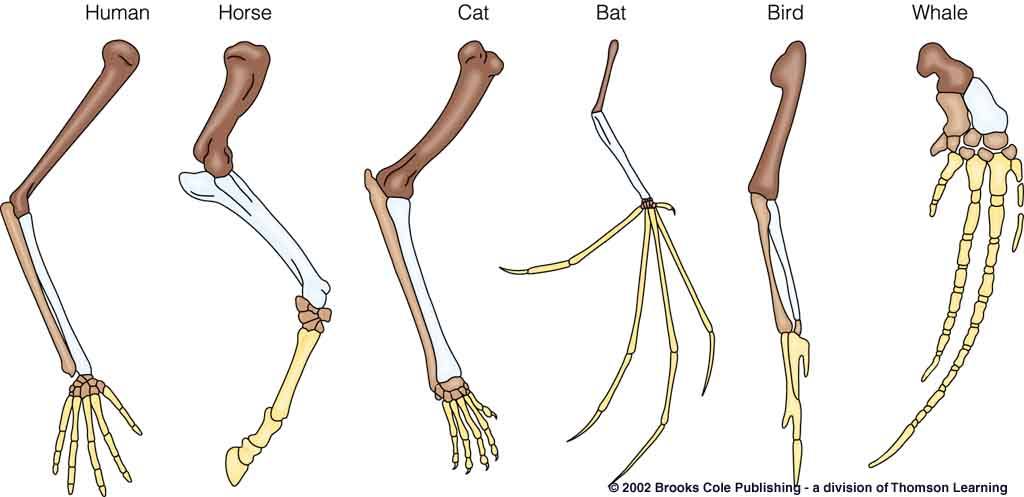
The structures shown are_________
a)
homologous
b)
heterologous
c)
analogous
d)
vestigial
12.
This is the trace or remains of an organism that lived long ago, most commonly preserved in sedimentary rock.
a)
Competiton
b)
Extinction
c)
Evidence
d)
Fossil
13.
The white feathers of a snowy owl allow it to blend in with its environment during the winter months (snow). This is an example of ________________
a)
Species
b)
Environmental Change
c)
Adaptation
d)
Variation
14.
Genetic differences between organisms of the same species
a)
Variation
b)
Adaptation
c)
Behavior
d)
Environment
15.
What is the advantage of having different shaped beaks?
a)
To look different from other species.
b)
To be able to eat the food readily available in the environment.
c)
To protect itself against predators.
d)
To protect itself against prey.
16.
Darwin's expedition took how many years?
a)
3
b)
4
c)
5
d)
6
17.
A group of similar organisms that can mate with each other and produce fertile offspring is called a species.
a)
True
b)
False
18.
Choose the answer that is NOT a line of evidence for evolution.
a)
DNA
b)
Comparative anatomy
c)
Comparative environments
d)
Embryology
19.
The presence of vestigial pelvic bone in a living whale species and vestigial hind limb bones of an extinct whale provides evidence of which of the following?
a)
Whales can travel on land when necessary
b)
Whales are developing into animals with four functioning limbs
c)
Whales have functional legs that are hidden by fat and skin
d)
Whales evolved from four-legged animals
20.
Two different species can never interbreed with each other.
a)
True
b)
False
Reset

