wayground logo

Free Printable Worksheets

NEW

Font size

S
M
L
XL
Worksheets

Chapter 4 Atomic Structure Quiz Review

Total questions: 23

Worksheet time: 26mins

Name
Class
Date
1.

Greek philosopher that came up with the concept of "atomos"

a)

Democritus

b)

Dalton

c)

Thomson

d)

Schrodinger

2.
What contribution did John Dalton make to atomic theory? 
a)
He discovered that every atom was positively charged. 
b)
He discovered that every element consisted of one type of atom that couldn't be divided. 
c)
He discovered that atoms had nuclei. 
d)
He discovered that atoms could be divided into smaller parts. 
3.

Discovered the nucleus of the atom

a)

Dalton

b)

Thomson

c)

Rutherford

d)

Bohr

4.

Which subatomic particle determines the identity of an element?

a)

protons

b)

neutrons

c)

electrons

5.
Subatomic particle with a charge of 0
a)
neutron
b)
proton
c)
electron
d)
quark
6.

In which way are protons and electrons the same in an atom?

a)

same mass

b)

same number of particles

c)

same charges

7.
The mass number of an isotope is equal to the number of ______ in an atom.
a)
Protons
b)
Neutrons
c)
Protons + Neutrons
d)
 Electrons
8.
In order for an atom to be neutral what has to be true?
a)
The atom has more protons than neutrons
b)
The atom has more neutrons than protons
c)
The atom has the same number of protons and neutrons
d)
The atom has the same number of protons and electrons
9.
Most of the mass in an atom is made up of _____________________?
a)
protons and electrons
b)
protons and neutrons
c)
neutrons and electrons
d)
electrons and quarks
10.
How is the number of neutrons in the nucleus of an atom calculated?
a)
Add the number of e- and p+ together
b)
Subtract the number of e- from p+
c)
Subtract the number of p+ from the mass number
d)
Add the mass number to the number of e-
11.

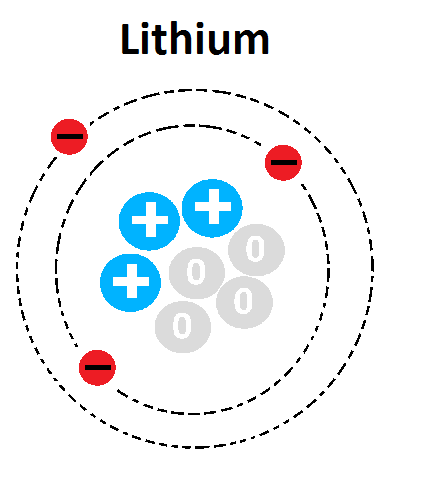
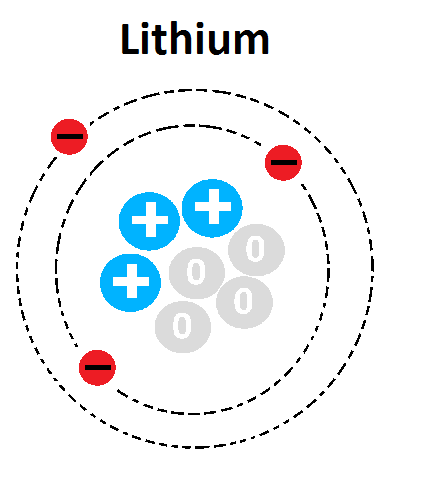
What is the atomic number of this atom?

a)

1

b)

3

c)

4

d)

7

12.
What is the number of protons that the element in this image contain?
a)
14
b)
7
c)
15
d)
18
13.

The number 16 for the atomic element sulfur is the

a)

ionic number

b)

isotope

c)

atomic mass

d)

atomic number

14.

What is the mass number of this atom?

a)

1

b)

3

c)

4

d)

7

15.

How many protons does sulfur have?

a)

32

b)

16

c)

48

d)

12

16.
How many electrons does this atom contain?
a)
29
b)
63
c)
34
d)
92
17.

An atom has 10 protons, 15 neutrons and 10 electrons what is its mass number.

a)

20

b)

10

c)

35

d)

25

18.
The atomic number of an element that has 9 protons, 9 electrons, and 10 neutrons is _____.
a)
9
b)
10
c)
19
d)
28
19.

To calculate average atomic mass, you need

a)

the atomic mass of each isotope

b)

the percent abundance of each isotope

c)

the atomic mass and percent abundance of each isotope

d)

to find the average of the atomic masses of each isotope

20.
An element has two naturally occurring isotopes. One is 10.013 amu and is 19.9% abundant. The other is 11.01 amu and is 80.1% abundant. What is the average atomic mass? What element is it?
a)
9.012, Beryllium
b)
12.011, Carbon
c)
6.941, Lithium
d)
10.812, Boron
21.

Chlorine has two naturally occurring isotopes, Cl-35 and Cl-37, The atomic mass of chlorine is 35.45. Which of these two isotopes of chlorine is more abundant?

a)

Cl-35

b)

Cl-37

c)

Cannot be determined from the information provided.

22.
Nitrogen has three occurring isotopes: Nitrogen-13, Nitrogen-14, Nitrogen-15. Which isotope is the most abundant?
a)
Nitrogen-13
b)
Nitrogen-14
c)
Nitrogen-15
d)
Based on the information given, it cannot be determined
23.

An element has three isotopes. Given the abundances and relative masses, calculate the average atomic mass and determine (from the periodic table) which element it is.


Abundances | Relative masses

0.005% | 234.04 amu

0.720% | 235.04 amu

99.275% | 238.05 amu

a)

Uranium (#92, Atomic Mass: 238.03 amu)

b)

Fluorine (#9, Atomic Mass: 19.00 amu)

c)

Mercury (#89, Atomic Mass: 200.59 amu)

d)

Polonium (#84 209 amu)