wayground logo

Free Printable Worksheets

Font size

S
M
L
XL
Worksheets

Great Depression 2021 TMHS

Total questions: 50

Worksheet time: 1hrs 12mins

Name
Class
Date
1.
In 1929, the United States entered an economic slowdown called the Great Depression. One of the early events was the stock market crash. What was a major cause of the stock market crash? (Use process of elimination)
a)
Stock prices went up so fast that investors could not keep up with the changes.
b)
The government decided to close the stock market in New York.
c)
Stock prices fell; investors panicked and sold their stocks, which led to more panic.
d)
People decided to invest their money in stock markets in Europe.
2.
Shanty towns (make-shift) towns were named after this person due to the people’s dissatisfaction of the amount of help they were given after the Stock Market Crash?
a)
Franklin D. Roosevelt
b)
Herbert Hoover
c)
Theodore Roosevelt
d)
William McKinley
3.
How was the Dust Bowl caused by both humans and nature?
a)
Many families moving from Dust Bowl areas settled in the San Joachin Valley and became migrant farmers.
b)
Nearly 350 dust storms carried away the topsoil, and land and homes were covered with dust.
c)
The Dust Bowl caused families to move west in search of jobs and new homes.
d)
Farming methods and cattle had harmed the land, and then a severe drought hit the region in the mid-1930s. 
4.
Why were the people of the United States angry at President Hoover during the Great Depression?
a)
he seemed uncaring, opposing most types of government direct relief
b)
he did not take enough action to help enough during the depression
c)
Americans opposed his handling of the Bonus Army marchers
d)
all of these are reasons
5.
The Dust Bowl was a problem with farmland that happened during the Great Depression. The Dust Bowl happened for two MAIN reasons. These two reasons were:
a)
Farmers over planted their fields and there was a drought 
b)
New Deal programs ruined farms and there was a drought 
c)
Farmers over planted fields and President Hoover ended the New Deal 
d)
Farmers sent too much food to soup kitchens and did not save enough for themselves
6.
What year did the Stock Market Crash?
a)
1928
b)
1929
c)
1930
d)
1931
7.
Where did most people move to during the Dust Bowl to escape the storm and to start over? 
a)
Out West ( California )
b)
Up North ( New York )
c)
Down South ( Georgia )
d)
East ( South Carolina ) 
8.
What was the impact on Business during The Great Depression?
a)
The demand for goods decreased
b)
The demand for goods increased
c)
The demand for goods stayed the same
d)
Banks were able to make more loans so business could invest more into their buisness
9.
Who was Dorothea Lange?
a)
Photographer who took historically important pictures that documented the effects of the time
b)
A famous movie actress who spent time helping those impacted by the Dust Bowl
c)
FDR's wife
d)
A famous business woman who gave jobs to women to help support their family's 
10.
Why are Dorothea Lange's photographs worth seeing?
a)
Her photographs document the struggles of government officials
b)
Her pictures show how weak that generation was
c)
She documents the struggles of white men
d)
Her photographs tell the story of the hardship so many Americans suffered during this time
11.
What was the impact The Great Depression had on Women?
a)
Women's employment increased by 30%
b)
Many states prohibited hiring women whose husbands earned a "living wage" or hiring married women altogether.
c)
Domestic violence reports reduced by 30%
12.
What was the Mexican Repatriation Act?
a)
Mexicans were encouraged to enter the country
b)
To send Mexican Americans back to Mexico
c)
Given many high paying jobs
d)
Given a quick process to citizenship 
13.

What were THREE causes of the Great Depression?

a)

WWI disrupted the international economy

b)

A severe drought caused farmers to fail

c)

New Deal caused the nation to go into debt.

d)

The stock market crashed

e)

Banks failed and caused many people to lose money.

14.

Migrants from the Great Plains headed west in search of better lives were called

a)

Okies

b)

Speculators

c)

Wagners

d)

Hoosier

15.

Roots of the Depression included overproduction, high tariffs, and

a)

uneven distribution of wealth

b)

inadequate money supply

c)

over-spending by government

d)

excessive reliance on export sales

16.

President Hoover's image was tarnished by the Bonus March and the

a)

lingering depression

b)

public works funding

c)

emergency loans to states

d)

building the Hoover Dam

17.

People who took a chance on the stock market were called

a)

Speculators

b)

Okies

c)

Bailiffs

d)

Republicans

18.
This ended prohibition in the United States
a)
17th Amendment
b)
18th Amendment
c)
20th Amendment
d)
21st Amendment
19.
This happened when too much money was loaned to individuals who could not pay it back
a)
Bank failures
b)
Fireside chats
c)
Dust Bowl
d)
Black Tuesday
20.
What does "laissez faire" mean
a)
to take seriously
b)
to give money
c)
to become free
d)
to leave alone
21.
Designed to raise prices on imports from Europe and to promote buying American goods
a)
Hawley Smoot Tariff
b)
Dust Bowl
c)
Gross National Product
d)
Hooverville
22.
President during the Great Depression
a)
Franklin Roosevelt
b)
Herbert Hoover
c)
John Kennedy
d)
Teddy Roosevelt
23.
Name two groups that faced discrimination during the Great Depression because some whites felt they were taking jobs
a)
African Americans and Native Americans
b)
Native Americans and Europeans
c)
African Americans and Mexican Americans
d)
Mexican Americans and Native Americans
24.
What problems did American farmers face after WWI ended?
a)
There was a surplus of crops and they could no longer sell all their products
b)
Farmers could no longer use their land
c)
They did not know what crops to grow
d)
Factories made too many goods
25.
Which of the following is NOT a role that individuals play in the economy? 
a)
Buying food, clothing, and other things that they need.
b)
Working to receive a paycheck.
c)
Taxing their fellow citizens.
d)
Starting businesses which offer services and goods to other individuals. 
26.
Which of the following is the government's role in the economy? 
a)
Providing stocks to people who need to invest. 
b)
The  main provider of loans to people who want to buy homes.
c)
Giving interest to people who put their money into savings accounts. 
d)
Building roads, schools, hospitals, and more with tax money.
27.
What role do private businesses have in the economy? 
a)
They provide goods for people to buy.  They provide jobs for people to work at.
b)
They help people open up savings accounts.
c)
They give interest to people who save money in a savings account. 
d)
They do not play a role in the economy.
28.
Which technological advance in the 1920s and 1930s caused over farming and the destruction of many farms when a drought hit?
a)
tractors
b)
contour farming
c)
plow
d)
windbreaks
29.
The Great Depression that began in 1929 hit farmers especially hard. Farmers had not been doing well in the 1920s and several years of severe drought turned the land into a "dust bowl." What was an immediate result of this?
a)
Many farmers decided to grow crops that did not use as much water. 
b)
The government built large dams in the West for irrigation. 
c)
Many farmers and their families lost their farms and moved west. 
d)
The government helped farmers by buying their land and equipment. 
30.

What is a good title for this list?

a)

Culture of the 1920s

b)

The Great Migration

c)

Impact of the Great Depression

d)

Features of the New Deal

31.

Who believed in Rugged Individualism?

a)

Hoover

b)

FDR

32.

Using credit to buy stocks was a common practice in the 1920s and a major cause of the Great Depression. This practice was also known as

a)

installment plans

b)

laissez-faire

c)

buying on margin

d)

calculated risk

33.

What is a tariff?

a)

Buying stock with credit.

b)

Using installment plans to purchase goods.

c)

Tax on foreign goods (imports).

d)

A process to remove the President from office.

34.

The Great Depression and the New Deal occurred during which decade?

a)

the 1890s

b)

the 1920s

c)

the 1940s

d)

the 1930s

35.
In the 1930's, people would line up at ____________ to get food.  These were normally run by charities.
a)
churches
b)
businesses
c)
soup kitchens
d)
work
36.
After the Stock Market Crash, many people lost their life savings because _______________.
a)
banks closed
b)
banks gave away their money
c)
they couldn't remember where they put it
d)
someone stole it
37.
What were the villages full of shacks located in cities filled with unemployed Americans called?
a)
Hoovervilles
b)
Okies
c)
Bonus Army Bases
d)
Rooseveltowns
38.
The Bonus Army incident in 1932 best illustrates the idea that
a)
F.D.R.'
s relief programs were unsuccessful.
b)
many felt that Herbert Hoover was not handling the Depression well.
c)
protests by veterans during the Depression were effective.
d)
the U.S. Army had increased in size and power during the Depression.
39.

Veterans of this conflict were owed bonus pay for their service.

a)

World War I

b)

World War II

c)

Gulf War

d)

Civil War

40.

What was President Herbert Hoover's response to the Great Depression?

a)

He believed "rugged individualism" would solve the economy

b)

He created mass welfare

c)

He increased infrastructure to create jobs

d)

He violated his policy of laissez-faire

41.

Roots of the Depression included overproduction, high tariffs, and

a)

uneven distribution of wealth

b)

inadequate money supply

c)

over-spending by government

d)

excessive reliance on export sales

42.

Which is a reason Americans preferred movies, radio, and entertainment during the Great Depression?

a)

Focused on the homeless and unemployed

b)

Evoked indignation at social injustice

c)

Provided a release from the daily worries

d)

Created thrills with new special effects

43.
Which of the following is NOT a cause of the Great Depression?
a)
Stock Market Crash
b)
Credit
c)
Advertisment
d)
Prohibition
44.
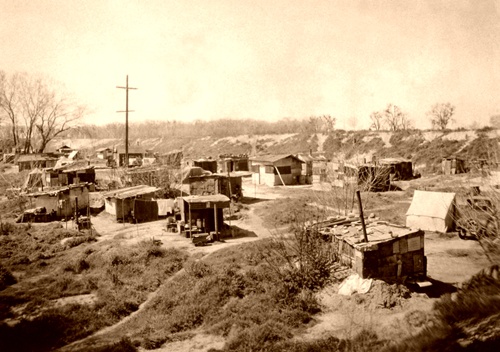
The photograph best illustrates which impact of the Great Depression upon Americans?
a)
A large number of banks failed.
b)
The stock market crashed.
c)
Large numbers of people were hungry and homeless.
d)
Farmer’s incomes fell to low levels.
45.
$100 will buy this car.  Must have cash. Lost all on the stock market.

The photograph best illustrates which cause of the Great Depression?
a)
People over speculated on stocks.
b)
Government failed to prevent the collapse of banks.
c)
Tariffs discouraged trade.
d)
Drought occurred in the Midwest.
46.
The New York Times
October 1929
The topic of this newspaper article is the...
a)
Stock Market Crash
b)
Stock Market Boom
c)
Great Migration north and west
d)
Roaring Twenties
47.
In 1929, the United States entered an economic slowdown called the Great Depression. One of the early events was the stock market crash. What was a major cause of the stock market crash?
a)
Stock prices went up so fast that investors could not keep up with the changes. 
b)
Stock prices fell, investors panicked and sold their stocks, which led to more panic. 
c)
The government decided to close the stock market in New York. 
d)
People decided to invest their money in stock markets in Europe. 
48.
a)
Margaret Mitchell
b)
Charles Lindbergh
c)
Jesse Owens
d)
Duke Ellington
49.
Why is it important to have representatives in our government?
a)
It allows people who are well educated to make decisions. 
b)
Representatives in our government can change our freedoms granted by the Bill of Rights. 
c)
Representatives in our government can only make decisions based on their personal beliefs. 
d)
It allows citizens to have a voice in the decision making process. 
50.
People have different roles in our economic system__producer, provider, consumer, and investor. The person who buys stock in a company is
a)
a consumer. 
b)
a producer. 
c)
a provider. 
d)
an investor.