
NEW
Font size
 Worksheets
College Acct 2- Chapter 1
Total questions: 24
Worksheet time: 6hrs 31mins
Which of the following costs is considered both a direct cost and a conversion cost?
Variable overhead
Fixed overhead
Direct materials
Direct labor
Which of the following is considered a period cost?
Depreciation of factory machinery
Advertising expenses for a new product
Raw materials used in production
Wages of factory workers
What does the contribution margin represent?
Sales less all expenses
Sales less variable costs
Sales less fixed costs
Sales less cost of goods sold and variable expenses
A company pays $3,000 for a four-year insurance policy at the beginning of the first year. Seventy percent of the premium is for manufacturing operations and thirty percent is for selling and administrative activities. What amounts should be considered product and period costs respectively for the first year of coverage?
Product - $525
Period - $225
Product - $225
Period - $525
Product - $750
Period - $0
Product - $0
Period - $750
Which of the following statements is true when referring to fixed costs?
Committed fixed costs arise from the annual decisions by management
As volume increases, unit fixed cost and total fixed cost will change
Fixed costs increase in total throughout the relevant range
Discretionary fixed costs can often be reduced to zero for short periods of time without seriously impairing the long-run goals of the company
A cost that has already been incurred and cannot be recovered is known as a(n):
Sunk cost
Marginal cost
Fixed cost
Variable cost
Which of the following would most likely be considered a direct cost in a furniture factory?
The salary of the factory manager
The cost of wood used in making a table
The depreciation on factory equipment
The factory's electricity bill
In the cost formula Y = a + bX, what does the "a" represent?
Total fixed cost
Total variable cost
Variable cost per unit
Total cost
Indirect costs:
are incurred to benefit a particular accounting period.
cannot be easily traced to a particular cost object.
are incurred due to a specific decision.
are the fixed costs of producing a product.
As the level of activity increases, how will a mixed cost in total and per unit behave?
In Total - Decrease
Per Unit - Increase
In Total - Increase
Per Unit - No Effect
In Total - Increase
Per Unit - Decrease
In Total - Increase
Per Unit - Increase
In Total - Decrease
Per Unit - No Effect
Courage B is a merchandising company. Last month the company's merchandise purchases totaled $90,000. The company's beginning merchandise inventory was $12,000 and its ending merchandise inventory was $18,000. What was the company's cost of goods sold for the month?
$84,000
$96,000
$102,000
$120,000
The classification of costs into variable, fixed, and mixed categories is referred to as the company’s:
cost structure
relevant range
contribution margin
product mix
Which of the following statements about differential costs is true?
They are always sunk costs.
They can only be variable costs.
They can only be fixed costs.
They can be either fixed or variable costs.
The costs of direct labor are classified as:
Conversion Cost
Manufacturing Cost
Prime Cost
Conversion Cost
Manufacturing Cost
Manufacturing Cost
Prime Cost
Where can product costs that have been expensed be located?
cost of goods sold
administrative expenses
selling expenses
period costs
Given the cost formula, Y = $15,000 + $5.25X, total cost for an activity level of 3,000 units would be:
$20,750
$25,750
$15,750
$30,750
Direct Materials $20,000
Direct Labor $30,000
Manufacturing Overhead $40,000
Selling Expenses $21,100
Administrative Expenses $40,900
Conversion costs during the month totaled:
$70,000
$50,000
$60,000
$68,800
Direct Materials $50,000
Direct Labor $10,000
Manufacturing Overhead $25,000
Selling Expenses $12,000
Administrative Expenses $8,000
Prime costs during the month totaled:
$85,000
$35,000
$60,000
$75,000
Cost of raw materials used in production $75,000
Wages paid to the assembly line workers $85,000
Salary of the marketing manager $30,000
Cost of promotional events $50,000
What is the total of the direct costs above?
$75,000
$160,000
$190,000
$240,000
What are Prime Costs?
Direct Materials
Direct Labor
Manufacturing Overhead
Direct Materials & Direct Labor
Which of the following would most likely NOT be included as manufacturing overhead in a factory that makes furniture?
The utility bills of the factory
The wages paid to the individual who assembles the chairs
The cost of the glue in a chair
The insurance policy that covers the factory
Kota Longboards has provided the following information:
Direct Materials $6.85 per unit
Direct Labor $2.75 per unit
Variable MOH $1.40 per unit
Fixed MOH $11,000 (total)
Sales commissions $1.00 per unit
Variable Administrative Expenses $0.40 per unit
Fixed Administrative Expenses $5,500 total
If the selling price is $17.75 per unit, what is the contribution margin per unit?
$17.75
$5.35
$6.75
$0
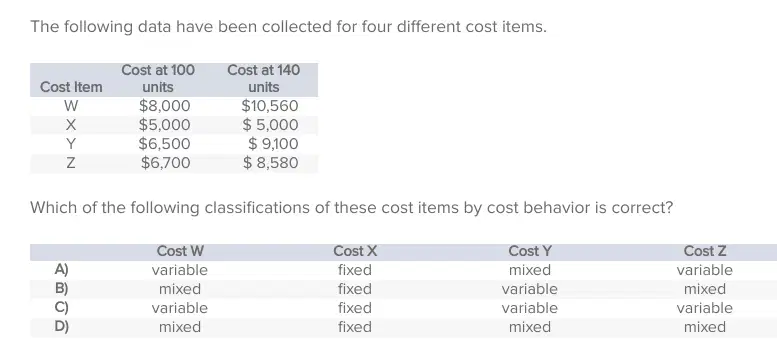
Which of the following classifications of these cost items by cost behavior is correct?
Choice A
Choice B
Choice C
Choice D
Direct Materials $5
Direct Labor $2.35
Variable Manufacturing Overhead $1.75
Sales commissions $1.00
Variable Administrative Expenses $0.40
If 2,000 units are produced, what is the total amount of direct manufacturing costs incurred?
$14,700
$18,200
$21,000
$33,300

