
 Worksheets
Work, energy, and Power
Total questions: 55
Worksheet time: 3hrs 45mins
What are the two necessary conditions for work to be done?
Force and Velocity
Force and Displacement
Force and Time
Which of the given pictures shows that work can not be done?


What are the factors affect gravitational potential energy?
Mass and Velocity
Mass, Acceleration due to gravity, and Height
Mass, Acceleration due to gravity and Time
Which of the following illustration shows elastic potential energy?


Which of the following statements show kinetic energy?
The battery of a lit flashlight
A golf ball placed at the edge of the hole
A river flowing down a hill
What are the factors that can affect power?
Work done and time
Work done and velocity
Work done and force
What will be the formula if we are finding the TIME using the formula of power?
Time = powerwork done
Time = work donepower
Time = work x power

The diagram shows part of a rollercoaster ride with the car at different positions. The car runs freely down from position X to position Y and up the hill on the other side.
What happens to the kinetic energy and to the gravitational potential energy of the car as it moves from position X to position Y?
K.E = decreases, G.P.E = decreases
K.E = decreases, G.P.E = increases
K.E = increases, G.P.E = decreases
K.E = increases, G.P.E = increases

The escalator takes 20 seconds to carry the man between the two floors. The useful work done against gravity is W. The useful power developed is P. The lift takes 30 seconds to carry the same man between the same two floors. How much useful work against gravity is done by the lift, and how much useful power is developed by the lift?
work done by lift = more than W, useful power by lift = less than P
work done by lift = more than W, useful power by lift = P
work done by lift = W, useful power by lift = less than P
work done by lift = W, useful power by lift = P

A box of mass m and weight W is carried up some stairs of total height x and total width y. On which quantities does the work done against gravity on the box depend?
m and y
W and x
W and y
x and y
Which movement will require the greatest amount of work to be done?
a force of 10N moving an object a distance of 3.0m
a force of 10N moving an object a distance of 5.0m
a force of 15N moving an object a distance of 3.0m
a force of 15N moving an object a distance of 5.0m
A lorry of mass 4000kg is travelling at a speed of 4.0m/ s. A car has a mass of 1000kg. The kinetic energy of the car is equal to the kinetic energy of the lorry. What is the speed of the car?
2.0 m/s
4.0 m/s
8.0 m/s
16.0 m/s
A weight-lifter raises a 2000N weight through a vertical height of 2.0m in 0.80s. What useful power does he develop in doing this?
800 W
3200 W
4000 W
5000 W

A ball is dropped on to a hard surface and bounces. It does not bounce all the way back to where it started, so it has less gravitational potential energy than when it started. What happens to the ‘lost’ energy?
It is converted into chemical and strain energy.
It is converted into internal (heat) energy and sound.
It is destroyed as the ball rises upwards after hitting the ground.
It is destroyed when the ball hits the ground.
What is the unit of thermal energy?
W
Pa
N
J
Three situations are listed.
(1) someone blowing air into a party balloon
(2) a crane lifting a block of concrete
(3) a pile of books at rest on a shelf
In which situations is work being done?
1 only
1 and 2 only
2 and 3 only
1, 2 and 3
Brakes are used to slow down a moving car. Into which form of energy is most of the kinetic energy converted as the car slows down?
sound
elastic potential
chemical
thermal
A man carries 20 tiles from the ground to the roof of a house. Each tile has a mass of 1.2 kg. The roof of the house is 15 m above the ground. How much work does the man do against gravity on the tiles in carrying them to the roof?
36 J
180 J
360 J
3600 J

A person in a factory has to lift a box on to a shelf. Which action involves the person doing the least amount of work?
lifting the box quickly to the high shelf
lifting the box slowly to the high shelf
lifting the box to the low shelf instead of to the high shelf
lifting the box to the low shelf first then lifting it to the high shelf
Which formula is this?
? = 21mv2
Potential Energy
Kinetic Energy
Mechanical Energy
Work
Which formula is this?
? = F.d
Potential Energy
Kinetic Energy
Mechanical Energy
Work

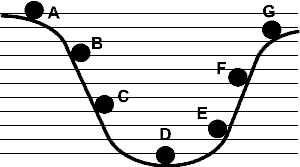
At which point does the ball has the greatest gravitational potential energy (GPE)?
A
G
D
C
G
Kinetic energy is associated with ---.
speed
position
direction
temperature
Potential energy is associated with ---.
speed
position
direction
temperature
Where is the kinetic energy of pendulum at its highest?
at the top of the swing
at the bottom of the swing
at 1/4 of the swing
at 3/4 of the swing
Two workers use 100 N of force to move a sofa 2 meters in 2 seconds. How much power is required?
100 watts
400 watts
104 watts
50 watts
A worker climbs a ladder and does 8 J of work on a 2 N object. What is the distance they lift the object?
18 m
4 m
10 m
6 m

At which point of this roller coaster is the energy 1/2 kinetic and 1/2 potential?
A
B
C
D

Suppose a cart has a kinetic energy of 0.5 J. If you add enough mass to double the mass and make the cart go three times as fast, its kinetic energy is now ---.
6 J
3 J
18 J
9 J

A block starts at rest at point P at the top of a ramp which is height h above the ground. The block slides down one side and up the other, stopping at a point less than h above the ground. Which statement is TRUE?
The block did not go as high on the other side because gravity pulls down.
The block did not go as high on the other side because potential energy always has to decrease.
The block did not go as high on the other side because work from friction made the mechanical energy less.
The situation as described is impossible to happen.

If there is no friction on this track, at which point would the coaster have the most kinetic energy?
A
B
C
D
How high up is a 3200-kg plane if it has 960000 J of potential energy?
10 m
30 m
307200000 m
300 m
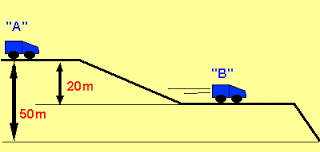
In diagram 2, if the mass of the car is 600 kg, what is the change in potential energy from point A to point B?
411,600 J
294,000
176,400 J
117,600 J
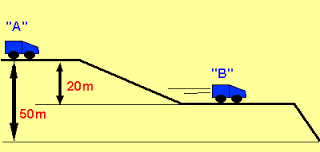
In diagram 2, if the 600 kg cart is initially at rest, what is its velocity at point B?
19.8 m/s
15.0 m/s
10.3 m/s
3.8 m/s

Bob (80 kg) uses 180 N of force to get him up the slope. The vertical distance is 2 m and the diagonal is 10 m. Calculate the work he does.
1600 J
160 J
3600 J
1800 J
Energy Efficiency is calculated by useful energy (Energy Out) divided by energy consumed (Energy In) , expressed as a percentage
False
True
What type of energy transformation takes place when you plug in a lamp and turn it on?
electrical to radiant
electrical to mechanical
chemical to radiant
mechanical to thermal
What percent energy is wasted by a machine if the energy input is 262 J and the energy output is 131 J?
5%
50%
100 J
What is the work output of a machine that has a work input of 2,800 Joules and an efficiency of 90%?
25200 J
2520 J
0.0082J
The ability to do work or cause change:
work
energy
momentum
power

Who has the most power?
Ms Criza who encodes her observation tools using 12000J of work in 20 minutes.
Sir Pau who studies his 5 lessons for the next classes in 15 minutes.
Mrs Punzalan who used 50N force to inoculate mushrooms at a speed of 2m/s.
Mrs Masalunga who watches her learners while taking their quiz in 30 minutes.
A 100 N force is applied to move an object a horizontal distance of 5 meters at constant speed in 10 seconds. How much power is done?
50J
50W
500J
500W

If the mass of the cart is 15kg, how much is the potential energy of the cart?
0J
1.2J
6J
58.8J

How will you describe the energy at Point A?
mostly potential energy
mostly kinetic energy
losing PE, gaining KE
losing KE, gaining PE
If a system is isolated, the total energy of the system
Increases constantly.
Decreases constantly.
Is constant.
Depends on the work done on the system.
Depends on the work done by the system.

A light plastic cart and a heavy steel cart are both pushed with the same force for a distance of 1.0 m, starting from rest. After the force is removed, the kinetic energy of the light plastic cart is ________ that of the heavy steel cart.
greater than
equal to
less than
can't say unless we know how big the force is

