Wayground logo

Free Printable Worksheets

Font size

S
M
L
XL
Worksheets

revision 1st year

Total questions: 56

Worksheet time: 1hrs 1mins

Name
Class
Date
1.

Which organelle protects cells?

a)

nucleus

b)

cytoplasm

c)

cell membrane

d)

ribosomes

2.
the jelly like substance in the plant cell.
a)
cytoplasm
b)
choroplast
c)
vacuole
d)
nucleus
3.
Which part of the cell contains DNA?
a)
The cell wall
b)
The mitochondria
c)
The Vacuoles
d)
The Nucleus
4.

Rigid layer surrounding a plant cell

a)

Cell Membrane

b)

Cytosplasm

c)

Cell Wall

d)

Chloroplast

e)

Vacuole

5.

Contains a cell wall, chloroplasts, and one large vacuole.

a)

Animal Cell

b)

Plant Cell

c)

Bacteria Cell

6.

Controls the activities of the cell

a)

Nucleolus

b)

Mitochondria

c)

Nucleus

d)

Endoplasmic Reticulum

7.
A microscope is an instrument that.
a)
makes faraway objects look closer.
b)
makes small objects appear larger.
c)
decreases the size of small objects.
d)
increases the size of small objects.
8.
If the eyepiece of your scope has a power of 10, and the selected objective lens has a power of 20,what is the total magnification?
a)
20x
b)
30x
c)
200x
d)
2000x
9.
If your teacher asks you to move a microscope to table, how do you carry it?
a)
by the body tube and the eyepiece
b)
with one hand
c)
one hand on the arm and the other under the base
d)
with one hand on the base and the other on the eyepiece.
10.
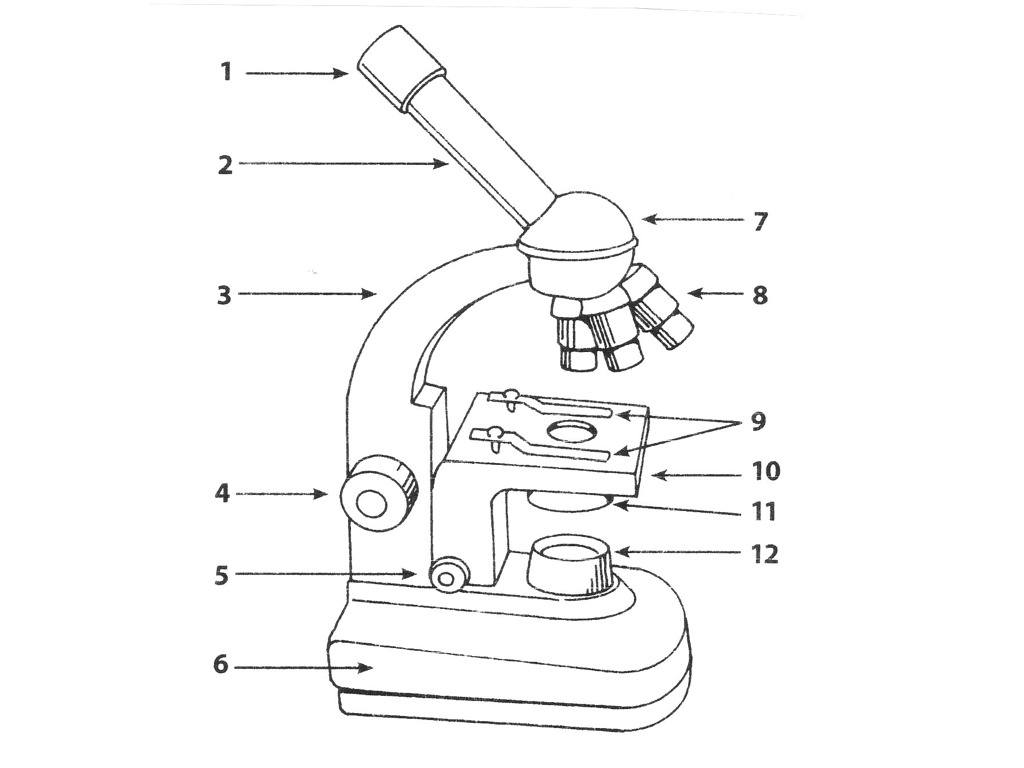
What is part 1?
a)
eye piece
b)
body tube
c)
arm
d)
coarse adjust
11.
The curved surface at the top of a column of water is called the __________ . 
a)
arch 
b)
meniscus
c)
bowl
d)
scoop
12.
What is volume?
a)
The amount of space matter takes up
b)
The amount of matter in an object
c)
The distance between two points
d)
The amount of heat energy
13.
What is the maximum value this graduated cylinder can measure?
a)
1 ml
b)
10 ml
c)
25 ml
d)
50 ml
14.

The length of the clownfish is _______

centimeters.

a)

5

b)

2

c)

4

d)

3

15.

I can use a ______ to measure the length of my Mathematics Textbook.

a)

clock

b)

ruler

c)

weighing scale

d)

magnifying glass

16.

What would you use to measure the

length of a small piece of paper?

a)

Kilogram

b)

centimeter

c)

meter

d)

Litre

17.

Which of the following protects our organs in our body?

a)

Diaphragm

b)

Ribcage

c)

Trachea

d)

Bronchi

18.

Which of the following is a tube-like structure that allows the air you breathe in through your mouth and nose to travel to your lungs?

a)

Bronchus

b)

Trachea

c)

Bronchioles

d)

Diaphragm

19.

Which of the following are the smaller branches of the bronchial airways in the respiratory tract?

a)

Bronchus

b)

Trachea

c)

Bronchioles

d)

Diaphragm

20.

What is the force of attraction between any two objects due to their mass?

a)

gravity

b)

rotation

c)

revolution

d)

orbit

21.

What is the blocking of the Sun's light that happens when Earth passes through the Moon's shadow?

a)

Lunar Eclipse

b)

Solar Eclipse

c)

Tide

d)

Phase

22.

What is a mixture of ice, frozen gases, rock, and dust left over from the formation of the solar system?

a)

Asteroid

b)

Meteor

c)

Comet

d)

Star

23.

What is an object in space that produces its own energy, including heat and light?

a)

Supernova

b)

Star

c)

Comet

d)

Meteor

24.

What is the distance light travels in a year?

a)

Star

b)

Light-year

c)

Constellation

d)

Black Hole

25.

What is a huge cloud of gas and dust in space that is the first stage of star formation?

a)

Star

b)

Nebula

c)

White dwarf

d)

Supernova

26.
Where does the Asteroid Belt fall in the picture?
a)
between venus and earth
b)
between earth and mars
c)
between mars and jupiter
d)
between jupiter and saturn
27.

Which two planets are on either side of Earth?

a)

Venus and Mars

b)

Venus and Mercury

c)

Mercury and Mars

d)

Jupiter and Saturn

28.

The digestive process starts in the:

a)

Stomach

b)

Esophagus

c)

Mouth

d)

Bathroom

29.

The liver’s role is to:

a)

Mash up food

b)

Turn water into food

c)

Help the stomach

d)

Remove harmful substances from the blood

30.

Bile is made in the:

a)

Large intestine

b)

Stomach

c)

Liver

d)

All of the above

31.

What tube moves food from the back of your throat to the stomach?

a)

Epiglottis

b)

Esophagus

c)

Feeding tube

d)

Pharynx

32.

TRUE or FALSE:

Enzymes speed up, or catalyze the rate of chemical reactions.

a)

FALSE

b)

TRUE

33.

The mechanical and chemical breakdown of food into small particles and molecules that your body can absorb and use....

a)

ingestion

b)

elimination

c)

digestion

d)

absorption

34.

Which organ churns food and uses acid and enzymes to break down food?

a)

stomach

b)

esophagus

c)

mouth

d)

epiglottis

35.

This organ absorbs water from digested food

a)

small intestine

b)

stomach

c)

villi

d)

large intestine

36.
The chewing and grinding of food into smaller pieces is an example of...
a)

Physical Digestion

b)

Chemical Digestion

37.
How is a gas defined?
a)
no shape, no volume
b)
Definite shape, definite volume
c)
Found in stars
d)
Definite volume, no shape
38.
Molecules are closest together in a 
a)
Solid
b)
Liquid
c)
Gas
d)
plasma
39.
Which state of matter does ice start as (before you cool it)?
a)
liquid
b)
solid
c)
gas
40.
Which thing in this picture represents a gas? 
a)
ice cubes
b)
bubbles 
c)
soda
41.

Particles in a ______________________ move quickly and are far apart.

a)

gas

b)

solid

c)

liquid

42.

Definite shape and definite volume

a)

Solid

b)

Liquid

c)

Gas

43.
Change of state from a solid to a liquid.
a)
sublimation
b)
deposition
c)
freezing
d)
melting
44.
The steam coming off the pot of boiling water is an example of....
a)
a solid becoming a liquid
b)
a liquid becoming a solid
c)
a liquid becoming a gas
d)
a gas becoming a liquid
45.
A large piece of ice is placed on the sidewalk on a warm day. What will happen to the ice? 
a)
It will melt to form liquid water
b)
It will melt to form water vapor
c)
It will not change at all.
d)
It will freeze to form liquid water. 
46.

The diagram shows arrangement of particles in a

a)

Solid

b)

Liquid

c)

Gas

47.

What state of matter does the picture below represent?

a)

solid

b)

liquid

c)

gas

d)

plasma

48.

What state is represented in the gif?

a)

Solid

b)

Liquid

c)

Gas

49.
What is at the center of every atom?
a)
An electron
b)
A compound
c)
A molecule
d)
A nucleus
50.
Which two particles make up the nucleus of an atom?
a)
Protons and Electrons
b)
Protons and Neutrons
c)
Molecules and Compounds
d)
Neutrons and Electrons
51.
The particles with no charge in an atom are the _______.
a)
electrons
b)
neutrons
c)
protons
d)
protons and neutrons
52.
The positively charged particles of an atom are the ________.
a)
electrons
b)
protons
c)
neutrons
d)
protons & neutrons
53.
Everything is made up of little tiny things called _____
a)
compounds
b)
molecules
c)
atoms
d)
solids
54.

Which of these has the smallest mass?

a)

A proton

b)

An electron

c)

A neutron

55.

What particle is labeled A?

a)

proton

b)

electron

c)

neutron

56.

What particle is labeled B?

a)

proton

b)

electron

c)

neutron