
 Worksheets
kinematics review
Total questions: 70
Worksheet time: 2hrs 3mins


How long would it take a car, starting from rest and accelerating uniformly in a straight line at 5 m/s2, to cover a distance of 200m
9.0s
10.5s
12.0s
15.5s

What is the average velocity of the object between 0 and 10 seconds?
6.0 m/s
1.5 m/s
-4 m/s
0 m/s

What is the average velocity of the object between 10 and 15 seconds?
6 m/s
1.5 m/s
-4 m/s
0 m/s

What is the rate of acceleration of the object between 0 and 4 seconds?
1 m/s
0 m/s2
-1 m/s2
1 m/s2

What is the velocity of the object between 4 and 5 seconds?
0 m/s
5 m/s
1 m/s
2 m/s

Which graph(s) represents a constant velocity?
a and c
b and c
c
a and b


This chart represents the velocity of a motorcycle over time. Select the correct statement regarding the motorcycle's movement.
The motorcycle is speeding up.
The motorcycle has 0 acceleration.
The motorcycle is slowing down.
The motorcycle has constant acceleration.

Avery likes to walk 30 feet in 10 seconds. What is her speed?
3 feet/sec
6 feet/sec
10 feet/sec
2 feet/sec

What does the speed-time graph below represent the object as?
Travelling at constant speed, then decelerating.
Accelerating, then decelerating
Accelerating, then travelling at constant speed.

Using the graph, calculate the total distance travelled by the motor cycle.
1000m
1125m
1500m
What is the slope of a velocity-time graph an indication of?
Distance travelled
Instantaneous speed
Acceleration

An increasing slope, like graph C means that the object is
Moving away from start
increasing speed
accelerating
all of the above

Susan drives 60 miles per hour on the highway for 2 hours. How far did she go?
25 miles
50 miles
75 miles
120 miles
Which one is NOT an example of acceleration?
Speeding up
Slowing Down
Turning
Jogging at a steady speed


You toss a ball straight upward, in the positive direction. The ball falls freely under the influence of gravity.
At the highest point in the ball’s motion,
its velocity is zero and its acceleration is zero.
its velocity is zero and its acceleration is positive (upward).
its velocity is zero and its acceleration is negative (downward).
its velocity is positive (upward) and its acceleration is zero.
its velocity is positive (upward) and its acceleration is zero.


What does it mean when a change in velocity is negative?
The object is speeding up.
The object is slowing down.
The object is changing direction.
The object is falling down.

Which would hit the ground first if dropped from the same height in a vacuum—a feather or a metal bolt?
the feather
the metal bolt
They would hit the ground at the same time.
They would be suspended in a vacuum.
Which of the following statements applies to the motion of a ball tossed upward?
I. It has constant acceleration on the way up
II. It has constant acceleration at the top of its path
III. It has constant acceleration as it moves downward.
I only
I and III
III only
All are correct

Which object would fall with greater acceleration in a vacuum - leaf or pebble?
The leaf
The pebble
Difficult to determine without more information
Both accelerate at the same rate

If you throw a ball straight up, what is its velocity at the highest point?
9.81 m/s2
0.0 m/s2
9.81 m/s
0.0 m/s
A ball is tossed upward and caught at the same position of throw. In the absence of air resistance, the speed of the ball when it is caught would be
less than the speed it had when tossed upwards
the same as the speed it had when tossed upwards
more than the speed it had when tossed upwards

If air resistance is ignored, objects of different masses when dropped from rest
fall with equal accelerations and with equal displacements
fall with equal accelerations and with different displacements
fall with different accelerations and with different displacements
fall with different accelerations and with equal displacements
A hammer is dropped on Earth and the Moon. If gravitational pull on the Moon is about six times weaker than on Earth, where does a hammer fall faster?
Moon
Earth
No difference
Depends on the mass of the hammer
Heavier objects free fall faster than lighter objects in the absence of air resistance.
True
False

How do free falling objects move?
Falling objects accelerate at -9.8 m/s2
Falling object move at constant velocity
Falling objects accelerate at 100 m/s2
It depends on the mass: heavy objects accelerate, light objects do not
What values are always known for a free falling object?
d = -9.8 m vi = 0 m/s
vi = -9.8 m/s a = -9.8 m/s2
vi = -9.8 m/s a = 0 m/s2
vi = 0 m/s a = -9.8 m/s2
A baseball catcher throws a ball vertically upward and catches it in the same spot as it returns to the mitt. At what point in the ball’s path does it experience zero velocity and nonzero acceleration at the same time?
the instant it leaves the catcher’s hand
midway on the way up
at the top of its path
the instant before it arrives in the catcher’s mitt

Look at the following distance vs. time graphs. Which graph(s) show positive acceleration?
Graph A
Graph B
Graph C
Graph D

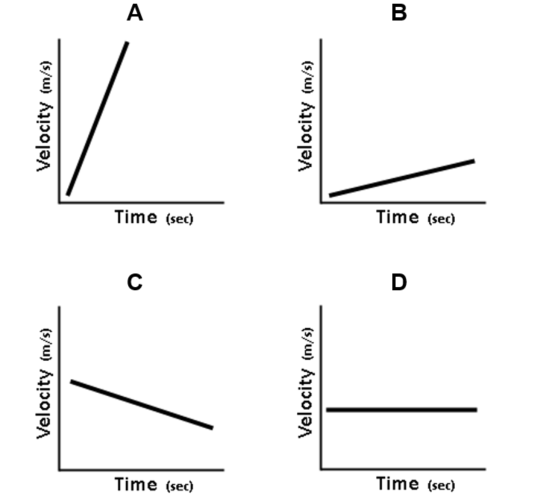
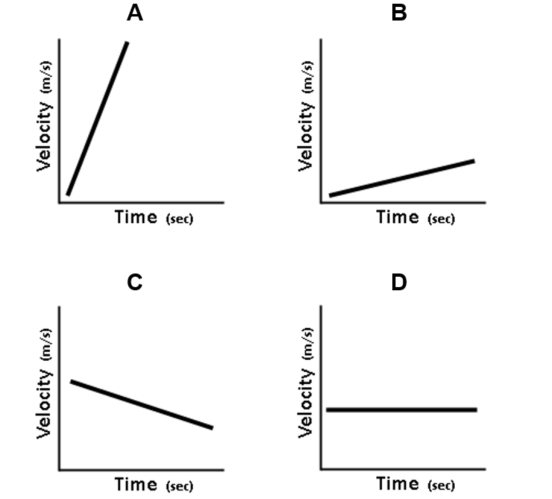
Check the graph. Which object shows the greatest acceleration?
A
B
C
D

The following graphs show a displacement – time graph.
Which graph corresponds to a body at rest?
A
B
C
D
The following graphs show a displacement – time graph.
Which graph corresponds to a body moving with a constant velocity?
A
B
C
D
The following graphs show a displacement – time graph.
Which graph corresponds to a body moving with a constant acceleration?
A
B
C
D

The following figure shows the velocity, v against time, t.
Which of the following graphs is its corresponding acceleration, a against time , t graph?

A
B
C
D

Diagram 2 shows a velocity-time graph for a motion of an object.
What is the total distance travelled by the object in 8 s? (SPM 2009)
16 m
24 m
32 m
64 m

Diagram shows the velocity-time graph of an object.
Which acceleration-time graph represents the same motion as the object? (SPM 2008)
A
B
C
D

