
 Worksheets
IPC Fall Final Exam
Total questions: 65
Worksheet time: 1hrs 23mins
Scalar quantities
have magnitude only
have magnitude and direction
have distance and displacement
have speed and velocity
Vector quantities
have magnitude only
have magnitude and direction
have distance and displacement
have speed and velocity
Match the description to the graph:
"The car is stopped."


Match the description to the graph:
"The car is traveling at a constant speed."

What is the independent variable in this experiment: Will an egg float higher in water with more salt?
type of egg
amount of salt in the water
how high the egg floats
What is the dependent variable in this experiment: Will an egg float higher in water with more salt?
type of egg
amount of salt in the water
how high the egg floats
Does the amount of homework I complete have an effect on my science test scores? What is the independent variable in this question?
what class the homework is for
how much homework I do
my test scores
Does the amount of homework I complete have an effect on my science test scores? What is the dependent variable in this question?
what class the homework is for
how much homework I do
my test scores

A ____________ is a push or a pull on an object.
friction
force
magnet
gravity
Inertia depends on ______
Velocity
Speed
Distance
Mass
A skateboard rolls down a hill, reaches the level surface and eventually comes to a stop. The fact that the skateboard ultimately stops is best explained by ____.
an unbalanced force would be required to keep the sled moving forward at constant speed
the presence of an unbalanced force (e.g., friction) can cause a moving object to stop
the presence of inertia causes it to stop
the natural tendency of any object is to ultimately stop
More mass = More inertia
True
False
The rate something is traveling in a certain time
(example: miles per hour)
velocity
inertia
speed
The rate something is traveling in a certain direction.
speed
inertia
velocity
The amount of MATTER in an object.
momentum
velocity
mass
Inertia is the tendency of an object to resist a change in its ___________.
temperature
shape
size
motion

Velocity is speed with __________________________.
a unicycle helmet
direction
fight
What is Newton's 2nd Law?
Every action has an equal and opposite reaction
An object at rest stays at rest, an object in motion stays in motion.
F = ma
Friction
True or False. 800 N = 800 kg ⋅ m/s2
True
False

If the man pushes with an equal amount of force, which object will accelerate more?
Car because it has more mass
Lawnmower because it has less mass
Car because it has less mass
Lawnmower because it has more mass

A 50-kg crate is pushed with a horizontal acceleration of 20 m/s2. What net force is acting on the crate?
2.5 N
0.4 N
1000 N
30 N

A 10-kg crate is pushed across a frictionless surface with a force of 30 N. What is its acceleration?
300 m/s2
3 m/s2
20 m/s2
0.33 m/s2

What is the mass of a motorcycle that accelerates at 4 m/s2 when a net force of 400 N is applied to it?
1600 kg
100 kg
0.01 kg
396 kg
An evil ewok threw a rock with a force of 24.6N and an acceleration of 6m/s2 at an innocent stormtrooper. What was the rock's mass?
4Kg
41kg
4.1kg
46kg
Your car has a mass of 2500 kg and a force of 5000 N. How fast will it accelerate?
20 m/s2
2 m/s2
0.5 m/s2
120 N
Newton’s 3rd law states that for every action, there is an ________ reaction.
unequal and opposite
equal and similar
stronger and opposite
equal and opposite

When a cannon fires a cannonball we observe Newton's third law. Which is the reaction force?
The cannon moving forward
The cannon moving backwards
The cannonball moving backwards
The cannonball moving forward
When the person pushes the ground with their foot, the equal and opposite reaction force is
the ground pushing back on their foot
when they start to move forward

What will happen if the Action is greater than the Reaction?
The man will fall
The boat will sink
Nothing will happen

If the person is pushing backwards with the paddle, why do they move forward?
The person will actually move backwards, they need to paddle the other way
The water pushes back with an equal and opposite force
The person is pushing harder than the water
The water pushes back with a greater force than the person

How is this an example of Newton's 3rd Law?
Only his head is pushing on the ball
Only the ball is pushing on his head
Both the ball and the head are exerting equal force on each other
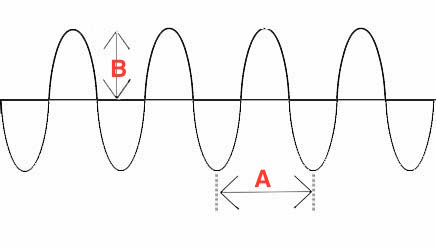
What property of this wave is represented by the letter "A"
amplitude
crest
trough
wavelength

When the frequency of a wave increases, what happens to the wavelength?
The wavelength is not directly affected by the frequency of a wave.
The wavelength increases.
The wavelength decreases.
More specific information is needed to form a conclusion about the wavelength.


Which type of wave moves parallel to the direction of the wave?
transverse
longitudinal
surface
electromagnetic

It is the high pressure part of the wave where the particles are close together. It is part A on this picture.
Compression
Amplituide
Rarefaction
Wavelength
How are musical instruments grouped?
by frequency
by pitch
by wavelength
by amplitude
High pitched waves would have wavelengths that are...
at a rarefaction
far apart
close together
at the trough

What does the arrow in the picture represent?
wavelength
echolocation
amplitude
peak
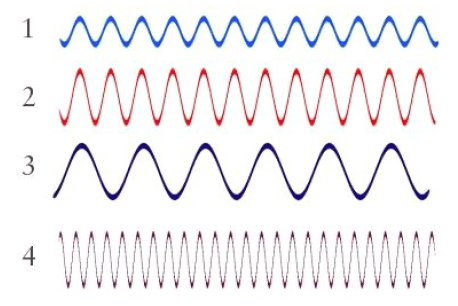
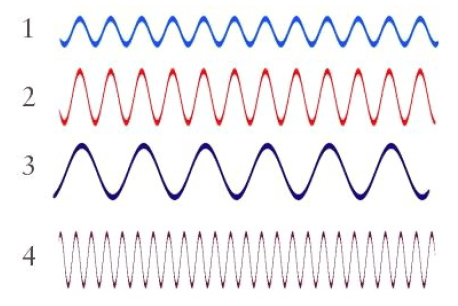
Which wave in the diagram has the longest wavelength?
1
2
3
4
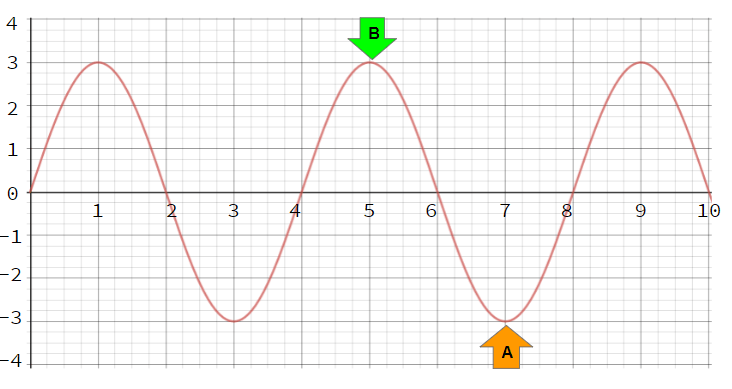
What property does the orange arrow (A) represent?
Crest
Trough
Wavelength
Peak
Transverse waves move __________ to the energy in the wave (select all that apply).
Parallel
Perpendicular
At 90 degree angle
In the same direction
The areas of a longitudinal waves where particles are spread far apart from each other are called:
rarefactions
compressions
amplitude
wavelength


When is it OK to eat or drink in class?
Always
Never
When you are absent or looking for an assignment in this class, you should start by going to
CANVAS
Modules
The date of the assignment
ALL OF THE ABOVE

