wayground logo

Free Printable Worksheets

NEW

Font size

S
M
L
XL
Worksheets

Newton's Laws

Total questions: 66

Worksheet time: 2hrs 4mins

Name
Class
Date
1.

v represents

a)

volume

b)

velocity

c)

force

d)

acceleration

2.

m/s is a unit for

a)

mass

b)

force

c)

acceleration

d)

velocity

3.

kg is a unit that represents

a)

force

b)

velocity

c)

mass

d)

momentum

4.

When one variable increases and another decreases, on a graph, it is said to have a ___________________ relationship

a)

directly proportional

b)

inversely proportional

c)

indirectly proportional

d)

no relationship

5.

When one variable increases and the other also increases, on a graph, it is said to have a ___________________ relationship

a)

directly proportional

b)

inversely proportional

c)

indirectly proportional

d)

no relationship

6.

Law of Inertia

a)

Newton's 1st law

b)

Newton's 2nd law

c)

Newton's 3rd law

d)

Law of conservation of momentum

7.

Forces come in pairs

a)

Newton's 1st law

b)

Newton's 2nd law

c)

Newton's 3rd law

d)

Law of conservation of momentum

8.

For every action, there is an equal and opposite reaction

a)

Newton's 1st law

b)

Newton's 2nd law

c)

Newton's 3rd law

d)

Law of conservation of momentum

9.

F=ma

a)

Newton's 1st law

b)

Newton's 2nd law

c)

Newton's 3rd law

d)

Law of conservation of momentum

10.

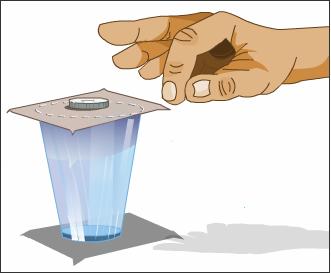
This example can be applied to which law?

a)

Newton's 1st law

b)

Newton's 2nd law

c)

Newton's 3rd law

d)

Law of conservation of momentum

11.

An object in motion will stay in motion, or an object at rest will stay at rest unless acted on by an unbalanced force

a)

Newton's 1st law

b)

Newton's 2nd law

c)

Newton's 3rd law

d)

Law of conservation of momentum

12.
A magician pulls a tablecloth out from under dishes and glasses on a table without disturbing them.
a)
Newton's 1st Law
b)
Newton's 2nd Law
c)
Newton's 3rd Law
13.
Pushing a child on a swing is easier than pushing an adult on the same swing, because the adult has more mass and requires more force to accelerate.
a)
Newton's 1st Law
b)
Newton's 2nd Law
c)
Newton's 3rd Law
14.
This person bought coffee and put it on the seat next to them. If they stopped quickly and the coffee spilled which law would that represent?
a)
Newton's 1st Law
b)
Newton's 2nd Law
c)
Newton's 3rd Law
15.
When you step on a Lego. You push on the Lego and the Lego pushes back on you.
a)
Newton's 1st Law
b)
Newton's 2nd Law
c)
Newton's 3rd Law
16.

Which law states that the acceleration of an object depends on the force exerted on it and its mass?

a)

1st Law

b)

2nd Law

c)

3rd Law

17.

Which law states that for every action there is an equal and opposite reaction?

a)

1st Law

b)

2nd Law

c)

3rd Law

18.

Which law states that an object at rest stays at rest and an object in motion stays in motion unless an unbalanced force acts on it?

a)

1st Law

b)

2nd Law

c)

3rd Law

19.
A picture is hanging on a wall and does not move.
a)
Newton's 1st Law
b)
Newton's 2nd Law
c)
Newton's 3rd Law
d)
None of them
20.
A person not wearing a seatbelt flies through a car window when someone slams on the breaks because the person’s body wants to remain in continuous motion even when the car stops.
a)
Newton's 1st Law
b)
Newton's 2nd Law
c)
Newton's 3rd Law
d)
None of them
21.
Pushing a child on a swing is easier than pushing an adult on the same swing, because the adult has more inertia.
a)
Newton's 1st Law
b)
Newton's 2nd Law
c)
Newton's 3rd Law
d)
None of them
22.
Acceleration is produced when a force acts on a mass. The greater the mass (of the object being accelerated) the greater the amount of force needed (to accelerate the object).
a)
Newton's 1st Law
b)
Newton's 2nd Law
c)
Newton's 3rd Law
d)
None of them
23.
What law is best described by inertia?
a)
1st
b)
2nd
c)
3rd
24.
a)
1st
b)
2nd
c)
3rd
25.
If a 10 kilogram object accelerates suddenly at 15 m/s^2, how much force was applied to the object?
a)
150 Newtons
b)
15 Newtons
c)
150 kilograms
d)
100 kilograms
26.
If a force of 50 Newton's was applied to an object with a mass of 500 grams, what will the object's acceleration be?
a)
10 m/s^2
b)
.1 m/s^2
c)
100 m/s^2
d)
1 m/s^2
27.
45 m/s2 is the... 
a)
Mass
b)
Force 
c)
Acceleration
d)
weight
28.
If a force of 26 N is exerted on two balls, one with a mass of 0.52 kg and the other with a mass of 0.78 kg, which ball will have the greater acceleration?  (F=ma)
a)
The one with a mass of .78 kg will have the greatest acceleration.
b)
The one with a mass of .52 kg will have the greatest acceleration.
c)
They will both accelerate at the same rate.
29.
A 20 kg bike accelerates at 10 m/s2.  what was the force?
a)
25 Newtons
b)
20 Newtons
c)
200 Newtons
d)
10 Newtons
30.
Unit of mass
a)
m/s 2
b)
m/s
c)
newtons
d)
kg
31.
The mass of a car is 1000 kg.  How much force would be required to accelerate the car at a rate of 3 m/s2? 
a)
1000 ÷ 3
b)
3 ÷ 1000
c)
1000 x 3
32.
A force of 250 N is applied to an object that accelerates at a rate of 5 m/s2.  What is the mass of the object? To solve this problem you must do - 
a)
250 ÷ 5
b)
5 ÷ 250
c)
250 x 5
33.
A 5 kg block is pulled across a table by a net force of 32 N. Calculate the acceleration of the object. To solve this problem you must do - 
a)
32 ÷ 5
b)
5 ÷ 32
c)
32 x 5
34.
A skier needs to apply a force of 132 N to accelerate at a rate of 2 m/s2. What is the mass of the skier? To solve this problem you must do - 
a)
132 ÷ 2
b)
2 ÷ 132
c)
132 x 2
35.
A skier needs to apply a force of 132 N to accelerate at a rate of 2 m/s2. What is the mass of the skier? The answer to this question is most likely (HINT: Look at the units!!!) - 
a)
66 N
b)
66 m/s2
c)
66 kg
36.
The masses of four objects are given in this table. If all objects are struck with the same amount of force, which one will have the greatest acceleration?
a)
Object 1
b)
Object 2
c)
Object 3
d)
Object 4
37.
Examine the table provided. Which of the objects is producing the greatest force?
a)
Soccer Ball
b)
Tennis Ball
c)
Marble
d)
Ping-Pong Ball
38.
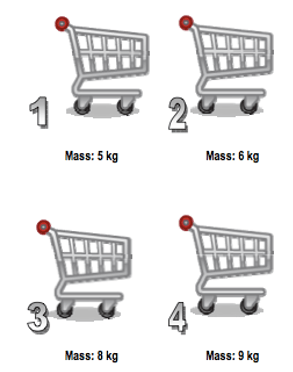
A force of 90N is applied to each cart below, which one will accelerate the fastest?
a)
Cart 1
b)
Cart 2
c)
Cart 3 
d)
Cart 4
39.
What is the SI unit used to measure force? 
a)
pounds 
b)
grams 
c)
newtons 
d)
kg/ m2
40.
Unbalanced forces make an object:
a)
Come to rest
b)
move at constant velocity
c)
accelerate
d)
explode
41.
A basketball with a mass of 0.60 kg is accelerated with a force of 10.8 N. If resisting forces are ignored, what is the acceleration of the basketball to the nearest m/s2?
a)
16 m/s2
b)
17 m/s2
c)
18 m/s2
d)
19 m/s2
42.

If a force of 50 Newton's was applied to an object with a mass of 500 grams, what will the object's acceleration be? (HINT - UNITS!)

a)

10 m/s^2

b)

.1 m/s^2

c)

100 m/s^2

d)

1 m/s^2

43.

An object is accelerating.

a)

Thrust and friction forces are equal and opposite

b)

Thrust force > Friction force

c)

Friction force > Thrust force

d)

Thrust and friction forces are equal and act in the same direction

44.

An object is travelling at constant speed.

a)

Thrust and friction forces are equal and opposite

b)

Thrust force > Friction force

c)

Friction force > Thrust force

d)

Thrust and friction forces are equal and act in the same direction

45.

An object is decelerating.

a)

Thrust and friction forces are equal and opposite

b)

Thrust force > Friction force

c)

Friction force > Thrust force

d)

Thrust and friction forces are equal and act in the same direction

46.

Mass = 4 kg and a = 0.2 ms-2. Calculate the force.

a)

8N

b)

80 N

c)

2 N

d)

0.8N

47.

Force = 20 N and Mass = 4 kg. Calculate the acceleration.

a)

80 N

b)

80 ms-2

c)

5 ms-2

d)

0.2 ms-2

48.

Force = 25 N and Mass = 5 kg. Calculate the acceleration.

a)

5 ms-2

b)

125 ms-2

c)

30 ms-2

d)

4 ms-2

49.

Describe the motion of this car

a)

accelerating to the left

b)

decelerating to the left

c)

travelling at constant speed

d)

at rest (stopped)

50.

Describe the motion of the lawn mower

a)

constant speed

b)

accelerating

c)

at rest / stationary

d)

decelerating

51.

What is the net force in the horizontal direction?

a)

3200 N

b)

6400 N

c)

0 N

d)

12000 N

52.

What is the net force to the right?

a)

5000 N

b)

2000 N

c)

0 N

d)

3000 N

53.

Which would hit a wall with a greater force, a car or bus with the same acceleration?

a)

car

b)

bus

c)

both the same

54.

Why does a car accelerate faster with just the driver, compared to driver + 3 passengers?

a)

Car and driver has less mass than car, driver + 3 passengers

b)

Car and driver has more mass than car, driver + 3 passengers

c)

Car has less friction (drag)

d)

Car is accelerating faster

55.

A 2 kg brick is pulled by a force of 10N. Friction force is 4 N. What is the acceleration?

a)

3 N

b)

3 ms-2

c)

5 ms-2

d)

2 ms-2

56.

F=ma. If force is kept the same but the mass is doubled, then the acceleration will....

a)

stay the same

b)

be halved

c)

be doubled

d)

be zero

57.
The weight of an object _________ as it moves away from the center of Earth.
a)
increases
b)
stays the same
c)
triples
d)
decreases
58.
What is the definition of "weight"?
a)
measure of the force of gravity on your body
b)
the time it takes to get on a ride 
c)
the amount of matter in an object
d)
the size of an object
59.
A measure of how much matter an object has is--
a)
weight
b)
gravity
c)
mass
d)
volume
60.

Which is the smallest measurement of mass?

a)

gram

b)

milligram

c)

kilogram

61.
Objects with greater _________ also have greater inertia.
a)
speed
b)
mass
c)
temperature
d)
friction
62.
Because of inertia, a resting object will remain at ________.
a)
rest
b)
a constant speed
c)
school
d)
inertia 
63.
Because of inertia, a moving object will keep ________.
a)
at rest
b)
moving
c)
in one spot
d)
inertia 
64.
What kind(s) of objects have inertia?
a)
all objects with mass
b)
only objects at rest
c)
only objects in motion
d)
only objects whose motion is being changed
65.
An object in motion tends to stay in motion unless an ___ force acts on it.
a)
unbalanced
b)
balanced
66.
What is the tendency of an object to resist a change in motion?
a)
coffee
b)
motion
c)
inertia
d)
gravity