wayground logo

Free Printable Worksheets

Font size

S
M
L
XL
Worksheets

Newton's Laws

Total questions: 61

Worksheet time: 49mins

Name
Class
Date
1.
A sled sliding on a flat, icy surface with a constant velocity is best described by
a)
Newton’s first law of motion for objects at rest.
b)
Newton’s first law of motion for objects in motion.
c)
Newton’s second law of motion.
d)
Newton’s third law of motion.
2.
A person steps out of the boat and onto the dock.  As the person moves forward onto the dock, the boat moves backward.  Which statement best describes the backward motion of the boat as the person steps forward?
a)
For every action there is an equal and opposite reaction.
b)
Every mass exerts a force on every other mass.
c)
An object at rest tends to stay at rest.
d)
Friction opposes the motion of an object.
3.
Which of these best describes why your weight (on Earth) would change on another planet?
a)
weight doesn’t change, no matter where you are
b)
different planets have different gravitational pulls
c)
In general, the smaller the planet, the greater weight
d)
dehydration effects on different planets change weight
4.
An empty truck and a fully loaded truck are next to each other at a traffic light. When the light turns green, the lighter truck increases speed more quickly. Which of these best explains this situations
a)
Newton's first law
b)
Newton's second law
c)
Newton's third law
d)
Conservation of momentum
5.
What is the name of the units that we measure force in?
a)
Einsteins 
b)
Newtons
c)
Kg
d)
Metres
6.
What will cause an object to move?
a)
Applied forces
b)
Balanced forces
c)
Unbalanced forces
7.
If an object is stationary (not moving) the forces acting upon it are _____________
a)
unbalanced
b)
weak
c)
balanced
d)
Hulk Smash!
8.
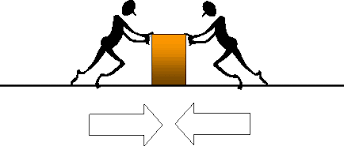
Which one is balanced?
a)
top
b)
bottom
c)
both
9.

A ____________ is a push or a pull on an object.

a)

friction

b)

force

c)

magnet

d)

gravity

10.
The sum of all forces acting on an object.
a)
Contact Force
b)
Balanced Force
c)
Unbalanced Force
d)
Net Force
11.

Suppose that an astronaut throws a baseball in outer space at a location far from significant influences of gravity and air resistance. One would expect that the baseball would ____.

a)

eventually stop since all objects ultimately "lose their steam"

b)

eventually stop as its inertia slowly becomes used up

c)

continue in motion with the same speed and direction

d)

either a, b, or c -- depending on whether the astronaut continues to push it

12.

All objects have inertia

a)

True

b)

False

13.

Inertia depends on ______

a)

Velocity

b)

Speed

c)

Distance

d)

Mass

14.

A skateboard rolls down a hill, reaches the level surface and eventually comes to a stop. The fact that the skateboard ultimately stops is best explained by ____.

a)

an unbalanced force would be required to keep the sled moving forward at constant speed

b)

the presence of an unbalanced force (e.g., friction) can cause a moving object to stop

c)

the presence of inertia causes it to stop

d)

the natural tendency of any object is to ultimately stop

15.

Mac and Tosh are arguing in the cafeteria. Mac says that if he flings the jello with a greater speed it will have a greater inertia. Tosh argues that inertia does NOT depend upon speed, but rather upon mass. Who is correct?

a)

Mac

b)

Tosh

c)

Neither

d)

Both

16.

More mass = More inertia

a)

True

b)

False

17.

the tendency of an object to resist a change in its motion

a)

acceleration

b)

inertia

c)

mass

d)

frame of reference

18.
Objects with greater _________ also have greater inertia.
a)
speed
b)
mass
c)
temperature
d)
friction
19.

A force has both strength and _____.

a)

power

b)

direction

c)

color

d)

balance

20.
Which of the following is a unit for acceleration?
a)
km/s
b)
m/s2
c)
mi/hr
d)
ft
21.
Acceleration only takes place when things speed up. 
a)
True
b)
False
22.
When a car goes around a corner at 20 mph, why do we say it  accelerates?
a)
The car is accelerating because of the velocity is constant
b)
The car accelerates because it's going 20 mph
c)
Cars always accelerate when they are in motion
d)
The car is accelerating because it's changing direction
23.
Acceleration only takes place when things speed up. 
a)
True
b)
False
24.
Acceleration can be classified as _______________
a)
Speeding up
b)
Slowing Down
c)
Changing directions
d)
All of the above
25.
This type of force resist motion between two surfaces that are pressed together
a)
contact
b)
gravity
c)
friction
26.
"For every action, there is an equal and opposite reaction."
a)
Newton's 1st Law
b)
Newton's 2nd Law
c)
Newton's 3rd Law
d)
Newton's 4th Law
27.
Force = Mass x Acceleration
a)
Newton's 1st Law
b)
Newton's 2nd Law
c)
Newton's 3rd Law
d)
Newton's 4th Law
28.
The tendency of an object to resist changes in its motion is...
a)
inertia
b)
force
c)
acceleration
d)
velocity
29.
The force that opposes motion between two surfaces in contact with each other.
a)
inertia
b)
friction
c)
momentum
d)
gravity
30.
A force that opposes motion between a surface in contact with the atmosphere.
a)
air resistance
b)
gravity
c)
momentum
d)
terminal velocity
31.
An automobile you are riding in suddenly stops, but you continue to go forward.
a)
Newton's
1st
Law of Motion
b)
Newton's
2nd
Law of Motion
c)
Newton's
3rd
Law of Motion
32.
You push against a wall and the wall is pushing back on you.
a)
Newton's
1st
Law of Motion
b)
Newton's
2nd
Law of Motion
c)
Newton's
3rd
Law of Motion
33.

What is the acceleration of a 50 kg object pushed with a force of 500 newtons?

a)

100 m/s2

b)

25,000 m/s2

c)

10 m/s2

d)

25 m/s2

34.
Which force produces a change in motion?
a)
unbalanced force
b)
balanced force
c)
gravitational force
d)
frictional force
35.
A crumpled piece of paper hits the ground before a flat sheet of paper because
a)
the acceleration of gravity is greater on the  crumpled paper.
b)
there is more air resistance against the flat paper.
c)
the crumpled paper is more massive
d)
the crumpled paper is less massive.
36.
A sled sliding on a flat, icy surface with a constant velocity is best described by
a)
Newton’s first law of motion for objects at rest.
b)
Newton’s first law of motion for objects in motion.
c)
Newton’s second law of motion.
d)
Newton’s third law of motion.
37.
The gravitational force of any object near Earth's surface is ____.
a)
unknown
b)
friction
c)
Newton's first law
d)
9.8 m/s2
38.
A magician pulls a tablecloth out from under dishes and glasses on a table without disturbing them.
a)
Newton's 1st Law
b)
Newton's 2nd Law
c)
Newton's 3rd Law
d)
None of them
39.

A pulling force exerted along a rope, string, wire, cable...

a)

Friction

b)

Gravity

c)

Normal

d)

Tension

40.

The gravitational attraction between an object and the Earth.

a)

Friction

b)

Weight

c)

Normal

d)

Tension

41.

Which of Newton's Laws describes the relationships between Force, mass and acceleration.

a)

1st

b)

2nd

c)

3rd

42.

Which of Newton's Laws says that objects tend to maintain a constant velocity unless acted on by an unbalanced force.

a)

1st

b)

2nd

c)

3rd

43.

Which of Newton's Laws states that forces always come in pairs that are equal and opposite to one another.

a)

1st

b)

2nd

c)

3rd

44.

A swimmer pushes backward on the water in order to move forward. This is an example of Newton's ________ Law.

a)

1st

b)

2nd

c)

3rd

45.

A shopping cart accelerates more slowly when full. This is an example of Newton's ________ Law.

a)

1st

b)

2nd

c)

3rd

46.

When a driver slams on the brakes, passengers fly forward. This is an example of Newton's ________ Law.

a)

1st

b)

2nd

c)

3rd

47.

A person is pushed forward into their seatbelt when a car stops. Which of Newton's Laws explains this?

a)

1st

b)

2nd

c)

2 and 3

d)

3rd

48.
What is Newton's First Law known as? The Law of
a)
Friction
b)
Mass
c)
Inertia
d)
Gravity
49.
What is Newton's First Law
a)
F=ma
b)
Every action has an equal and opposite reaction
c)
An object at rest stays at rest, an object in motion stays in motion. 
d)
Friction 
50.
What can a force do?
a)
all of the above
b)
start a motion
c)
stop a motion
d)
change the direction of the motion
51.
Which law explains why when you put a book on a table the table pushes on the book
a)
3rd law
b)
4th law
c)
1st law
d)
2nd law
52.
If you double the mass of an object with the same force apply on it, the acceleration will
a)
double
b)
cut in half
c)
the same
d)
zero
53.
What kind(s) of objects have inertia?
a)
all objects with mass
b)
only objects at rest
c)
only objects in motion
d)
only objects whose motion is being changed
54.
Which one needs a greater net force to move, a kilogram of feathers or a kilogram of iron? 
a)
feathers 
b)
iron
c)
same
d)
depends on their friction
55.
A book weighs 4 N. When held at rest in your hands, the net force on the book is
 
a)
0 N.
b)
 0.4 N.
c)
 4 N.
d)
 39 N.
56.
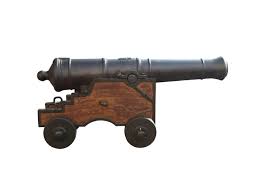
When a cannon fires a cannonball we observe Newton's third law. Which force is the reaction force?
a)
The cannon moving forward
b)
The cannonball moving forward
c)
The cannon moving backward
d)
The cannonball moving backward
57.
What is the difference between mass and weight?
a)
mass is how much matter is in an object, and weight is the gravitational pull on that object
b)
mass and weight are the same
c)
weight affects how much mass is in an object
d)
weight is determined by how many atoms make up an object
58.
What is the name of the units that we measure force in?
a)
Einsteins 
b)
Newtons
c)
Kg
d)
Metres
59.
An object at rest will remain at rest unless acted on by an unbalanced force. An object in motion continues in motion with the same speed and in the same direction unless acted upon by an unbalanced force.
a)
Newton's 1st Law
b)
Newton's 2nd Law
c)
Newton's 3rd Law
d)
None of them
60.
Acceleration is produced when a force acts on a mass. The greater the mass (of the object being accelerated) the greater the amount of force needed (to accelerate the object).
a)
Newton's 1st Law
b)
Newton's 2nd Law
c)
Newton's 3rd Law
d)
None of them
61.
For every action there is an equal and opposite reaction.
a)
Newton's 1st Law
b)
Newton's 2nd Law
c)
Newton's 3rd Law
d)
None of them