Wayground logo

Free Printable Worksheets

Font size

S
M
L
XL
Worksheets

MAAP Review Center 2

Total questions: 37

Worksheet time: 35mins
Name
Class
Date
1.
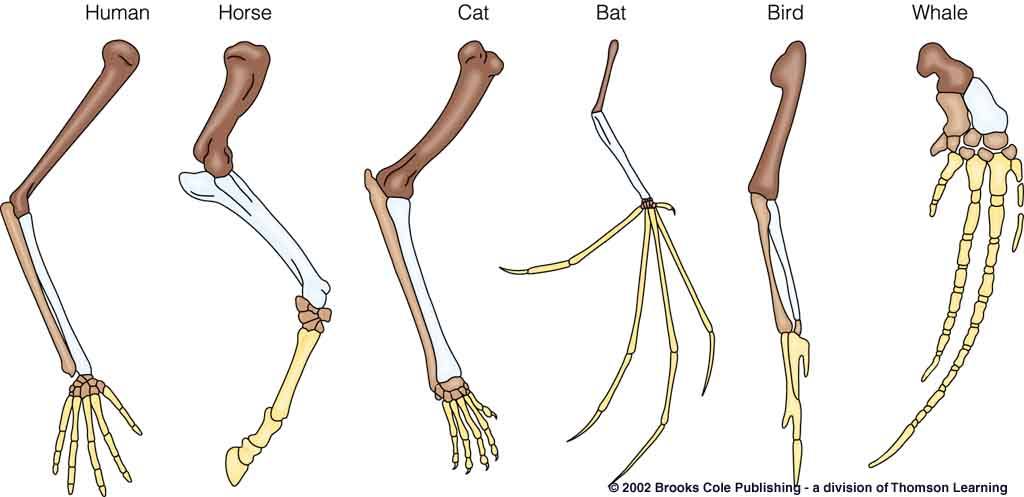
Humans, birds, whales, and lizards all have similar arm bones. What is the reason for this?
a)
The function of these bones is the same in all animals
b)
They live in similar environments
c)
They have a common ancestor
d)
All organisms resemble humans
2.
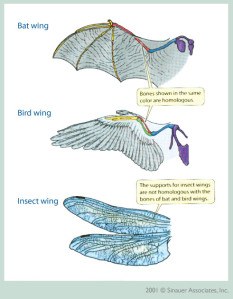
The structures shown are_________
a)
homologous
b)
heterologous
c)
analogous
d)
vestigial
3.
An example of a homologous structure 
a)
human arm and bird wing
b)
rat appendix  and human appendix
c)
wing of butterfly and bird wing
4.
  The diagram shows an image of a Pterosaur wing, bat wing, and bird wing.  These are all different organisms, but share similar wing structures.  If these structures are similar due to common ancestry, which of the following best describes them?
a)
a.  Vestigial Organ
b)
b.  Embryological Similarities
c)
c.  Homologous Structures
d)
d.  Analogous Structures
5.

Which of the following are vestigial structures humans have? Select all that apply.

a)

Appendix

b)

Tailbone

c)

Forearm bones

d)

Goosebumps

6.

Whales have pelvic bones. What type of structure does this best represent?

a)

Homologous structure

b)

Analogous structure

c)

Vestigial structure

d)

None of the above

7.
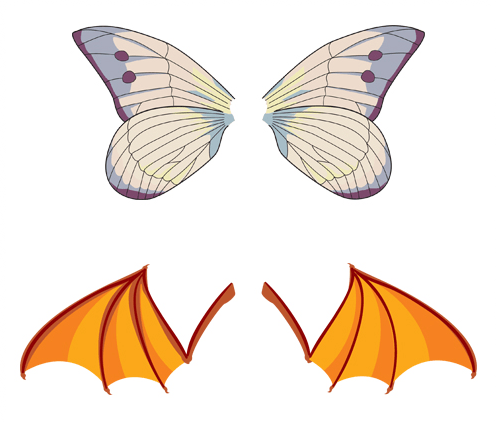
Bird wings and butterfly wings are an example of
a)
Homologous structure
b)
Analogous structure
c)
Mimicry
d)
Camoflague
8.
Shark fins and dolphin fins are examples of analogous structures.
a)
True
b)
False
9.
How would you describe this evolution?
a)
Homologous structure
b)
Analogous structure
c)
Structural adaption
d)
Functional adaption
10.
States that younger rocks lie above older rocks if the layers have not been disturbed
a)
Law of crosscutting
b)
Law of superposition
c)
Relative Dating
d)
Unconformity
11.
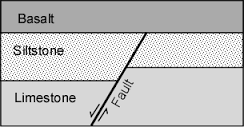
How does the law of crosscutting explain the age of a fault?
a)
The fault is younger than the rocks above it.
b)
The fault is younger than the rocks it cuts through.
c)
The fault is older than the rocks above it.
d)
The fault is older than the rocks it cuts through.
12.
What are the relative ages of the features in order from oldest to youngest?
a)
Limestone, Basalt, Fault, Siltstone
b)
Siltstone, Fault, Basalt, Limestone
c)
Limestone, Fault, Basalt, Siltstone
d)
Limestone, Siltstone, Fault, Basalt
13.
Which of the following is the oldest?
a)
Layer L
b)
Intrusion D
c)
Intrusion H
d)
Layer E
14.

What rock in the Oldest?

a)

Conglomerate

b)

Shale

c)

Breccia

d)

Sandstone

15.
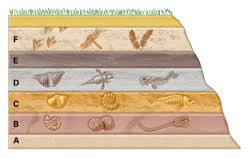
Which rock layer in the diagram seems to be the oldest?
a)
F
b)
E
c)
B
d)
A
16.
According to the law of superposition, which layer is the youngest?
a)
A
b)
B
c)
C
17.
According to the law of superposition, the oldest fossils are found 
a)
At the top of the rock layers
b)
Near the bottom of the rock layers
c)
In the middle of the rock layers
d)
Somewhat near the surface
18.
Which of the following correctly lists the layers in order from oldest to youngest?
a)
A, B, C, D, E
b)
E, B, C, D, A
c)
E, D, C, B, A
d)
C, B, A, D, E
19.

Which layer is OLDER? Layer M or Intrusion P?

a)

Layer M

b)

Intrusion P

20.

Which layer is OLDER? Layer E or Intrusion A?

a)

Layer E

b)

Intrusion A

21.

Which layer is OLDER? Fault E or Intrusion D?

a)

Fault E

b)

Intrusion D

22.

Which layer is OLDER? Intrusion M or Layer D?

a)

Intrusion M

b)

Layer D

23.
Which rock layer contains the newest fossils?
a)
F
b)
E
c)
B
d)
C
24.
The best index fossils have which two traits?
a)
widespread geographically, long lifespan
b)
widespread geographically, short lifespan
c)
specific place, long lifespan
d)
specific place, short lifespan
25.
Which of the following organisms formed last on Earth?
a)
Jellyfish
b)
Shark
c)
Lizards
d)
Horses
26.
To be considered an index fossil, it had to have lived for a relatively short period of time.
a)
True
b)
False
27.
Which fossil makes the best index fossil?
a)
Fossil 1
b)
Fossil 2
c)
Fossil 3
d)
None follow all of the rules
28.

What is the best reason that fossil #4 is NOT a good index fossil?

a)

It is not widespread

b)

it is not short-lived (in numerous layers)

c)

It is in half of the outcrops

29.

If you found an index fossil in a layer of rock in Montana and a similar fossil in a layer of rock in Texas, you would know that:

a)

the fossils and rock layers are the same age

b)

the fossils from Montana are older

c)

the fossils from England are older

d)

none of the above

30.

What can the fossil record tell us?

a)

history of life on Earth

b)

groups of organisms changed over long periods of time

c)

Information about the past climate of our Earth

d)

information about the past environments and changes of the Earth's surface

e)

all of these are correct

31.

Examine the image here. Hint: Use the slides to get a better view. Gastropods appeared on Earth ____________ ammonites.

a)

before

b)

after

32.
What are the 3 major types of rocks?
a)
Igneous, Metamorphic, Sedimentary
b)
Metamorphic, Igneous, Cementation
c)
Brown, Red, Gray
d)
Streak, Hardness, Breakage
33.
This rock formed when bits of other rocks became pressed into a solid. What type of rock is it?
a)
Sedimentary Rock
b)
Metamorphic Rock
c)
Igneous Rock
34.
This rock was formed when molten rock cooled into a solid. What type of rock is it?
a)
Igneous Rock
b)
Metamorphic Rock
c)
Sedimentary Rock
35.
When sediments are pressed together tightly, this is called ____________.
a)
Compaction
b)
Cementation
c)
Weathering
d)
Erosion
36.
The process by which metamorphic rocks are formed...
a)
heat and pressure
b)
erosion and deposition
c)
melting and cooling
37.
The name rock is given when it is broken down into smaller pieces.
a)
texture
b)
weathering
c)
sediment
d)
erosion