wayground logo

Free Printable Worksheets

NEW

Font size

S
M
L
XL
Worksheets

Classification and Ecology review

Total questions: 54

Worksheet time: 1hrs 1mins

Name
Class
Date
1.
A frog eats a fly. The frog and fly are demonstrating ________.
a)
mutualism
b)
competition
c)
predator/prey
d)
parasitism
2.
A relationship between two organisms in which one organism benefits and the other is unharmed
a)
Mutualism 
b)
Competition
c)
Parasitsm 
d)
Commensalism 
3.
The crocodile and bird have a _______________ relationship.  The crocodile benefits by having its teeth cleaned.  The bird benefits by gaining food and protection.  Both animals benefit from this relationship.
a)
parasitism
b)
predator and prey
c)
mutualism
d)
commensalism
4.
a relationship in which two different organisms live in close association with each other
a)
mutualism
b)
commensalism
c)
symbiosis
d)
parasitism
5.
Part of the earth that living organisms inhabit...
a)
biosphere
b)
biome
c)
niche
d)
ecosystem
6.
Which of the following is a population?
a)
hawks, barred owls, and eagles on NC coast
b)
mountain stream
c)
all the frogs in a pond
d)
blue-tailed skinks (lizards) around a barn
7.
A tapeworm and a cat have this type of relationship.
a)
mutualism
b)
parasitism
c)
commensalism
d)
competition
8.
Barnacles create home sites by attaching themselves to whales. This neither harms nor benefits the whales.  What kind of relationship is this?
a)
Mutualism 
b)
Parasitism 
c)
Commensalism 
9.
A collection of organisms that make up a community as well as all of the nonliving aspects of the environment.
a)
Population
b)
Community
c)
Habitat
d)
Ecosystem
10.
What is it called when you have groups of different populations along with their abiotic factors?
a)
An organism
b)
A population
c)
A community
d)
An ecosystem
11.
Which domain includes all animals and plants?
a)
Archaea
b)
Eukarya
c)
Bacteria
12.
Who organized living things by creating binomial nomenclature?
a)
Carolus Linnaeus
b)
Robert Hooke
c)
Anton van Leeuwenhoek
d)
James Watson
13.
A collection of organisms that belong to different populations but all live in the same area and interact with one another.
a)
Population
b)
Ecosystem
c)
Community
d)
Ecosphere
14.
What is the science of organizing, classifying and naming living things.
a)
taxonomy
b)
taxadermy
c)
taxicab
d)
toxicology
15.

The temperate deciduous forest, the tropical rain forest, the desert, and the tundra are all examples of...

a)

the biopshere.

b)

biomes.

c)

ecosystems.

d)

communities.

16.
Which of the following best describes a community?
a)
sharks, groupers, anemones and shrimp on a coral reef
b)
decorator crabs on the seafloor
c)
loggerhead sea turtles in Atlantic
d)
prairie grassland in Wyoming
17.
The scientific name for water bear is Hypsibius dujardini.  What is its species?
a)
Hypsibius 
b)
dujardini
c)
water 
d)
tardigrade
18.
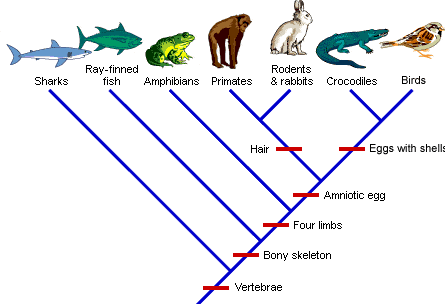
Which two orgainsms have hair? 
a)
Sharks & Ray Finned Fish
b)
Primates & Rodents
c)
Birds & Crocodiles
d)
Rabbits & Birds
19.
How do scientists organize living things?
a)
by looks
b)
by shared characteristics
c)
by size
d)
by differences
20.
The scientific name for an organism is made from the:
a)
class and family name
b)
genus and species name
c)
domain and kingdom name
d)
kingdom and phylum name
21.
Cells that do not have a true nucleus are called....
a)
eukaryote
b)
prokaryote
c)
unicellular
d)
multicellular
22.
Who is the closest relative to the birds?
a)
crocodiles
b)
sharks
c)
fish
d)
amphibians
23.
Which of the following organisms are LEAST closely related?
a)
organisms that share a domain
b)
organisms that share a family 
c)
organisms that share a genus 
d)
organisms that share a species 
24.
The 8 levels of classification, most broad to most specific.
a)
Domain, Genus, Family, Order, Class, Phylum, Kingdom, Species
b)
Domain, Species, Kingdom, Genus, Phylum, Family, Class, Order
c)
Domain, Kingdom, Phylum, Class, Order, Family, Genus, Species
d)
Order, Kingdom, Species, Domain, Phylum, Family, Class, Genus
25.
Who first proposed binomial nomenclature as a way of classifying organisms?
a)
Carl Linnaeus
b)
Carl's Jr.
c)
Charles Darwin
d)
Henry Groseclose
26.
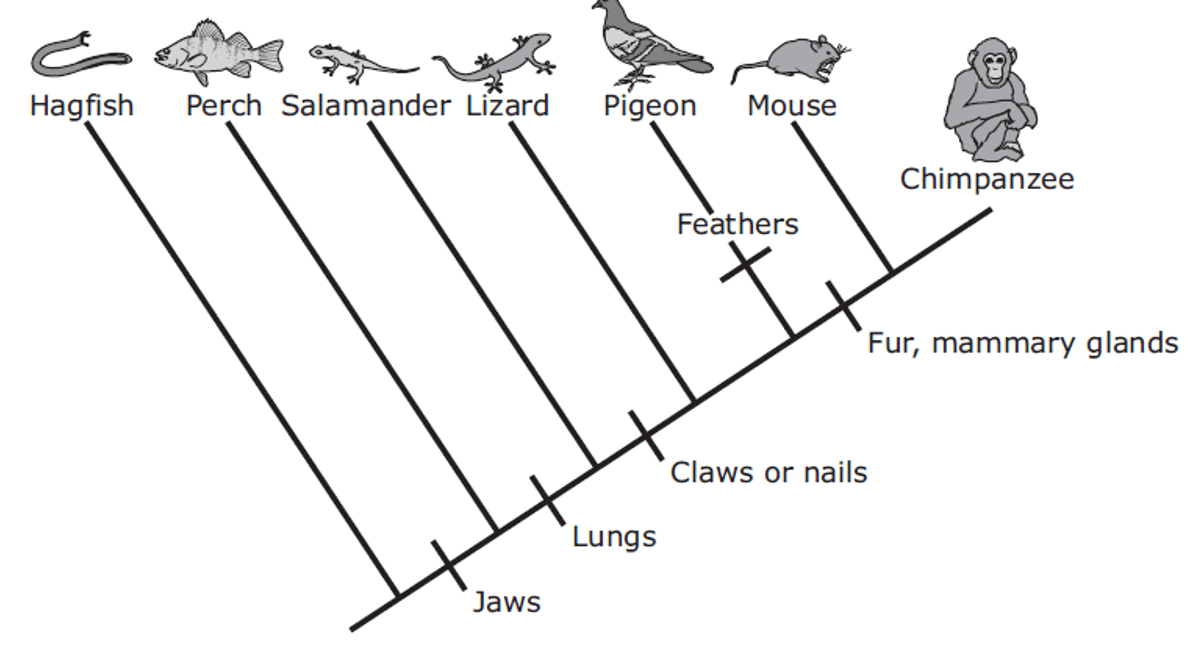
All the animals to the right of the hagfish would have the common characteristic of -
a)
Fur
b)
Claws or nails
c)
Lungs
d)
Jaws
27.
Cells that have a true nucleus are called....
a)
eukaryotes
b)
prokaryotes
c)
unicellular
d)
multicellular
28.
Which organisms are most closely related?
a)
Equus caballas (Horse) & Equus burchellii (Zebra)
b)
Cyanea artica (Jellyfish) &
Ctenodiscus crispatus (Mud Starfish)
c)
Naja naja (cobra) & Glycine max (soya bean)
d)
Ophiocomina nigra (black brittle star) & Brassica nigra (black mustard)
29.

What is the correct order for this food chain?

a)

Owl, Mouse, Grasshopper, Grass

b)

Grass, Mouse, Owl, Grasshopper

c)

Grass, Owl, Grasshopper, Mouse

d)

Grass, Grasshopper, Mouse, Owl

30.
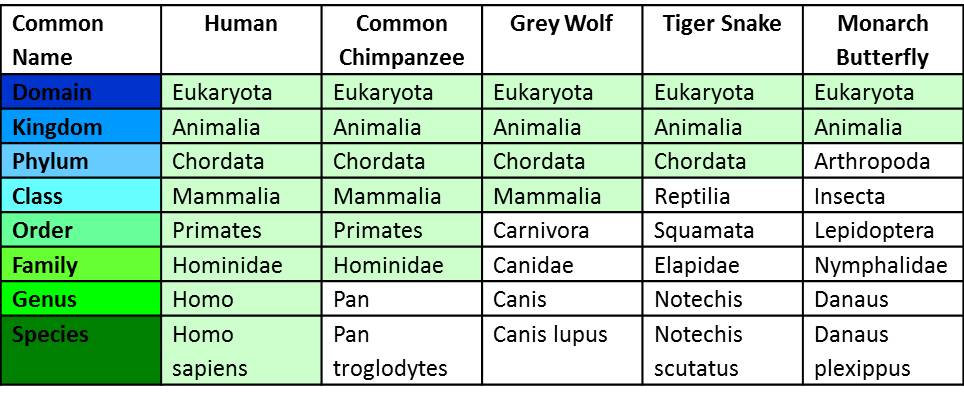
Which organism in the table is least closely related to the chimpanzee?
a)
human
b)
grey wolf
c)
tiger snake
d)
monarch butterfly
31.

What do omnivores eat?

a)

Animals

b)

Plants and Animals

c)

Plants

d)

Dead Animals

32.
An illustration and a dichotomous key are given. What is the correct classification for this organism?
a)
Class Insecta
b)
Order Amblygygi
c)
Order Araneae
d)
Order Scorpiones
33.

Place the levels of environment in the correct order.

a)

biome, biosphere, population, organism, ecosystem,community

b)

organism, ecosystem, biosphere, population, community, biome

c)

organism, population, community, ecosystem, biome, biosphere

d)

population, community, organism, biome, ecosystem, biosphere

34.

Which of these organisms is the secondary consumer?

a)

Owl

b)

Mouse

c)

Grass

d)

Grasshopper

35.

What is the hawk in the food web?

a)

Producer

b)

Primary consumer

c)

Secondary consumer

d)

Tertiary consumer

36.
What is the role of fungi in food webs?
a)
scavenger
b)
bacteria
c)
producer
d)
decomposer
37.
What may happen if the snowshoe hare was removed from the food web pictured?
a)
The insects in the habitat would increase.
b)
The shrew population would decrease due to being only hawk food source.
c)
The willow tree population would decrease.
d)
Foxes would dies due to no food source. 
38.

How much energy is transferred between trophic levels?

a)

25%

b)

20%

c)

10%

d)

90%

39.

Which of the following characteristics do Archaea and bacteria have in common?

a)

They both live in extreme environments.

b)

They both reproduce asexually.

c)

They are both eukaryotic.

d)

They are both multicellular.

40.

Which of these is an autotroph?

a)

Consumer

b)

Producer

c)

Decomposer

41.
What is the original source of almost all energy in most ecosystems?
a)
carbohydrates
b)
sunlight
c)
water
d)
carbon
42.
In the food web shown, the snail would be considered...
a)
primary consumer
b)
secondary consumer
c)
tertiary consumer
d)
producer
43.

What characteristic do Plants, Eubacteria, and Fungi share?

a)

They are all eukaryotic.

b)

They are all multicellular.

c)

They all have a cell wall.

d)

They are all photosynthetic.

44.

grass --> grasshopper --> sparrow --> hawk

In the food chain above, which organism would be found on level B of the energy pyramid shown?

a)

grass

b)

grasshopper

c)

sparrow

d)

hawk

45.

What are the abiotic factors in this image?

a)

water, sunlight, dirt, air

b)

birds and plants

c)

birds, water, dirt

d)

plants, water

46.
Salamanders live in cool, damp places like underneath rocks. This is a description of a salamander's: 
a)
habitat
b)
niche
c)
community
d)
decorating preferences
47.
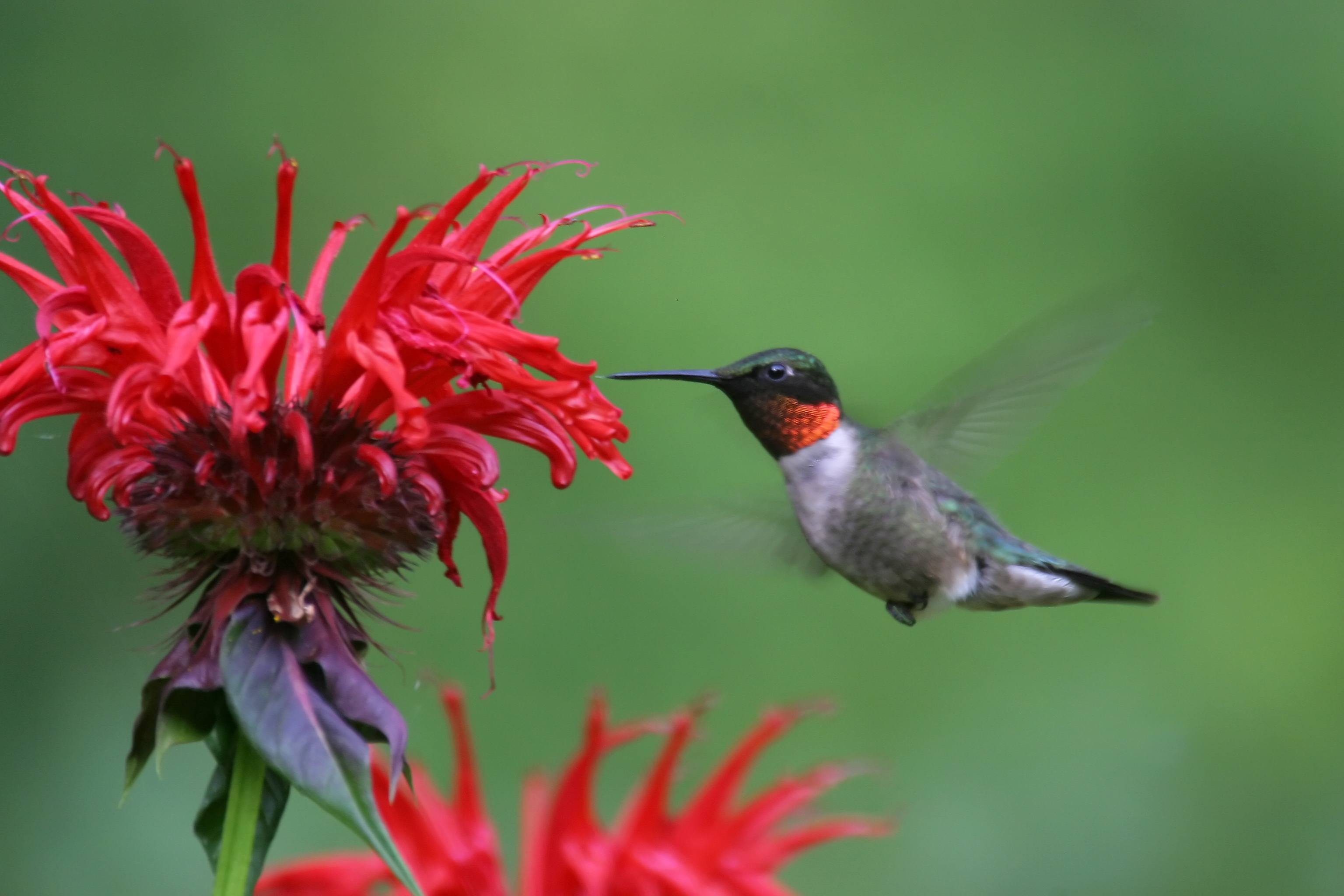
What type of symbiosis?  Hummingbirds feed on nectar from flowers.  The flowers are pollinated by hummingbirds as they move from flower to flower.
a)
commensalism
b)
mutualism
c)
parasitism
d)
predation
48.
What characteristics do algae (plant-like protists) share with plants?
a)
They are heterotrophic decomposers without cell walls.
b)
They are photosynthetic autotrophs without cell walls.
c)
They are heterotrophic decomposers with cell walls.
d)
They are photosynthetic autotrophs with cell walls. 
49.

Into which kingdom should a unicellular, photosynthetic aquatic eukaryote be classified?

a)

Archaea

b)

Eubacteria

c)

Protista

d)

Fungi

50.

Into which kingdom should a prokaryote that lives in an extremely acidic sulfur spring be classified?

a)

Archaea

b)

Eubacteria

c)

Protista

d)

Fungi

51.
Why are fungi, such as mushrooms, NOT classified as plants?
a)
Fungi do not have cell walls.
b)
Fungi are not autotrophs.
c)
Fungi have cell walls.
d)
Fungi are autotrophs.
52.

Which of the following compounds is found in the cell walls of Fungi?

a)

Peptidoglycan

b)

Glycogen

c)

Chitin

d)

Cellulose

53.
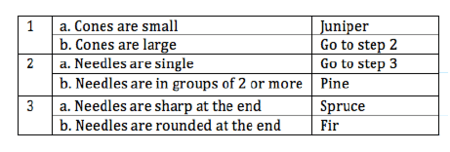
A dichotomous key for trees is provided. Hikers found a tree that has large brown cones and single sharp needles. What species of tree have the hikers found?
a)
Juniper
b)
Pine
c)
Spruce
d)
Fir
54.
A dichotomous key for insects is given. To what order does an insect with two pairs of scaly wings belong?
a)
Coleoptera
b)
Heteroptera
c)
Diptera
d)
Lepidoptera