wayground logo

Free Printable Worksheets

Font size

S
M
L
XL
Worksheets

2021 Semester Exam Review

Total questions: 30

Worksheet time: 18mins

Name
Class
Date
1.

A plane traveling across the country is suddenly met with strong air currents that are pushing with a greater force than the wind before but not greater than the plane. The plane will begin to move....

a)

Slower

b)

Faster

c)

Stop flying

d)

Catch on Fire

2.

Click everything that is true.

a)

Related to Newton's 3rd Law

b)

The greater mass will accelerate farther

c)

The smaller mass will accelerate farther

d)

The ball that will have the greatest change of speed is the smaller ball

e)

The larger the item is the more inertia it has

3.

Which are examples of unbalanced forces?

a)

Constant speed

b)

Stationary

c)

Speed increasing

d)

Speed decreasing

4.

When the race car sped away from the starting line, the driver experienced an acceleration of 32.0 m/s2. If the drivers mass is 58 kg, what is the net force the she experienced? (no decimals, no commas)

(a)  

5.

According to the law of conservation of mass, the mass of the elements on the reactants side should be ______ to the mass of the elements on the product side.

a)

doubled

b)

Less

c)

More

d)

The same

6.

A soccer ball with a mass of .45kg is accelerated with a force of 13.7 N. Without calculating friction, what is the acceleration of the soccer ball? (round to a whole number)

(a)  

7.

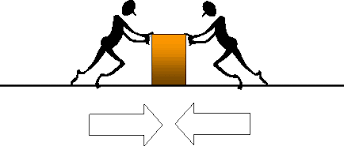
the blue man is pulling the caret with 20 Newtons and the red man is pulling the cart with 85 Newtons. What is the net fore acting on the cart?

a)

105 Newtons

b)

65 Newtons

c)

4.25 Newtons

d)

1700 Newtons

8.

Which are signs of a chemical reaction?

a)

Temperature Change

b)

water cooling

c)

Gas produced (bubbling)

d)

Dissolving

e)

Color change

9.

Potassium (K) has a mass number of 39. How many neutrons would one atom of potassium have?

(a)  

10.

How many Protons does one atom of Potassium (K) have?

a)

39

b)

20

c)

19

d)

a lot

11.

How many valence electrons are in an atom of each element in group 16?

a)

12

b)

6

c)

16

d)

32

12.

In the chemical formula picture above, how many Phosphorous atoms are there in the molecule?

a)

1

b)

3

c)

4

d)

12

13.

How many atoms of each element are in the molecule pictured?

a)

2 carbons, 4 hydrogens, and 1 oxygen

b)

2 carbons, 3 hydrogens, and 1 oxygen

c)

3 Carbons, 3 hydrogen, and no oxygens

d)

2 carbons, 2 hydrogens, and one oxygen

14.

Which two elements are in the same group?

a)

Be and F

b)

Sc and Ti

c)

Li and Cs

d)

Cl and Ar

15.

Which two elements are in the same period?

a)

Be and F

b)

Sc and Y

c)

Li and Cs

d)

Cl and At

16.

What identifies and element?

a)

Neutrons

b)

Mass

c)

Electrons

d)

Protons

17.

How many protons, neutrons, and electrons are found in a single atoms Zinc (atomic number 30)

a)

30 protons, 35 electrons, 30 neutrons

b)

30 protons, 30 electrons, 35 neutrons

c)

35 protons, 30 electrons, 35 neutrons

d)

35 protons, 35 electrons, 30 neutrons

18.

How do you find the mass of an atom?

a)

add atomic number and protons

b)

subtract mass number from the atomic number

c)

Add protons and neutrons

d)

f=ma

19.

Which 2 subatomic particles can be found in the nucleus of an atom? (Check all that apply)

a)

Protons

b)

Neutrons

c)

Electrons

d)

Nucleus

20.
What is the net force?
a)
20 N 
b)
0 N 
c)
400 N 
d)
40 N 
21.
What is Newton's 1st law of motion?
a)
An object at rest stays at rest and an object in motion stays in motion with the same speed and in the same direction unless acted upon by an unbalanced force
b)
F=MxA
c)
For every action there is an equal and opposite reaction
22.
A runners races in the 100 meter dash.  It takes her 10 seconds to finish.  What is her average speed?
a)
10 m/s
b)
1000 m/s
c)
100 seconds
d)
10 seconds
23.
If an object is stationary (not moving) the forces acting upon it are _____________
a)
unbalanced
b)
weak
c)
balanced
d)
Hulk Smash!
24.
During a demonstration of Newton’s laws of motion, a student used the setup shown in Figure 1. The student flicked the index card with a fingertip, and the coin fell straight down into a plastic cup as shown in Figure 2. Which of these best explains why the coin fell straight down into the cup instead of remaining on the index card?
a)
The coin was at rest until the card was removed, so it tended to remain in the same location. Once the card was gone, the unbalanced force of gravity caused the coin to fall.
b)
Moving the card applied an action force on the coin. Since the card was gone, gravity applied a reaction force on the coin.
c)
The card had less mass than the coin, so a smaller force of gravity acted on the card. The larger force of gravity on the coin made it fall.
d)
The acceleration of the coin falling into the cup was equal and opposite to the acceleration of the card.
25.
The masses of four vehicles and the net forces acting on them as they enter a highway are recorded in the table below. Which vehicle has the greatest acceleration as it enters the highway?
a)
Sedan
b)
Coupe
c)
SUV
d)
Truck
26.
Newton’s first law of motion, applied to a book sitting on a table, would explain that the book will not move until which of the following conditions is met?
a)
Gravity on the book can be reduced to zero
b)
Unbalanced forces act on the book
c)
Balanced forces act on the book
d)
Friction being exerted on the book
27.
Two cars with different masses travel at the same speed down a hill toward a stop sign. What will happen when both cars apply brakes at the same time to stop?
a)
The car with the smaller mass will require less forces to stop than the car with the larger mass.
b)
The car with the larger mass will amintain its velocity while traveling down the hill.
c)
The car with the smaller mass will take longer to stop than the car with the larger mass.
d)
The car with the larger mass will have less inertia than the car with the smaller mass.
28.

According to Newton's Second Law, How do you calculate force?

a)

Multiply mass and acceleration

b)

Divide mass by acceleration

c)

Divide acceleration by mass

d)

Divide force by mass

29.

According to Newton's Second Law, How do you calculate acceleration?

a)

Multiply mass and acceleration

b)

Divide force by acceleration

c)

Divide acceleration by mass

d)

Divide force by mass

30.
How many Sodium atoms are in the compound 6NaCl?
a)
1
b)
12
c)
6
d)
4