Worksheets
Civics Midterm Practice EOC Questions
Total questions: 60
Worksheet time: 43mins
Why did the Founding Fathers separate the power to make, enforce, and interpret laws between
different branches of government?
Consider this situation: On January 25, 2011, widespread pro-democracy demonstrations began in Egypt. For 18 days, hundreds of thousands of Egyptians took to the streets, demanding free elections, free speech, and an end to government corruption, police brutality, and President Hosni Mubarak’s regime. Finally, on February 11, Mubarak resigned. Which of the following ideas expressed in the U.S. Declaration of Independence best supports the actions of the Egyptian people?
What is the most likely reason it was difficult to pass laws under the Articles of Confederation?
The Preamble of the Constitution lists six goals, including which of the following?
What is meant by “the rule of law”?
Why is it important for citizens to pay taxes?

Which statement most accurately explains the significance of the excerpt?
to the people.
Which of the following best describes the purpose of the Bill of Rights?
What would be the most likely consequence to society if citizens began refusing to fulfill their citizenship responsibilities?
People would face the threat of losing their individual rights and freedoms.
People would have more free time because they would have fewer social obligations.
People would benefit from the direction of strong leaders who would guard their freedoms.
People would find that society was able to look after itself with the help of civic participation.
Which of these is one of the legal requirements for becoming a citizen?
registering to vote
paying income taxes
having relatives in the United States
living in the United States at least five years
How does rule of law affect U.S. government officials and institutions?
It holds government officials and institutions accountable to the law.
It requires government officials and institutions to create new laws.
It prevents government officials and institutions from making their work public.
It ensures government officials and institutions are exempt from laws.
What is the term used in the Fourteenth Amendment to describe persons who are born or naturalized in the United States?
Aliens
Citizens
Immigrants
Residents

This graph shows the number of naturalized U.S. citizens from 2000 to 2008.
Source: U.S. Citizenship and Immigration Services
Which of the following statements can be inferred from this graph?
Naturalization has become less popular than it was in the past.
Naturalization has steadily increased voter turnout.
Naturalization laws have become increasingly strict over time.
Naturalization leads to a larger pool of voters.
Which viewpoint was common among Anti-Federalists?
There is no need for a separate Bill of Rights.
The Constitution does not give enough power to the states.
The Constitution will not strengthen the government.
A strong national government will protect the people in times of crisis.
Which of the following was a weakness of the Articles of Confederation?
The government did not have a separate judicial branch.
The judicial branch of government was too strong.
The president was able to spend taxes too freely.
The government had too much power over trade.
Which of the following facts describes federalism?
Power is divided among legislative, executive and judicial branches.
Power is divided amongst the two main political parties.
Citizens in the United States are subject to both state and federal laws.
Citizens in the United States are protected by the Bill of Rights.
“We hold these truths to be self-evident, that all men are created equal, that they are endowed by their Creator with certain inalienable rights, that among these are life, liberty and the pursuit of happiness. That to secure these rights, governments are instituted among men, deriving their just powers from the consent of the governed.”
What is one of the basic purposes of government in the United States as stated above in the excerpt from the Declaration of Independence?
to protect the rights of individuals
to protect the power of the government
to provide property to individuals
to keep criminals in federal prisons
In 1836, the countries of Bolivia, North Peru, and South Peru attempted a government system in which the three countries created a loose union that shared power as well as ruled themselves independently. Which system of government is being represented?
Confederal
Federal
Democratic
Parliamentary
Why did the writers of the Articles of Confederation set up a weak central government? (1.5)
to encourage more trade between the states
to preserve the powers of the individual states
to promote national security against foreign invastion
to permit the taxation of citizens to pay the nation's debt
When the President negotiates a treaty, it must be approved by the Senate in order to be valid. This is an example of (1.7)
limited government
popular sovereignty
separation of powers
checks and balances

The diagram describes a cause that led to the writing of the Declaration of Independence. Which action completes the diagram?
British eliminate all taxes on colonists
Colonists vote to elect new member of Parliament
British ignore colonist grievances
Colonist send troops to Britain in protest
How did the U.S. Constitution address the problem under the Articles of Confederation that Congress had no power to ensure its laws were followed by the states?
It created an executive branch to enforce laws.
It gave each state sovereign authority over its laws.
It required the president to resolve disputes between states.
It required unanimous consent of states to create new laws.
What does the phrase "insure domestic tranquility" in the Preamble of the Constitution mean?
Give land to the homeless
Fight wars on foreign soil
Keep the homeland at peace
Provide citizens with insurance

SS.7.C.1.8
Use the quotation to answer the question.
Which group did Patrick Henry most likely side with during the ratification debate?
the Loyalists
the Federalists
the Antifederalists
the Constitutionalists

The passage attached about government is from Federalist No. 51.
How are the author's views from this passage applied in the U.S. Constitution?
The U.S. Constitution limits the rights of the people.
The U.S. Constitution limits the power of the federal government.
The U.S. Constitution requires the states to provide for the common defense.
The U.S. Constitution requires the government to promote the general welfare.
What pamphlet denounced British rule and fanned the flames of revolution?
Magna Carta
Two Treatises of Government
Compact
Common Sense
Use the quotation to answer the question.
“THE HORRID MASSACRE IN BOSTON, Perpetrated in the evening of the fifth day of March, 1770, by soldiers of the Twenty-ninth Regiment, which with the Fourteenth Regiment were then quartered there; with some observations on the state of things prior to that catastrophe.” —anonymous account, A Short Narrative of the Horrid Massacre in Boston, 1770
Who is the most likely author of this passage?
a Redcoat, to describe the risks faced by soldiers
a Patriot, to raise fears about the British army in the colonies
a Loyalist, to gain support for quartering British troops
an eyewitness, to promote nonviolent protest

SS.7.C.1.7
Use the table to answer the question.
Which of the following best completes the title of this table?
The Federal System
Separation of Powers
Checks and Balances
Popular Sovereignty
Which Enlightenment philosopher influenced Thomas Jefferson during his writing of the Declaration of Independence?
Baron de Montesque
Mrs Corrigan
Thomas Paine
John Locke
What is one of the reasons the Mayflower Compact was a great influence on the colonists?
It outlined how the colonists would trade with the Native Americans
It declared our loyalty to Britain
It helped to limit the power of the king in the new world
It was the first example of self-government in the new world

SS.7.C.1.8
Use the information in the box to answer the question.
Who are the speakers and what are they afraid of?
Patriots; ineffective government
Federalists; the loss of liberty
Antifederalists; a strong national government
Loyalists; the loss of property rights

The statements above are from the Declaration of Independence.
Which statement reflects the Enlightenment ideas of natural law as expressed by Locke?
A
B
C
D
What is a government that is run by the people, either directly or indirectly?
Democracy
Oligarchy
Autocracy
Communism
Which of the following accurately describes one way an amendment to the U.S. Constitution may be proposed?
Two-thirds of Congress votes to propose.
Two-thirds of citizens nationwide vote to propose.
Three-fourths of state legislatures vote to propose.
Three-fourths of Congress votes to propose.
What did many American colonists use Thomas Paine's Common Sense to justify?
Acts of sabotage against British merchants
Declaring independence from Britain
Joining the army instead of the militia
Supporting the British monarchy
One way the Senate can check or limit the power of the President is to
reject a presidential cabinet appointment.
limit the President to one term in office.
deny an executive order.
ratify a treaty without the President.
Which of the following facts describes federalism?
Power is divided among legislative, executive and judicial branches.
Power is divided amongst the two main political parties.
Citizens in the United States are subject to both state and federal laws.
Citizens in the United States are protected by the Bill of Rights.
The fact that the US Congress can override a presidential veto is an example of
judicial review
separation of powers
advice and consent
checks and balances
“We the People of the United States, in order to form a more perfect union, establish justice, ensure domestic tranquility, provide for the common defense, promote the general welfare and secure the blessings of liberty to ourselves and our posterity do ordain and establish this Constitution for the United States of America.”
The purpose of the Preamble to the United States Constitution is to
outline the purpose of US government.
establish the rights of citizens.
create a domestic policy plan.
define the responsibilities of the three branches.
What is one reason why the Mayflower Compact is considered to be a significant historical document?
because it outlined how the colonists would trade with the Native Americans
because it declared our loyalty to Britain
because it gave women rights among the first settlements in New England.
because it was the first social contract of the New World.
“We hold these truths to be self-evident, that all men are created equal, that they are endowed by their Creator with certain inalienable rights, that among these are life, liberty and the pursuit of happiness. That to secure these rights, governments are instituted among men, deriving their just powers from the consent of the governed.”
What is one of the basic purposes of government in the United States as stated above in the excerpt from the Declaration of Independence?
to protect the rights of individuals
to protect the power of the government
to provide property to individuals
to keep criminals in federal prisons
Which is true about both amendments added to the Constitution and Supreme Court decisions?
right after the decision, everything changes immediately
people and states ignore the decisions and nothing ever changes
change does not always come instantly, but over time, and with citizens' effort
people and states change at first, then things go back to the way they were
Marbury v. Madison established the power of judicial review. What is judicial review?
The power of the president to veto bills
The power of the court to overrule previous rulings
The power to appoint federal judges
The power of the Supreme Court to declare laws and acts unconstitutional

The passage attached about government is from Federalist No. 51.
How are the author's views from this passage applied in the U.S. Constitution?
The U.S. Constitution limits the rights of the people.
The U.S. Constitution limits the power of the federal government.
The U.S. Constitution requires the states to provide for the common defense.
The U.S. Constitution requires the government to promote the general welfare.
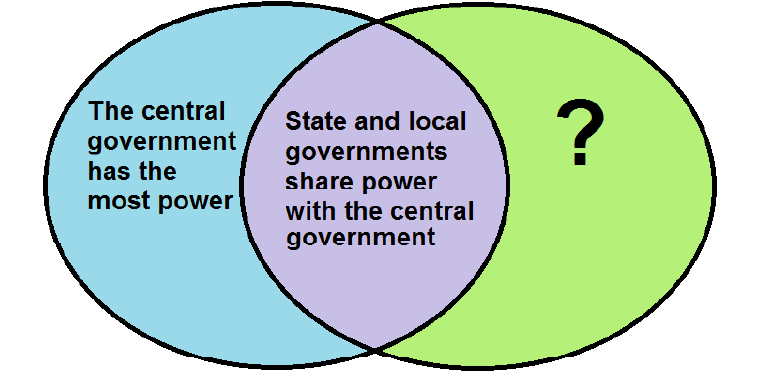
This diagram shows two different forms of government. Which statement completes the diagram?
In a confederal system, city governments have the most power.
In a confederal system, international associations have the most power.
In a confederal system, state governments have the most power.
In a confederal system, the people have the most power.
How are the responsibilities of the legislative and executive branches of government different when it comes to treaties?
U.S. Senate proposes treaties; the president carries out foreign treaties.
U.S. Senate negotiates foreign treaties; the president approves treaties.
U.S. Senate carries out foreign treaties; the president proposes treaties.
U.S. Senate ratifies treaties; the president negotiates foreign treaties.
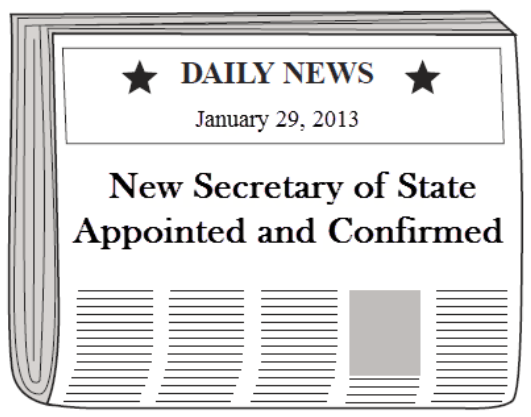
The newspaper headline below describes an event in U.S. history. Which parts of the national government participated in the process described in the newspaper headline?
Senate and president
House of Representatives and Senate
Supreme Court and president
Supreme Court and House of Representatives
Why is a formal amendment process important?
To prevent the Supreme Court from being eliminated
To keep some states from being too powerful
To allow the Constitution to be adjusted as times change
To give the president a role in changing the government
What was impact of John Locke’s views on natural law on the Founding Fathers?
It encouraged them to create a government based on a separation of powers.
It encouraged them to compromise with the British Parliament.
It encouraged them to preserve the system of trial by jury.
It encouraged them to challenge British laws.
Which belief did the colonists hold based on rights granted by Magna Carta?
All human beings are entitled to certain natural rights.
The king only rules over his subjects by their consent.
New taxes cannot be imposed on subjects without their approval.
All criminals must be tried in England rather than in the colonies.
The idea that people have the rights to fair and reasonable laws, and that the government leaders and officials have to follow rules when enforcing laws and treat all people in the same way
Limited Government
Rights
Due Process
Self Government

What was the significance of the stamp on the newspaper?
It demonstrated that Parliament ignored colonists media communications.
It represented the colonists' opposition to English tax policies
It demonstrated that Parliament controlled the colonists' press outlets
It represented the colonists' fulfillment of English tax policies.
"We hold these truths to be self-evident, that all men are created equal..." Which document contains this passage?
Declaration of Independence
English Bill of Rights
Articles of Confederation
U.S. Constitution
According to the Declaration of Independence, where does government get its power?
From the King
From God
From the courts
From the people
First came colonial independence, then _______, Shay's Rebellion, and then the Constitutional Convention. What is missing?
Declaration of Independence
U.S. Constitution
Articles of Confederation
Whiskey Rebellion
Which weakness of the Articles of Confederation led to Shay's Rebellion?
The national government lacked the power to tax
Executive regulation of farm trade
The national government lacked a national court system
Debt relief was enacted
Which of the following phrases from the Preamble is best described by saying: "Everyone deserves to be treated fairly!"
domestic tranquility
common defense
establish justice
form a more perfect union