
 Worksheets
Tropical Rainforests
Total questions: 36
Worksheet time: 18mins
How much of Earth’s surface is covered by tropical rainforests?
3 percent
5 percent
10 percent
25 percent
Where are tropical rainforests located?
Near the equator
In the Pacific Ocean
On every continent
In the southern hemisphere
Which rainforest layer receives the most sunlight?
Understory
Forest floor
Canopy
Emergent layer
The canopy contains the most of the _____ in the rainforest.
Fungi
Air
Animals
Soil


Which map best shows the location of tropical rainforests?
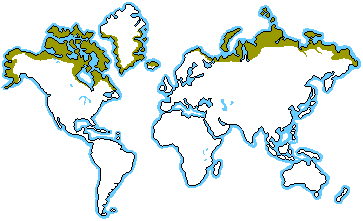
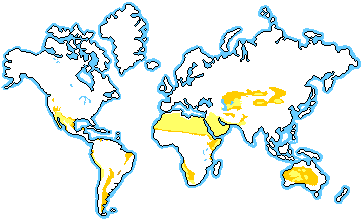
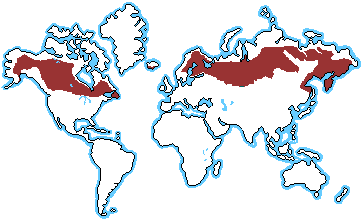
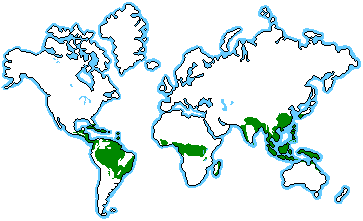
Most tropical rainforests are located in a band around which line of latitide?
Tropic of cancer
equator
Tropic of Capricorn
Arctic circle
Antarctic circle
What percentage of all biodiversity (plants and animals) is found in rainforests?
5-10%
20-30%
40-50%
70-80%
In the rainforest, the temperature range is very small.
True
False
Which of the following statements bests describes the location of the tropical rainforest. Select all correct answers.
Along the west coasts of the continents.
Along the Equator.
Latitudes north and south of the tropics.
Within the tropics of Cancer and Capricorn.
How would you describe the soils of the tropical rainforest?
Deep and rich in nutrients.
Thin and poor in nutrients.
Where are most of the nutrients locked up in the rainforest? Select all correct answers.
The soil.
The biomass - the living vegetation and animals.
The litter - dead wood, leaves, and animal remains on the ground.
What cycle is being described - a set of processes whereby plants extract minerals necessary for growth from the soils and water, which are then passed on through the food chain and ultimately then return back to the soil and water.
The Carbon Cycle
The Water Cycle
The Nutrient Cycle
The Food Cycle

Why is energy lost at each stage of the food chain? Select all correct answers.
Energy is used within each trophic level for life processes such as breathing, movement and keeping warm.
Not all the plant / animal at a given trophic level is eaten.
Faeces and remains are passed onto decomposers.
Which of the following are adaptations of plants in the tropical rainforest?
Drip tip leaves
Buttress roots
Succulents
Large leaves
Which of the following are causes of deforestation in Brazil?
Logging
Commercial farming - cattle ranching
Road building - e.g. The Trans Amazonian Highway
Loss of indigenous tribes
Reduced biodiversity
Which of the following are local strategies to combat deforestation.
Increased cattle ranching
Replanting projects
Agroforestry - growing tree crops and food crops in the same area.
Selective logging - where young trees are left and allowed to mature (cycle between 30-40 years)
Ecotourism
How many layers are there in the rainforest?
3
4
5
6
Fungi and microorganisms breaking down dead plants and animals is called?
Nutrient cycle
Nutrient recycling
Decomposition
Decaying
Rainforests are located in the continents of?
Africa
South America
Europe
Antarctica
What is the tallest layer of vegetation called?
Shrub layer
Undercanopy
Emergents
Canopy
At rainforests, air is rising and forming clouds. This creates...
High pressure
Low pressure
Where are tropical rainforests found?
30*N and S
At high latitudes
Along the Equator/between the tropics
In every continent on Earth
What are the tall roots called in a rainforest?
Buttress roots
Liana roots
Epiphyte roots
Canopy roots
What is the main cause of deforestation?
Logging
Cattle ranching
HEP
Mining
Why do trees in rainforests have buttress roots?
To get moisture from the air
To provide stability to the tall trees
To get nutrients from deep in the soil
To prevent leaves rotting

