wayground logo

Free Printable Worksheets

NEW

Font size

S
M
L
XL
Worksheets

Course Review: Physics

Total questions: 68

Worksheet time: 3hrs 39mins

Name
Class
Date
1.
A 50 kg ball rolls down the street at 5 m/s. Calculate the momentum of the ball. 
a)
55 kg*m/s
b)
100 kg*m/s
c)
250 kg*m/s
d)
500 kg*m/s
2.
Peanut ran 50 meters in 10 seconds.  What was Peanut's average speed?
a)
2 m/s
b)
5 km/h
c)
5 m/s
d)
5 m/s North
3.
The average speed of this object between points C and D is
a)
.375 km/s
b)
.375 m/s
c)
2.67 km/s
d)
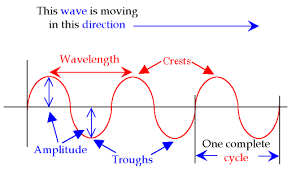
2.67 m/s
4.
The average speed between 4 and 16 seconds is?
a)
5.2 km/s
b)
.192 m/s
c)
.181 km/s
d)
5.5 km/s
5.
A ball rolls down a steep hill. It travels 500 m in 1 minute. It then rolls on a flat surface for an additional 3 minutes and travels 300 m. What is the average speed of the ball?
a)
.5 m/min
b)
100 m/min
c)
200 m/sec
d)
200 m/min
6.
D-Lo watches a red buggy car, which is his favorite activity. He watches the car cover 2 meters every second. Which graph would represent this?
a)
A (upper left)
b)
B (bottom left)
c)
C (upper right)
d)
D (bottom right)
7.
Which graph shows an object not moving?
a)
A
b)
B
c)
C
d)
D
8.
Which graph shows an object moving at a constant rate?
a)
A
b)
B
c)
D
d)
E
9.
Which graph shows an object increasing speed?
a)
A
b)
B
c)
D
d)
E
10.
Which graph shows an object going back to the start position?
a)
A
b)
B
c)
C
d)
D
11.
Which graph shows an object slowing down?
a)
A
b)
B
c)
C
d)
E
12.
How long will your trip take (in hours) if you travel 350 km at an average speed of 80 km/hr? 
a)
80 hours
b)
.22 hours
c)
4.38 hours
d)
6
13.
A trip to Cape Canaveral, Florida takes 10 hours. The distance is 816 km. Calculate  the average speed. 
a)
8 km/hr
b)
81.6 km/hr
c)
.012 km/hr
d)
61.8 km/hr
14.
A ball rolls down a steep hill. It travels 500 m in 1 minute. It then rolls on a flat surface for an additional 3 minutes and travels 300 m. What is the average speed of the ball?
a)
.5 m/min
b)
100 m/min
c)
200 m/sec
d)
200 m/min
15.
Which graph shows an object slowing down?
a)
A
b)
B
c)
C
d)
E
16.

This Meniscus reads __________, and is a ____________ meniscus.

a)

29 ml, Convex

b)

29 ml, Concave

c)

29.5 ml, Convex

d)

29.5 ml, Concave

17.

This Meniscus reads __________, and is a ____________ meniscus.

a)

41 ml, Convex

b)

41 ml, Concave

c)

45 ml, Convex

d)

45 ml, Concave

18.

If the Length = 4 cm, Width = 2 cm, and Height = 2 cm, what is the volume of this object? (V = L W h)

a)

4 ml

b)

8 ml

c)

16 ml

d)

32 ml

19.

If the radius = 3 cm, and height = 3.5 cm, what is the volume of this object? (V = π r2 h)

a)

10.5 ml

b)

21 ml

c)

63 ml

d)

99 ml

20.
Convert 8 kilometers to meters
a)
800 m
b)
80,000 m
c)
8,000 m
d)
.008 m
21.
42 L = ___mL
a)
4,200
b)
.0042
c)
4.20
d)
42,000
22.
1000 grams = _____ kilograms
a)
0.0001
b)
1,000,000
c)
10
d)
1
23.
Convert 17 m to cm:
a)
0.17 cm
b)
0.017 cm
c)
1,700 cm
d)
170 cm
24.
7,000 g = ____ kg
a)
70
b)
700
c)
7
d)
0.07
25.
1 cm = ________mm
a)
1
b)
100
c)
10
d)
1000
26.

How many minutes are in a school year, 187 days?

a)

269,280 min.

b)

16, 200 min.

c)

16, 156 min.

d)

269,000 min.

27.

The blue triangle is pointing at...

a)

12 cm

b)

117 mm

c)

11.5 mm

d)

12 inches

28.

The red dot is measuring exactly how many millimeters?

a)

7

b)

70

c)

700

d)

2 and 3/4

29.
An automobile you are riding in suddenly stops, but you continue to go forward.
a)
Newton's
1st
Law of Motion
b)
Newton's
2nd
Law of Motion
c)
Newton's
3rd
Law of Motion
30.
If a 10 kilogram object accelerates suddenly at 15 m/s^2, how much force was applied to the object?
a)
150 Newtons
b)
15 Newtons
c)
150 kilograms
d)
100 kilograms
31.
The mass of a car is 1000 kg.  How much force would be required to accelerate the car at a rate of 3 m/s2? 
a)
1000 ÷ 3
b)
3 ÷ 1000
c)
1000 x 3
32.
A 5 kg block is pulled across a table by a net force of 32 N. Calculate the acceleration of the object. To solve this problem you must do - 
a)
32 ÷ 5
b)
5 ÷ 32
c)
32 x 5
33.
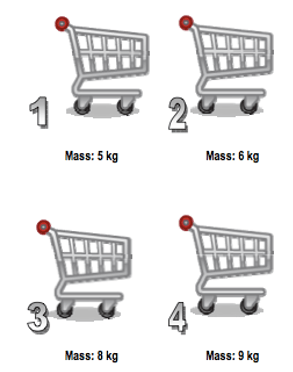
A force of 90N is applied to each cart below, which one will accelerate the fastest?
a)
Cart 1
b)
Cart 2
c)
Cart 3 
d)
Cart 4
34.

You kick a football while wearing sandals and sprain your big toe...

a)

Newton's First Law

b)

Newton's Second Law

c)

Newton's Third Law

d)

Not enough information

35.

You high five a friend really hard, it hurts you both because...

a)

Newton's First Law

b)

Newton's Second Law

c)

Newton's Third Law

d)

Not enough information

36.
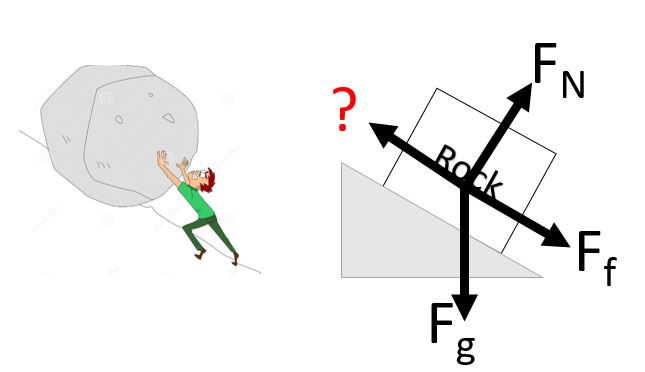
Name the missing force...
a)
applied force
b)
weight force
c)
lift
d)
normal force
37.
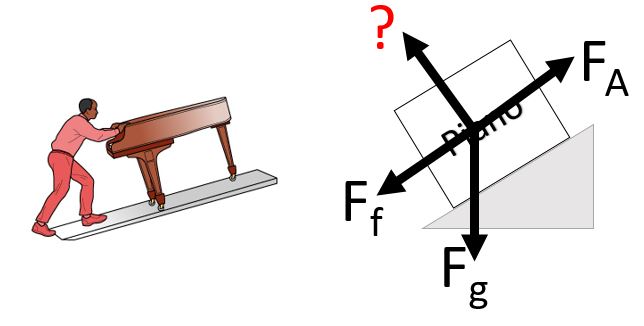
Name the missing force...
a)
tension force
b)
frictional force
c)
normal force
d)
spring force
38.
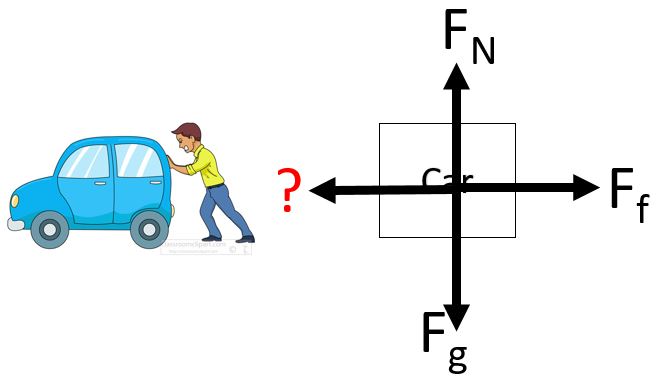
Name the missing force...
a)
normal force
b)
applied force
c)
frictional force
d)
tension force
39.
Name the missing force...
a)
applied force
b)
weight force
c)
tension force
d)
drag
40.
What is the magnitude (size) and direction of the net force?
a)
15 N to the left
b)
15 N to the right
c)
1 N to the left
d)
1 N to the right
41.
What is the magnitude (size) and direction of the net force?
a)
14 N Down
b)
14 N Up
c)
6 N Up
d)
6 N Down
42.
Calculate the Acceleration.
a)
8
b)
1
c)
.125
d)
5
43.
Calculate the net force.
a)
600 N
b)
66.7 N
c)
.015 N
44.

One hertz is equal to:

a)

1 cycle or wave per second

b)

the distance from crest to crest or trough to trough

c)

the distance from one rarefaction to the next rarefaction.

d)

the maximum displacement of the wave

45.

What is the kinetic energy of a 1-kilogram ball thrown into the air with an initial velocity of 30 m/sec?

a)

15 Joules

b)

30 Joules

c)

250 Joules

d)

450 Joules

46.

How much gravitational potential energy does a 100kg (220lb.) skydiver have if they jump from 4000 meters?

a)

3920000 J

b)

294 J

c)

180000 J

d)

1225 J

47.

You connect only wire B to the negative battery terminal...

a)

Nothing Happens

b)

Only Bulb 1 lights up

c)

Only Bulb 2 lights up

d)

Both bulbs light up and the compass deflects

48.

You connect wire B to the negative battery terminal, and Wire A to the positive battery terminal...

a)

Nothing Happens

b)

Only Bulb 1 lights up

c)

Only Bulb 2 lights up

d)

Both bulbs light up and the compass deflects

49.

You connect wire B to the negative battery terminal, and Wire A to the positive battery terminal. What does the compass do?

a)

Nothing Happens

b)

Red needle points West

c)

Red needle points East

d)

Red needle points South

50.

Amplitude of this wave...

a)

0.2 m

b)

0.4 m

c)

3 m

d)

6 m

51.

Wavelength of this wave...

a)

0.2 m

b)

0.4 m

c)

3 m

d)

6 m

52.

Assume the distance (x-axis) is actually time. And the visible time is 7.5 seconds. What is the frequency of this wave?

a)

0.2 Hz

b)

0.4 Hz

c)

0.33 Hz

d)

0.66 Hz

53.

How far did this object travel in the fist 3 seconds?

a)

18 meters

b)

18 feet

c)

18 miles

d)

18 kilometers

54.

According to the shape of this graph, the object is...

a)

Accelerating

b)

Slowing down

c)

Not moving

d)

A dog running

55.

How long did it take to travel 50 meters?

a)

5 seconds

b)

5 minutes

c)

3 seconds

d)

3 minutes

56.

What is the average speed between 0 and 50 seconds?

a)

10 meters per second

b)

5 meters per second

c)

80 meters per second

d)

3 meters per second

57.

How fast is this object moving between 2 and 3 seconds?

a)

10 meters per second

b)

5 meters per second

c)

It's not moving at all

d)

Pretty slow if you think about it

58.

What is the acceleration rate between 10 and 15 seconds?

a)

10 meters per second per second

b)

5 meters per second per second

c)

10 meters per second

d)

5 meters per second

59.

What is the acceleration rate between 2 and 3 seconds?

a)

10 meters per second per second

b)

0 meters per second per second

c)

5 meters per second per second

d)

-5 meters per second per second

60.
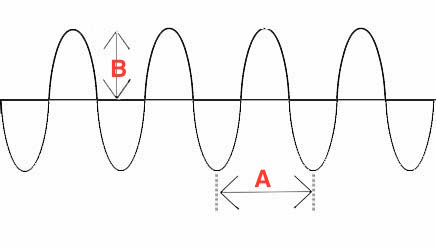
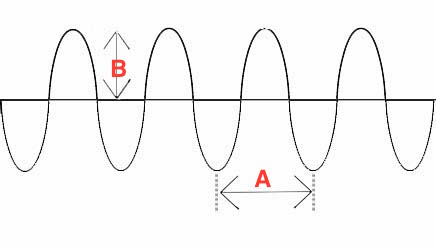
What property of this wave is represented by the letter "A"
a)
amplitude
b)
crest
c)
trough
d)
wavelength
61.
What property of the wave is represented by the letter "B"?
a)
amplitude
b)
crest
c)
trough
d)
wavelength
62.

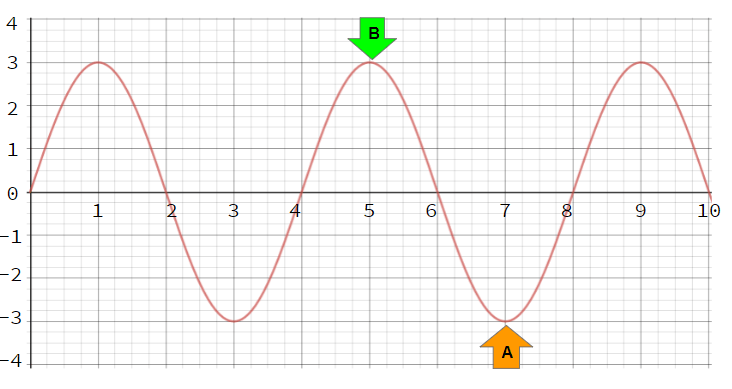
What property does the orange arrow (A) represent?

a)

Crest

b)

Trough

c)

Wavelength

d)

Peak

63.

One hertz is equal to:

a)

1 cycle or wave per second

b)

the distance from crest to crest or trough to trough

c)

the distance from one rarefaction to the next rarefaction.

d)

the maximum displacement of the wave

64.

A moving wave would be considered...

a)

Kinetic energy

b)

Potential Energy

c)

Potential and Kinetic Energy

d)

Large in most cases

65.

R1 is a bulb and burns out...

a)

Only R2 and R5 stop working

b)

Only R3 and R4 stop working

c)

Only R1 stops working

d)

All bulbs stop working

66.

R2 is a bulb and burns out...

a)

Only R2 and R5 stop working

b)

Only R2 and R4 stop working

c)

Only R2 stops working

d)

All bulbs stop working

67.

R4 is a bulb and burns out...

a)

Only R2 and R5 stop working

b)

Only R3 and R4 stop working

c)

Only R4 stops working

d)

All bulbs stop working

68.

R5 is a bulb and burns out...

a)

Only R2 and R5 stop working

b)

Only R3 and R4 stop working

c)

Only R4 stops working

d)

All bulbs stop working