
Font size
 Worksheets
Social Studies Midterm
Total questions: 259
Worksheet time: 3hrs 6mins
Name the ways scientists date fossils.
Radioactive Dating
Cuneiform Dating
Irrigation
Comparative Dating
The time before things were recorded or written down.
Ziggurat
Pre-history
Surplus
Neolithic
Anything made and used by humans.
(a)
What are 2 technologies used during the Paleolithic era?
Stone tools
wheel
plow
fire
Which is NOT a way they used fire?
heat
Irrigation
weapon-making
protection
The era that contained 99% human existence.
Neolithic era
Zhou Dynasty
Paleolithic era
Copper Age
The era we are currently existing in.
Neolithic era
Zhou Dynasty
Paleolithic era
Copper Age
Anthropology is...
the study of how humans behave.
the reason early humans migrated.
a closely interconnected group of people or things.
what they used to reach Australia.
Fossils are...
dated by scientists.
the oldest thing on earth
public works
shares in a bank
What does NOT make up a person's environment?
Climate
Geography
Plants
Religion
Why did early humans migrate?
Because they could
They didn't
Climate change
Just no
I don't know and I don't care

What changes occurred when people went from hunting and gathering to developing agriculture?
Click ALL options that are correct.
People settled in permanent communities
People migrated to follow their food source
People grew their own food
People domesticated plants and animals


During the Paleolithic Age, people were...
Scientifics.
Nomads.
Hunters.
Gatherers

What is the meaning of NOMADS?
They didn't live in one place.
They stay always in the same place.
They were constantly on the move in search of animals to hunt
They buy food on the supermarket.

How did they live?
In tribes.
In towns.
In small groups formed by families.
In caves.
What type(s) of evidence do historians have to verify that events in prehistory actually occurred?
Tools.
All of these.
Pictures.
Fossils.

What are three characteristics of the Paleolithic Age? Choose the BEST choice!
Hunting and gathering, Nomadic, uncivilized.
Hunting and gathering.
Nomadic warderers.
Farmers and Herders.

What are artifacts?
Are remains of living things (plants, animals, people).
They are a type of food.
Are remains of things that were made (tools).

The Paleolithic humans made...
Metal tools.
Wooden tools.
Stone tools.

Paleolithic people discovered...
Metal
Fire
Water
Electricity

The Paleolithic people used fire to...
Cook.
To light the dark caves.
To keep dangerous animals away.
To paint.

Which of them is associated with agricultural development?
Paleolithic
Neolithic
Stone Age
Metal Age
What is pre-history?
The period before history
The period before writing
The period after Jesus
The period before Jesus
The study of the past through what people left behind is called:
Archaeology
Anthropology
Architecture
Radio Carbon Dating
Remains of things that people made are called:
Fossils
Artifacts


silt


An empire is _____________
a state containing several countries or territories.
a name of a popular TV show.
another word for a city-state.
a tall building in New York City.

What is an ally? Select two answers.
An ally is a small street between houses.
A girl's name.
Someone who has your back.
An ally is an independent state that works with other states to achieve a shared military or political goal.

An idea or way of doing things that is common in a certain culture is called _______________.
an ally.
a cultural trait.
a code of laws.
tendency.

One of the oldest set of laws, it governed life in the Babylonian Empire.
The US Constitution.
the Ten Commandments.
Hammurabi's Code
My mommy's rules.

The idea that all members of society, rich or poor, weak or powerful, must obey the law of the land.
Civil Law
Distributive Property
Pythagorean Theorem
Rule of Law

What do they call a stone monument to a king with writing on it?
statue
stele
bust
tapestry

Why are the poorest always at the bottom of the Social Pyramid?
Someone has to be on the bottom so they selected the poor.
Because the teacher said so.
It is just ordered that way.
There are always more people than middle class and the wealthy class so that section is the biggest.

People have laws to ______________.
to make kings rich.
set rules and guidelines to help people settle disputes and to keep people in order and well-behaved for the good of the people.
have a closer relationship with their gods.
to make middle school kids upset because they can't do what they want to do anymore.

The Rule of Law says that everyone must obey the law. But does everyone benefit from the law that same way?
Yes, because all laws in America are based on laws written in religious writings.
Yes, because all laws must be equal and fair.
No, because rich people tend to have laws written to benefit them more than the poor people.
No, because the king can change is mind.

The fertile land between and around the Tigris and Euphrates Rivers form what archaeologists call __________________.
Mesopotamia
Mesoamerica
Middle Earth
Microzoology

Kings were in charge of their own _________________.
business.
body images.
temples.
city-states.

What is POLYTHEISM?
The belief that you have to sacrifice animals to please your city's god.
The belief in one true god.
Using too much plastic.
The belief in more than one god.
A series of rulers all from the same family
A team
A party
A group
A dynasty
The Aryans
Believed by many historians to be the greatest king of the Mauryan Dynasty
Chandragupta Maurya
Asoka
Siddhartha Guatma
Alexander the Great
Kalidasa
Buddhist Shrines
Synagogues
Cross
Hail Mary's
Stupas
An important writer of the Gupta period
Kalidasa
Aryabhata
Chandragupta
Siddartha
Who founded the Mauryan Empire?
Asoka
Chandragupta Maurya
Alexander the Great
Kalidasa
What did the military ruler Asoka do when he walked over the battlefield one day and saw so much bloodshed?
Devoted his life to peace and the Buddha
Readied his army for another attack
Converted to Hinduism
walked away and became a monk
The Gupta Empire grew wealthy through_____________________
War
Robbing
Trade
Racing
Who conquered India before Chandragupta?
Akkadians and Assyrians
Persia and Alexander the Great
Persia and Egypt
Alexander the Great and Cleopatra
Chandragupta founded his empire on what river?
Ganges
Indus
Nile
Euphrates
Capital city of the Mauryan Dynasty
Salem
Jerusalem
Cairo
Pataliputra
Mark ALL that kept Chandragupta Maurya on the throne
Good communication system
Spy system
Social Media
Stong army
Asoka banned Hinduism from India
True
False
Assyria should conjure ideas and images of...
brutal warriors in reliefs on the walls of Ninevah
a peaceful group who lived in the middle of the Mediterranean
sea-faring people
people to the south of Egypt who were conquerors
Part of the Assyrian's tactics included:
chemical weapons
biological weapons
spreading rumors of their terror before they conquered
mostly naval attacks
Part of the Assyrian's tactics included:
chemical weapons
biological weapons
spreading rumors of their terror before they conquered
mostly naval attacks
A siege is
a very heavy rain in the Indus valley
an encampment around a city in which a systematic attack takes place
a naval tactic in which the invaders hide their ships until the native ships attack
stone weaponry converted to warfare by the Assyrians
Interestingly, Assyrians also:
had a peace festival and invited their neighbors
collected a library of the works of those conquered, particularly called Ashurbanipal's Library
maintain a modern country and army that continues the empire
were defeated by Babylon
Babylon was revived under the rule of ____, often called the ____ Babylon.
Medea, the Fifth
Ashurbanipal, Medo-
the Chaldeans, Neo-
Crescent Empire, Next-
The difference between Persian Empire governance and other empires was:
the complete elimination of the old culture
the complete elimination of population
the intensity of terror used in administration of conquered people as slaves
the offer of tolerance and diplomacy with military presence to back it up

This is an artist's rendering of
a fancy ziggurat
the Palace of Sennacherib
the Hanging Gardens of Babylon
Babylonian Temple Motif
The Persian King who conquered territory making it an empire initially was:
Xerxes
Menes-Chaldo
Cyrus
Darius
Which of the following is NOT a part of successful Persian governance of a people?
satraps and Inspectors of the King to assure loyalty
Royal Road and network of roads for trade and military
tolerance of the people's culture and religion
mass execution of threatening rebellion leaders
Taxes and tributes

Where was Phoenicia located?
Mesopotamia
Along the Black Sea
Along the Mediterranean Sea
In Sumer

What little critter was very important to the Phoenicians?
clams
slugs
snails
shrimp

What were some of the important natural resources available to the Phoenicians?
clay and sand
fresh water and minerals
silver and gold
snails and cedar trees

Since this civilization of people lived near the sea, they became experts at...
sailing and trading
swimming and traveling
fishing and sailing
building boats and fishing

The Phoenicians dominated _______ trade across the Mediterranean.
land
all
sea
air

The Phoenicians location
Asia
Europe
Africa
Australia


The purple dye that the Phoenicians were famous for came from...
juice from berries.
liquid from snails.
a special kind of tree sap.
ink from squid.

What is Phoenicia called today?
Libya
Lebanon
Israel
Mesopotamia

How many symbols did their writing system have?
22
26
28
32

Tyrian purple is the name of this product
rare and expensive dye
fine linen
metalworking
carved ivory

This was the largest colony founded by the Phoenicians
Cree
Rome
Athens
Carthage

The Phoenicians were from where?
Syria
Babylon
Sumer
Phoenicia

the art of steering a ship from place to place
import
navigation
export
colony


The Phoenicians used cedar trees to....
make paper
build their homes
build beautiful furniture

What did Phoenicians manufacture?
wood ships
metal ships
flat ships
iron ships


A (a) is a risky or dangerous trip.

What does the word "profit" mean?
something that fits well
money made from an item after expenses are paid
trading money for goods
to pay off a debt
What river was the Ancient Indus Valley Civilization built around?
Nile River
Yellow River
Tigris River
Indus River
What language did the Ancient Indus people use?
Sanskrit
Calligraphy
Undecipherable
Cuneiform
What type of religion did the Indus have?
Polytheistic
Monotheistic
Pantheistic
Atheistic
What type of religion did the Indus have?
Polytheistic
Monotheistic
Pantheistic
Atheistic
Which was a major city in the Indus Valley?
Babylon
Harappa
Thebes
Ninevah
What major architectural work was built in Mohenjo-daro?
The Great Bath
The Great Wall
The Great Hall
The Great Tower
What do archaeologists believe the Great Bath was used for?
A community pool for the kids.
Ritual drownings to appease the gods.
Ritual bathing/cleansing ceremonies.
Practice area for the Indus Synchronized Swimming Team.
What group took over the places left behind by the Indus?
The Assyrians
The Aryans
The Egyptians
The Chinese
What happened to the Indus Civilization?
A massive earthquake destroyed their cities.
A horrible plague swept through, killing everyone.
They went to war against the Greeks and were destroyed.
No one knows for sure, but possible climate change or invasion.
What were the cities of the Indus River Valley like?
They were unplanned messes.
They were laid out in a grid pattern.
They had drainage and sewer systems.
They had uneven brick homes.

What is a strong, seasonal wind that brings heavy rain to southern Asia?
hurricane
tsunami
monsoon
typhoon
What prevented ancient India from having much contact with other civilizations?
religion
the Himalayas
no language
it was illegal

Why were the seasonal monsoons favorable to the development of the Indus Valley civilization?
Brought rain that watered crops
Deposited fertilizer to grow crops
People did not want to live in the terrible climate


A central fortress in Ancient Indian cities was called __________
keep
monsoon
citadel
brahamin
Monsoons cause India to become
Cold and Dry
Cold and Wet
Hot and Wet
Hot and Dry
The two major rivers in India are
The Indus and the Ganges
The Ganges and the Mekong
The Indus and the Tigris
The Tigris and the Euphrates
The two major rivers in India are
The Indus and the Ganges
The Ganges and the Mekong
The Indus and the Tigris
The Tigris and the Euphrates
The ancient culture that develop the Indus river is called...
The Maurya Civilization
The Gupta Civilization
The Mughal Civilization
The Harappa Civilization
Veda
to move from one region to another in order to live there
position in society
accomplishment that requires effort or skill
a collection of hundreds, and even thousands, of sacred hymns
caste
position in society
groupings based on one's skill
a fixed social class into which a person is born
birth group
varnas
groupings based on one's skill
position in society
a fixed social class into which a person is born
to move from one region to another in order to live there
jati
birth group
a collection of hundreds, and even thousands, of sacred hymns
position in society
problem or subject to be discussed or decided
jati
birth group
a collection of hundreds, and even thousands, of sacred hymns
position in society
problem or subject to be discussed or decided
evidence
to move from one region to another in order to live there
information used to prove something
a fixed social class into which a person is born
birth group
achievements
accomplishment that requires effort or skill
a collection of hundreds, and even thousands, of sacred hymns
a fixed social class
a position in society
Who is the founder of the Maurya Empire?
Chandragupta
Asoka
Kautilya
Bindusara
Who was Chandragupta's main advisor?
Asoka
Kautilya
Bindusara
Alexander
long-term plan for achieving a goal
province
stupa
subjects
strategy
region with its own government
state
province
territory
stupa
system of offices that carries out the work of government
stupa
bureaucracy
province
region
people under the rule of a leader
stupas
subjects
provinces
peasants
Chandragupta's army had over 9,000 of what?
war turtles
war eagles
war horses
war elephants
How did Asoka come to power?
killed his own brothers
won a war against China
he was the next in line
Kautilya annointed him
What did Asoka convert to?
Hinduism
Christianity
Judaism
Buddhism
willingness to respect different beliefs and customs
province
prejudice
tolerance
stupa
What did Asoka do to improve his empire?
built stone pillars with encouragement
built stupas
built roads, hospitals, and wells
all of these are correct
What happened to the Maurya Empire after Asoka's death?
the empire thrived
the empire succeeded
the empire struggled and collapsed
the empire grew and expanded
Buddhist commemorative burial mounds
stupas
subjects
provinces
obelisks
Who was the founder of Gupta empire?
Samudragupta
Chandragupta I
Sri Gupta
Chandragupta II
The Gupta Dynasty Lasted from
280-550 CE
300-600 CE
400-550 CE
280-550 BCE
Who was one of the 9 gems of vikramaditya's court is the greatest poet and dramatist of Ancient India
Kalidasa
Aryabhatta
Varahamihira
None of the above
Which kings engraved themselves on their coins
Chandragupta ∣
Skandagupta
Kumargupta
Sumudragupta
none of the above
Who was one of the 9 gems of vikramaditya's court is the greatest poet and dramatist of Ancient India
Kalidasa
Aryabhatta
Varahamihira
None of the above
What is the meaning of Maharajadhiraja
the king of kings
ruler of the world
A brave person
King who was never defeated
Who was the second king of Gupta Dynasty?
Chandra Gupta II
Ghatotkacha
Samudragupta
Kumargupta
Who was the first ruler in the Gupta Empire?
King Ashoka the third.
Chandragupta I.
King Ashoka the second
Gupta the first
What is loess?
A fine dustlike material that can form soil.
Something difficult to do.
The name of the river in China.
The mountain range in northern China.
What were the earliest written records from China?
Pictographs
Hieroglyphics
Logographs
Oracle bones
What are the written characters that represent a complete word or phrase?
Pictographs
Logographs
Oracle bones
Hieroglyphics
How did organization allow the leaders of the Shang dynasty to increase their power?
It allowed the to build the Great Wall of China.
It allowed for more people to become citizens of China.
It allowed large harvests, which helped support the army so they could conquer more land.
organization led to better leadership and people we happier.
Shang artisans were known for creating
Portraits, sculptures and bronze weapons.
Pottery, jade carvings, and bronze metal working.
Cups, plates and jade Jewlery.
Pottery, jade weapons and bronze pants.
Why was Chinese writing so challenging to learn?
Because it was comprised of many different languages.
Because not many people could read.
Because it had thousands of characters that had to be memorized.
Because it was expensive to study.
How did the Shang try to control flood waters?
By building bridges.
By building aqueducts.
By building dikes.
By building terra-cotta warriors.
What slowed the spread of information and ideas in China?
It’s people.
It’s geography.
It’s harsh climates.
It’s lack of a writing system.
What is loess?
A fine dustlike material that can form soil.
Something difficult to do.
The name of the river in China.
The mountain range in northern China.
What is a warlord?
is a military ruler of a small state.
a king of china
coins that are easy to cary.
the men responsible for unifying China.
What is the word for a time when government is weak, and chaos is likely.
Mandate of Heaven
Chaos
warlord
minor
How was the Zhou dynasty similar to and different from the Shang dynasty?
Same basic laws, similar clothing, same language, bronze art; differences were no human sacrifice or oracle bones.
They both depended too much on nobles. But one dynasty was stronger than the other.
They both worshiped the same gods and didn't travel much. But the Shang were better artists.
Same types of art was created, and lived near the desert, but the Zhou didn't continue trade with the outside world.
How did China's geography make it difficult for the Zhou kings to keep their large kingdom united?
The river flooding made it difficult to manage a large territory.
The mountains and rivers made travel and trade impossible.
The vast Zhou territory included mountainous regions and deserts that made travel and communication difficult.
The Zhou had trouble keeping their kingdom united because of the warlords who were fighting for power.
How did China's geography make it difficult for the Zhou kings to keep their large kingdom united?
The river flooding made it difficult to manage a large territory.
The mountains and rivers made travel and trade impossible.
The vast Zhou territory included mountainous regions and deserts that made travel and communication difficult.
The Zhou had trouble keeping their kingdom united because of the warlords who were fighting for power.
What did the Zhou place the greatest amount of value on?
gold
silk
family
food
What is the mandate of heaven?
The reason the warlords began fighting
the right to rule
the way they chose the rules for their country.
when a government is weak.
What does the word survived mean?
to be the best around
to never die
to be healthy
To continue to live.
Which would describe a minor battle?
A large scale battle where many die.
A small fight that wasn't important.
A battle that involved many people.
One which caused a lot of damage.
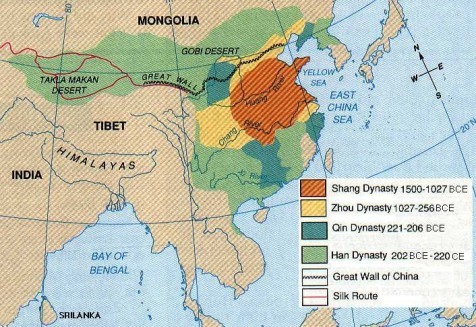
TRUE or False
Which of the following describes the Han government?
centralized
harsh ruling style
not harsh ruling style
incorporated the ideas of Confucious
All of the following are advancements and/or inventions made in Warfare
kites
fish scale armor
expanded their army
bamboo drills
The invention of iron molds helped the farmers by creating the
iron-tipped drill
the wheelbarrow
plow
chain pump
Civil servants were chosen based on
status
military ability
knowledge
where you live
The seismograph was helpful because
it helped determine the correct positioning for temples, graves, and homes
carry water in buckets from the ditches to the fields
extract salt from the Earth
it can detect which direction an earthquake is coming from
Chinese astronomers figured out what 2 things
why the moon shines
why the Earth has broom stars
why solar eclipses happen
what makes comets
The advancements made in iron helped all of the following areas except
science
agriculture
warfare
medicine
chain pump

