

Wayground logo

Free Printable Worksheets

Font size

S
M
L
XL
Worksheets

Semester 1-Biology Final Exam

Total questions: 38

Worksheet time: 24mins

Name
Class
Date
1.

What is the scientific method?

a)

A systematic procedure for how to conduct a scientific experiment

b)

The process of solving a problem

c)

A way of making non-scientific observations

d)

A way to summarize findings from multiple investigations

2.

Which of the following is NOT a testable question?

a)

How do rockets work?

b)

Does fertilizer help plants grow bigger?

c)

Does heart rate increase with exercise?

d)

Does the freezing point of water change at different elevations?

3.
The independent variable is the ONE thing you _____ to test your hypothesis.
a)
change
b)
keep the same
c)
experiment with
d)
investigate
4.

A Line graph

a)

shows the relationship that changes over time.

b)

compares information collected by counting.

c)

shows different parts of a whole quantity.
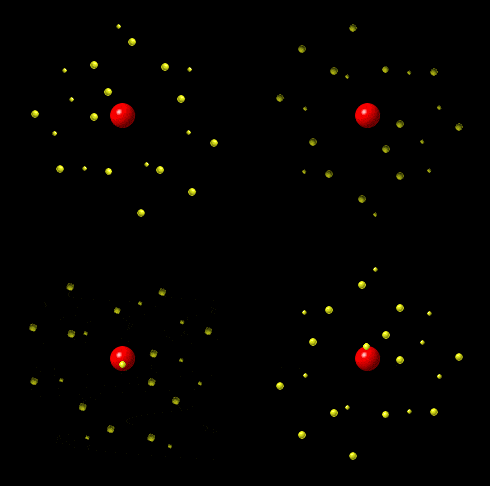
5.
Which of the following is described as the basic unit of matter?
a)
Element
b)
Atom
c)
Molecule
d)
Compound
6.
What charge does an electron have?
a)
Negative
b)
Positive
c)
Neutral
d)
Contrated
7.
Which of the following is found in the nucleus of an atom?
a)
electrons
b)
neutrons
c)
The center of an atom, composed of protons and neutrons
d)
molecules
8.
What two elements make up water?
a)
Helium and oxygen
b)
Hydrogen and oxygen
c)
helium and carbon
d)
oxygen and carbon
9.
What word describes when water is attracted to other substances?
a)
cohesion
b)
adhesion
c)
capillary action
d)
surface tension
10.

Water is a universal solvent because it...

a)

It can be found anywhere

b)

It freezes when it gets cold

c)

Floats when frozen

d)

Dissolves more substances than anything else

11.
Proteins are made of monomers called ___________
a)
Nucleotides
b)
Monosaccharides
c)
Amino Acids
d)
Glycerol and fatty acids
12.
DNA and RNA are examples of 
a)
Carbohydrates
b)
Lipids
c)
Proteins
d)
Nucleic Acids
13.
Monosaccharides are monomers of
a)
Carbohydrates
b)
Lipids
c)
Proteins
d)
Nucleic Acids
14.
Waxes, oils and fats are examples of
a)
Carbohydrates
b)
Lipids
c)
Proteins
d)
Nucleic Acids
15.
Glycerol and fatty acids are the monomers of
a)
Carbohydrates
b)
Lipids
c)
Proteins
d)
Nucleic Acids
16.
Enzymes are...
a)
nucleic acids
b)
proteins
c)
lipids
d)
carbohydrates
17.
What happens when enzymes are heated to a high temperature?
a)
The enzymes die.
b)
The shapes of the enzyme are altered denature
c)
The enzymes' amino acid sequence changes.
d)
The enzymes remain the same
18.

Which 2 factors can affect the rate of enzyme activity?

a)

Light intensity

b)

Temperature

c)

pH

d)

Oxygen concentration

19.
The function of the plasma membrane is....
a)
to regulate what enters and leaves the cell.
b)
fight bacteria and viruses that enter the cell.
c)
provide rigid support and protection to the cell.
d)
make sure each cell can move
20.
This picture represents what type of cell transport?
a)
endocytosis
b)
exocytosis
c)
osmosis
d)
passive transport
21.
Which is true about active transport?
a)
It requires energy
b)
it does not require energy
c)
It moves substances down the concentration gradient
d)
it moves material from high to low concentration
22.
The cell below is in a _________ solution.
a)
Hypotonic
b)
Hypertonic
c)
Isotonic
23.
The cell below is in a _____________ solution.
a)
Hypertonic
b)
Hypotonic
c)
Isotonic
24.
A cell in an isotonic solution will
a)
swell
b)
shrink
c)
stay the same size
d)
impossible to tell
25.
Who discovered and named cells? 
a)
Captain Hook
b)
Robert Hooke
c)
Zacharias Janssen
d)
Rudolf Virchow
26.
Which is not a part of cell theory?
a)
All organisms are made of cells
b)
All existing cells come from preexisting cells
c)
All matter is composed of living cells
d)
The cell is the most basic unit of life
27.
Which organelle is the protein factory? 
a)
Ribosomes
b)

Mitochondria

c)
Centriole
d)
Lysosomes
28.
Microscopic single-cells that do not have a nucleus or other membrane-bound organelles. 
a)
DNA
b)
RNA
c)
Eukaryotes
d)
Prokaryotes
29.
Genetic information is stored in the nucleus of all single or multicellular cells called
a)
Eukaryotes
b)
Prokaryotes
c)
Organelles
d)
Cytoplasm
30.

Which organelle produces the energy a cell needs to carry out its function

a)

Mitochondria

b)

Golgi Bodies

c)

Cytoplasm

d)

Nucleus

31.

Chromatin is

a)

tiny strands inside the nucleus that contain the instructions for directing the cell's function

b)

found inside the nucleus

c)

needed to make proteins

32.

which organism performs photosynthesis ___________

a)

Hetrotrophs

b)

Autotrophs

c)

Bonotrophs

33.

Where in the cell does photosynthesis occur?

a)

chlorophyl

b)

Chloroplast

c)

Roots

d)

Stem

34.

What is the molecule of stored enery called__________

a)

Phosphate

b)

Carbonate

c)

Glucose

d)

ATP

35.

What are three factors that affect Photosyntheis _______

a)

Sunlight, CO2, H2O

b)

Sunlight , Glucose, CO2

c)

Glucose, O2 , H20

36.

Waste products of photosynthesis is ______________

a)

CO2

b)

H2O

c)

Sunlight

d)

O2

37.

Small pores in the plants stem or leaves is called_______

a)

Grana

b)

Stomata

c)

Thykloid

38.

Where do the light dependent Reactions take place?

a)

Thylakoid

b)

Grana

c)

Stomata

d)

Plastids
