Wayground logo

Free Printable Worksheets

Font size

S
M
L
XL
Worksheets

Are you Level 21?

Total questions: 78

Worksheet time: 4hrs 29mins

Name
Class
Date
1.
Solve for f:
f - 4 = 6f + 26
a)
f = -5
b)
f = 5
c)
f = 6
d)
f = -6
2.
Solve the equation
4x - 5x + 9 =5x - 9
a)
x = -3
b)
x = 9
c)
x = 3
d)
x = -9
3.

−118=−5(4+7x)+7-118=-5\left(4+7x\right)+7  

a)

−5-5  

b)

−9-9  

c)

33  

d)

−1-1  

4.
3y+4y+6=20
a)
y=2
b)
y=-2
c)
y=4
d)
y=3
5.

−(3v+1)+7(6v+6)=−37-\left(3v+1\right)+7\left(6v+6\right)=-37  

a)

44  

b)

00  

c)

22  

d)

−2-2  

6.

Solve the equation:
34b = 24\frac{3}{4}b\ =\ 24


a)

b = 32

b)

b = 36

c)

b = 24

d)

b = 18

7.

Solve the equation:
3=12x−73=\frac{1}{2}x-7

a)

x = 10

b)

x = 7

c)

x = 20

d)

x = -8

8.

Solve the equation:
17=5+25x17=5+\frac{2}{5}x

a)

x = 12

b)

x = 36

c)

x = 33

d)

x = 30

9.

Solve:

5x + 4 = 5x − 3

a)

x = 4

b)

x = -3

c)

infinitely many solutions

d)

no solutions

10.

Solve:

2y − 3 = 2y − 3

a)

y = 0

b)

y = -3

c)

infinitely many solutions

d)

no solutions

11.

Solve:

4x + 1 = 8x − 3

a)

x = 1

b)

x = 2

c)

infinitely many solutions

d)

no solutions

12.

What does it mean when an equation has one solution?

a)

the equation is always TRUE when any value is substituted in for the variable

b)

the equation will NEVER be true when any value is substituted in for the variable

c)

only ONE solution will make the equation true
13.

What does it mean when an equation has infinitely many solutions?

a)

"To infinity and beyond"

b)

the equation is always TRUE when any value is substituted in for the variable

c)

the equation will NEVER be true when any value is substituted in for the variable

d)

only ONE solution will make the equation true
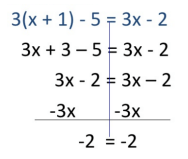
14.
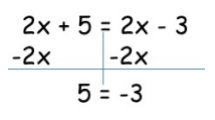
What is the solution to this equation?
a)
one solution
b)
no solution
c)
infinite solutions
d)
none of these
15.
What is the solution to the equations?
a)
one solution
b)
no solution
c)
infinite solutions
d)
none of these
16.

What type of transformation is this?

a)

rotation

b)

translation

c)

reflection

d)

dilation

17.

What type of transformation is this?

a)

rotation

b)

translation

c)

reflection

d)

dilation

18.

What type of transformation is this?

a)

rotation

b)

translation

c)

reflection

d)

dilation

19.

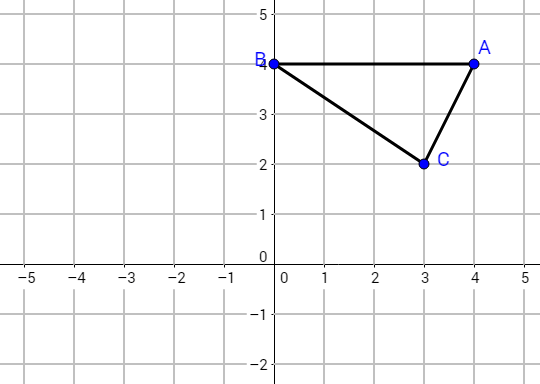
When you dilate the figure by a scale factor of 3, what is the location of B'?

a)

(12,0)

b)

(12,12)

c)

(4,3)

d)

(0,12)

20.
Triangle ABC is going to be translated. How is ABC being translated if the rule (x,y) --> (x+3, y-2) is used?
a)
3 up and 2 left
b)
3 right and 2 down
c)
3 left and 2 up
d)
3 right and 2 up 
21.
Determine where T' would be if you translated T three units to the right and six units up.
a)
(5, 1)
b)
(2, -5)
c)
(-1, 1)
d)
(8, -2)
22.
When you translate, (x,y+6) will move _____.
a)
6 units right
b)
6 units left
c)
6 units up
d)
6 units down
23.
If you were to rotate ABCD 90° counterclockwise about the origin, what would the coordinate of A' be?
a)
(-5, 5)
b)
(-3, 5)
c)
(-5, 3)
d)
(-3, 3)
24.
How many degrees was the figure rotated?
a)
90 degrees counterclockwise 
b)
180 degrees
c)
90 degrees clockwise
25.
Apply the following rule to the point (-5,6):
(x,y)-->(y,-x)
a)
(-5,-6)
b)
(5,-6)
c)
(6,5)
d)
(-6,5)
26.
(x, y) -------> (-y, -x) is a rotation of 90 degrees counterclockwise.  
a)
True 
b)
False
27.
C(-6, 2) and B(-1, -1)
Rotate 90 degrees counterclockwise.
a)
C' (-6, 2), B' (-1, -1)
b)
C' (6, 2), B' (1, -1)
c)
C' (2, -6), B' (-1, -1)
d)
C' (-2, -6), B' (1, -1)
28.
C(-6, 2) and B(-1, -1)
Translate (x, y) -> (x - 1, y - 3)
a)
C' (-6, 2), B' (-1, -1)
b)
C' (-7, -1), B' (-2, -4)
c)
C' (-5, 5), B' (0, 2)
d)
C' (-7, 1), B' (-2, -2)
29.

If an image were reflected over the x-axis from quadrant 1 to quadrant 4, what would you need to do to reflect it to quadrant 3?

a)

Translate it two units to the right

b)

Rotate 20 degrees CCW

c)

Reflect it over the x-axis

d)

Reflect it over the y-axis

30.

An image is dilated at a scale factor of 1.5. This means the dilation is an enlargement and the dilated image will be bigger.

a)

True

b)

False

31.

A dilation produces a similar figure

a)

True

b)

False

32.
Dilate the figure by a scale factor of 3 with the origin as the center of dilation. What are the coordinates of the image?
A(3,3) B(6,6) C(9,3)
a)
A'(9,9) B'(18,18) C'(27,9)
b)
A'(6,6) B'(9,9) C'(12,6)
c)
A'(0,0) B'(3,3) C'(6,0)
d)
A'(1,1) B'(2,2) C'(3,1)
33.
The point (8, 12) was dilated to become point (2, 3). What was the scale factor?
a)
½
b)
¼
c)
4
d)
2
34.
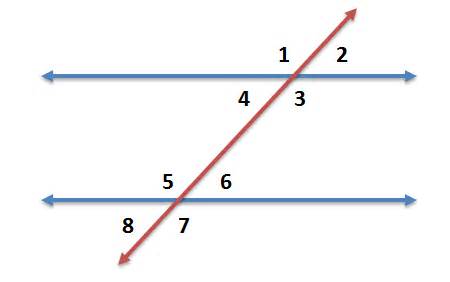
Name the angle relationship.
a)
Alternate Interior
b)
Alternate Exterior
c)
Corresponding
d)
Vertical Angles
35.
Which pair of angles are alternate exterior angles?
a)
Angle 7 and Angle 4
b)
Angle 2 and Angle 6
c)
Angle 8 and Angle 1
d)
Angle 2 and Angle 8
36.
What are supplementary angles?
a)
Angles that add up to 180°
b)
Angles that add up to 90°
c)
Angles that are equal to each other
d)
Angles that are opposite of each other when lines intersect
37.
If angle 6 is 25 degrees, how many degrees is angle 7?
a)
25 degrees
b)
50 degrees
c)
90 degrees
d)
155 degrees
38.

If  m∠10=53°m\angle10=53\degree  find  m∠4m\angle4  and give proper reasoning. 

a)

127°127\degree  because alternate exterior angles.

b)

undefined because alternate interior angles.

c)

53°53\degree  because consecutive interior angles.

d)

undefined because alternate exterior angles.

39.

Solve for x and give proper reasoning.

a)

x=8 because if two ∥\parallel lines are cut by a transversal then alternate interior angles are ≅\cong .

b)

x=9 because if two undefined lines are cut by a transversal then consecutive interior angles areundefined .

c)

x=4 because if two undefined lines are cut by a transversal then corresponding angles areundefined .

d)

x=9 because if two undefined lines are cut by a transversal then alternate exterior angles areundefined .
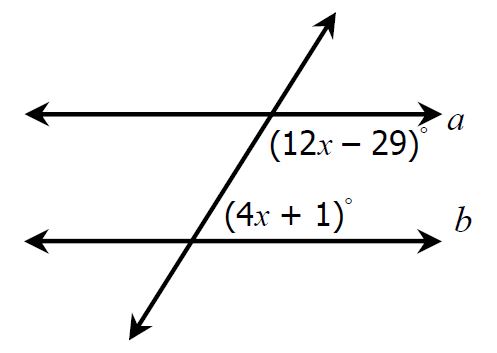
40.

WHICH IS THE CORRECT EQUATION TO SOLVE FOR X?

a)

16X+180 = 90

b)

12X - 29 = 4X +1

c)

12X - 29 + 4X +1=90

d)

12X - 29 + 4X +1=180

41.
a)
A
b)
B
c)
C
d)
D
42.
Find the measure of the indicated angle. 
a)
26
b)
36
c)
85
d)
144
43.
Find the measure of angle A.
a)
44o
b)
96o
c)
-14o
d)
63o
44.
What is the sum of the interior angles for a      24-gon
a)
3960
b)
360
c)
15
d)
4280
45.
What is the measure of ONE interior angle in a regular hexagon (6 sides)?
a)
60°
b)
80°
c)
108°
d)
120°
46.

Find the interior angle sum for each polygon. Round your answer to the nearest tenth if

necessary.

a)

A

b)

B

c)

C

d)

D

47.
If the sum of the interior angles of a polygon equals 900°, how many sides does the polygon have? 
a)
7
b)
9
c)
10
d)
12
48.
Find the sum of the interior of angles in a 12-gon
a)
1800
b)
1080
c)
1620
d)
1260
49.
Solve for X.
a)
2 ft
b)
3 ft
c)
4 ft
d)
6 ft
50.
To find the height of a very tall pine tree, you place a mirror on the ground and stand where you can see the top of the pine tree.  How tall is the tree?
a)
144 feet
b)
72 feet
c)
36 feet
d)
8 feet
51.
a)
10 ft
b)
5 ft
c)
8 ft
d)
15 ft
52.
Are the triangles similar?
a)
Yes
b)
No
53.
In similar Polygons, corresponding sides are ___ and corresponding angles are ___. (Fill in the blanks)
a)
congruent, proportional 
b)
proportional, congruent 
c)
congruent, congruent
d)
proportional, proportional
54.
If two figures are similar their angles are______.
a)
proportional
b)
congruent
c)
supplementary
d)
complementary
55.
Complete each proportion.
CB / DM  =  AC / ?
a)
BM
b)
MA
c)
BC
d)
AD
56.
Find the slope of the line that passes through the points (2, 4) and (6, 12)
a)
1/2
b)
-1/2
c)
2
d)
-2
57.
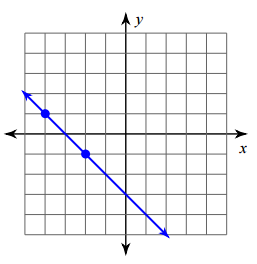
Find the slope of the line.
a)
-2
b)
2
c)
-1
d)
1
58.
Find the slope from the table:
a)
-2/5
b)
5/-2
c)
5/2
d)
2/5
59.
Determine the slope and y-intercept from the following equation:   y = 3/2x + 3
a)
slope: 5   y-intercept:  (0,3) 
b)
slope: 3/2   y-intercept:  (0,3) 
c)
slope:  4  y-intercept:  (0,3/2)
d)
slope: 1/5   y-intercept:  (0,5) 
60.

What is the slope of the line with the equation 2x - 3y = 18 ?

a)

2/3

b)

- 2/3

c)

3/2

d)

-3/2

61.

What is the slope of the line with the equation 4x - y = - 12

a)

4

b)

1/4

c)

-4

d)

-1/4

62.

What is the equation of a line with a slope of 4 and a y-intercept of 2?

a)

y = -4x + 2

b)

y = -2x + 4

c)

y = 4x + 2

d)

y = 2x + 4

63.

What is the equation of a line when m = -3 and b = 5?

a)

y = -3x + 5

b)

y = -3x - 5

c)

y = 5x + 3

d)

y = -5x - 3

64.

What is the equation of a line when m = -7 and b = -8?

a)

y = -7x + 8

b)

y = -7x - 8

c)

y = 7x - 8

d)

y = 7x + 8

65.

What is the equation of the line that passes through (-1, -7) and has a slope of 2?

a)

y = 2x - 5

b)

y = -2x - 5

c)

y = 2x - 1

d)

y = 2x - 7

66.

What is the equation of the line that passes through (-1, -4) and (-2, -1)

a)

y = 2x - 1

b)

y = -2x - 4

c)

y = 3x - 7

d)

y = -3x - 7

67.

What is the equation of the line that passes through (1, 4) and (2, 1)

a)

y = -3x + 1

b)

y = -3x + 4

c)

y = -3x - 7

d)

y = -3x + 7

68.

Find the slope  and y-intercept of:

2x - 3y = -12

a)
slope = 2/3, y-intercept = -12
b)
slope = -2/3, y-intercept = -3
c)
slope = 2/3, y-intercept = 4
d)
slope = -12, y-intercept = -3
69.

What is the slope:

5x + 10y  = 30

a)

m = -1/2

b)

m = 1/2

c)

m = 3

d)

m = 1/3

70.

Identify the form of the following linear equation:

5x + 3y = 15

a)

Standard Form

b)

Slope - Intercept Form

c)

Neither

71.

Write the slope intercept form of the equation x - 3y = 6

a)

y = -x - 2

b)

y = x + 2

c)

y = 1/3x - 2

d)

y = -1/3x + 2

72.

Which graph shows a line with an x-intercept of (9, 0)?

a)
b)
c)
d)
73.

Which graph shows a line with an x-intercept of (9, 0)?

a)
b)
c)
d)
74.

What is the x-intercept of 8y=2x−48y=2x-4  ?

a)

(2, 0)\left(2,\ 0\right)  

b)

(−12,0)\left(-\frac{1}{2},0\right)  

c)

(5, 0)\left(5,\ 0\right)  

d)

(4, 0)\left(4,\ 0\right)  

75.

What is the y-intercept of

y=5x+4y=5x+4  ?

a)

(0,4)\left(0,4\right)  

b)

(0,5)\left(0,5\right)  

c)

(0,−4)\left(0,-4\right)  

d)

(0,−5)\left(0,-5\right)  

76.
For the equation
y - 3 = 2(x + 4),
the line has a slope of 2 and contains what point?
a)
(-4, 3)
b)
(3, -4)
c)
(-3, -4)
d)
(-4, -3)
77.
Write the equation in point-slope form of the line that passes through the given point and has the given slope.
(4, -7); m = -1/4
a)
y +7 = -1/4(x - 4)
b)
y - 4 = -1/4(x + 7)
c)
y + 4 = -1/4(x - 7)
d)
y - 7 = -1/4(x - 4)
78.

Identify the slope and the coordinate the following equation passes through: y+8=2(x-1)

a)

m:2 (1,-8)

b)

m:-2 (1,-8)

c)

m: 2 (-1,8)

d)

m: -2 (-1,8)