
 Worksheets
Unit 3 Lecture 2 Neuromuscular Junction
Total questions: 33
Worksheet time: 24mins
The point at which the nerve cell reaches the sarcolemma of the muscle fiber is the _____.
Neurotransmitter
Acetylcholine
Synaptic cleft
Neuromuscular Junction
The gap between the nerve cell and sarcolemma is the ____ ___.
Synaptic cleft
Neurotransmitter
Motor unit
Neuromuscular junction
What is the specific neurotransmitter that stimulates the movement of skeletal muscles?
Sodium
Acetylcholine
Calcium
Potassium
Once the action potential reaches the end of the motor neuron what takes place?
Acetylcholine is released into the synaptic cleft.
Calcium is pumped into the sarcolemma.
Calcium is pumped into the synapse.
The muscle contracts.
What is the name of the component that houses the neurotransmitters?
Synaptic cleft
Acetylcholine
Receptors
Synaptic vesicles
Once sodium is pumped into the sarcoplasm, what happens?
Voltage of the cell changes to become more positive.
The process ends and ACh breaks down.
Calcium is pumped out of the sarcoplasmic reticulum
Acetylcholine is released into the synaptic cleft.

The outer membrane of a skeletal muscle cell is called the:
What is the structure that stores the Calcium in the muscle cell?
Myofibril
Once acetylcholine binds to receptor cells on the sarcolemma, what takes place?
Ion channels open and sodium rushes inside the cell
The muscle contracts.
Calcium is pumped out of the sarcoplasmic reticulum.
Synaptic vesicles release acetylcholine into the synapse
When ion channels in the sarcolemma first open to allow ions in/out of the muscle cell, changing the voltage of the cell, how and why does the voltage change?
Becomes more positive because sodium ions rush inside the cell
Becomes more positive because sodium ions rush out of the cell
Becomes more negative because sodium ions rush inside the cell
Becomes more negative because sodium ions rush out of the cell
When ion channels in the sarcolemma first open to allow ions in/out of the muscle cell, changing the voltage of the cell, what happens next?
Other ion channels are triggered to open in a cascade down the sarcolemma
Acetylcholine is released from the synaptic vesicles
Acetylcholine binds to the receptors on the sarcolemma
The sarcoplasmic reticulum is triggered by the voltage change to release calcium ions into the sarcoplasm
What triggers the first few ion channels to open in the sarcolemma?
The binding of acetylcholine to receptors
The release of acetylcholine into the synapse
A voltage change nearby
The action potential traveling through the motor neuron
After the initial few ion channels are triggered to open by the acetylcholine, what causes the rest of the ion channels to open one after the other in a cascade?
Changes in voltage
The binding of acetylcholine to receptors
The release of acetylcholine into the synapse
The sarcoplasmic reticulum releases calcium ions

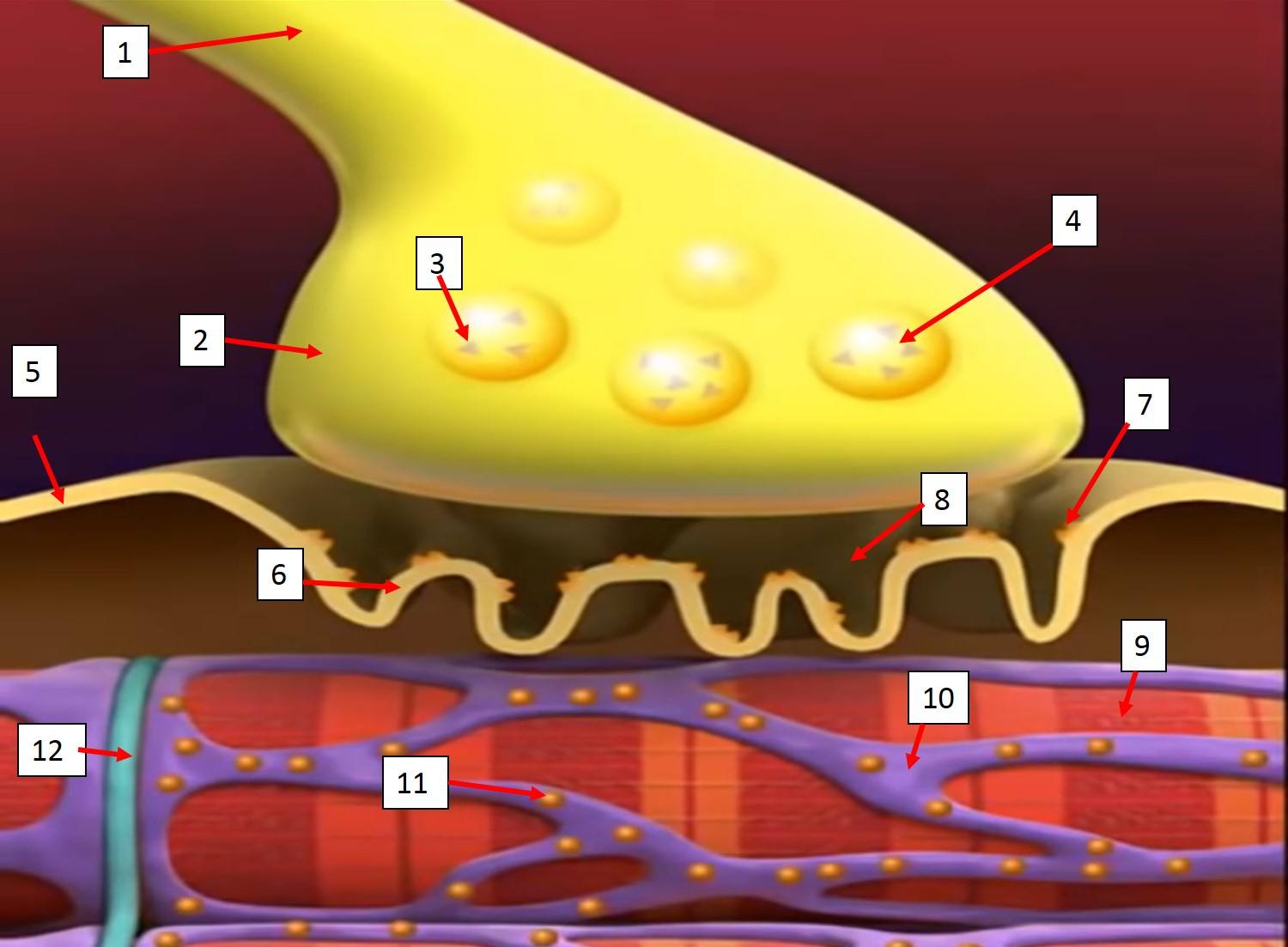
What is structure B?
motor neuron
muscle cell
acetylcholine
sarcolemma
What is structure C?
synaptic vesicle
muscle cell
acetylcholine
sarcolemma
What is structure D?
synaptic vesicle
muscle cell
synapse
sarcomere
What is structure E?
sodium ion
acetylcholine
calcium ion
synapse
What is structure F?
ion channel
acetylcholine receptor
sarcolemma
sarcoplasmic reticulum
What is structure G?
ion channel
acetylcholine receptor
sarcolemma
sarcoplasmic reticulum
What is structure H?
transverse tubule
muscle fiber
sarcolemma
sarcoplasmic reticulum
What is structure I?
transverse tubule
muscle fiber
sarcolemma
sarcoplasmic reticulum
What happens in step 1 of the muscle stimulation process?
(a)
What happens in step 2 of the muscle stimulation process?
(a)
What happens in step 3 of the muscle stimulation process?
(a)
What happens in step 4 of the muscle stimulation process?
(a)

What is structure J?
sarcoplasmic reticulum
sarcoplasm
sarcomere
t tubule
What is structure K?
sarcoplasmic reticulum
sarcoplasm
sodium ion
calcium ion
What is structure M?
sarcoplasmic reticulum
sarcoplasm
sodium ion
calcium ion
What is structure L?
ion channel
sarcoplasm
sarcoplasmic reticulum
acetylcholine receptor
In step 5, what triggers the other ion channels to open that are located along the t tubules?
(a)
What happens in step 6 of the muscle stimulation process?
(a)
What happens in step 7 of the muscle stimulation process?
(a)

